
by Ian | Jul 23, 2025 | Cicero in Catilinam Vocab
inquam - he said, she said The verb inquam, meaning ‘I say’, functions as a parenthetical or interruptive form used primarily in direct speech. It is irregular in its conjugation and appears most commonly in first-person present or perfect forms. In Cicero’s Latin,...
by Ian | Jul 22, 2025 | Caesar-SbS
16 Meanwhile, Caesar kept daily importuning the Aedui for the corn which they had promised in the name of their state; for, in consequence of the coldness (Gaul, being as before said, situated toward the north), not only was the corn in the fields not ripe, but there...
by Ian | Jul 22, 2025 | Caesar Vocab
interim- in the meanwhile The adverb interim, meaning ‘in the meantime’ or ‘meanwhile’, serves as a temporal hinge throughout classical Latin prose. Often appearing in transitional moments, interim allows authors to mark narrative pauses, shifts in action, or the...
by Ian | Jul 21, 2025 | Argonauts Vocab
quidam - a certain someone The word quidam, meaning ‘a certain one’ or ‘someone’, functions as both pronoun and adjective, often introducing unspecified or lightly characterized individuals in narrative, legal, or philosophical contexts. Its use allows authors to...
by Ian | Jul 18, 2025 | Mark SbS
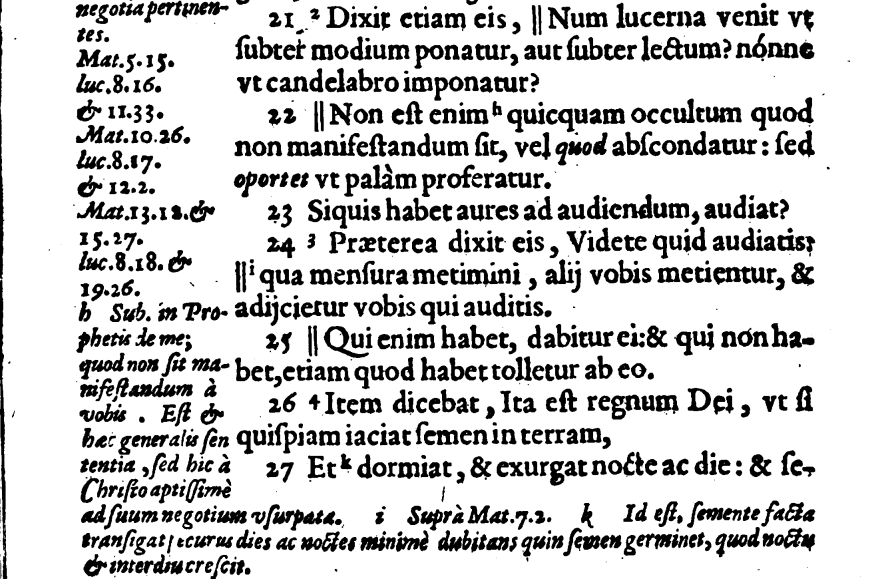
CHAPTER 4 21 And he said vnto them, Is a candle brought to be put vnder a bushell, or vnder a bed? & not to be set on a candlesticke?22 For there is nothing hid, which shall not be manifested: neither was any thing kept secret, but that it should come abroad.23 If...
by Ian | Jul 18, 2025 | Mark Vocab
aut - a deceptively simple conjunction The Latin conjunction aut—meaning ‘or’ in a disjunctive sense—is deceptively simple but holds significant syntactic and stylistic importance across Latin literature. Distinguished from vel, which often suggests a softer...

Recent Comments