
Harpies
In the myth of the Argonauts, the Harpies are vicious winged spirits known for their relentless torment of the blind prophet Phineus. Sent by the gods as punishment for Phineus’s misuse of his prophetic gifts, these creatures would swoop down, stealing or defiling his food, leaving him perpetually starving. When Jason and his crew arrived, the Boreads—Calais and Zetes—chased the Harpies away, either killing them or forcing them to retreat at the goddess Iris’s behest. This victory freed Phineus, allowing him to guide the Argonauts on their perilous journey, offering critical advice on navigating the Symplegades, the deadly clashing rocks.
After chasing the Harpies away Phineus' reward was to warn them about the Symplegades, also known as the Clashing Rocks. These were two enormous rocks that clashed together whenever a ship attempted to pass between them, crushing anything caught in their path. Phineus advised the Argonauts to release a dove before attempting to sail through. If the dove succeeded in passing the rocks unscathed, they should immediately follow its path. The Argonauts heeded Phineus' advice, grateful for the flight of the Harpies, and after the dove successfully navigated the rocks, they managed to sail through with only minor damage to the ship's stern.
In return for his freedom from the Harpies, Phineus' guidance proved invaluable to the Argonauts as they continued their quest. His story highlights themes of divine retribution, the consequences of misusing one's gifts, and the importance of seeking and heeding wise counsel. It also illustrates the interconnectedness of various characters and myths within the broader tapestry of Greek mythology.
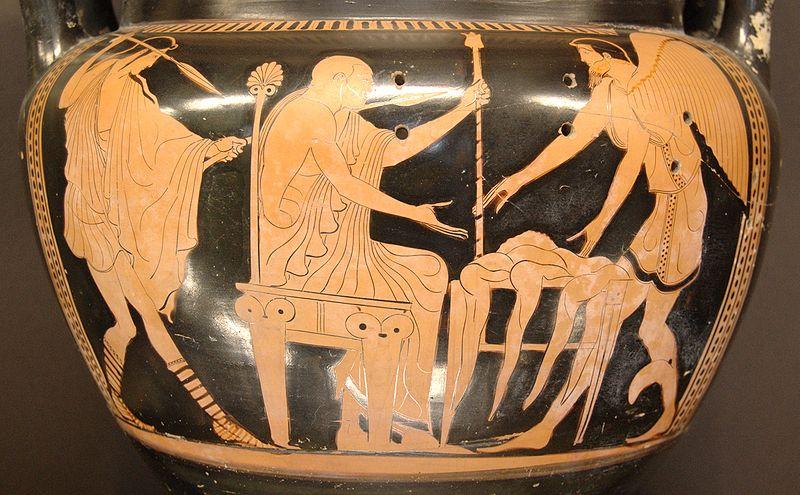
Today's Artwork: Phineus and the Harpies
Painted by: The Leningrad Painter, c. 460 BC
Depicts the Boread twins, Calais and Zetes, rescuing Phineus (seated) from the Harpies.Source: The Louvre
Here is a text only version. (See below for an interactive version)
9 Res igitur in hoc loco erant, cum Argonautae navem appulerunt. Phineus autem, simul atque audivit eos in suos finis egressos esse, magno opere gavisus est. Sciebat enim quantam opinionem virtutis Argonautae haberent nec dubitabat quin sibi auxilium ferrent. Nuntium igitur ad navem misit, qui Iasonem sociosque ad regiam vocaret. Eo cum venissent, Phineus demonstravit quanto in periculo suae res essent et promisit se magna praemia daturum esse, si illi remedium repperissent.
Argonautae negotium libenter susceperunt et ubi hora venit cum rege accubuerunt; at simul ac cena apposita est, Harpyiae cenaculum intraverunt et cibum auferre conabantur. Argonautae primum gladiis volucris petierunt; cum tamen viderent hoc nihil prodesse, Zetes et Calais, qui alis instructi sunt, in aera se sublevaverunt, ut desuper impetum facerent. Quod cum sensissent Harpyiae, rei novitate perterritae, statim aufugerunt neque postea umquam redierunt.
How To Read the Interactive Text
To Read the Interactive Text Below Without a Dictionary-
On a Computer: you hover over a word and get all the possible parts of speech; declensions; and conjugations of every word.
How To Read the Interactive Text
To Read the Interactive Text Below Without a Dictionary-
On a Phone or Tablet: don't 'hover' -'tap' the word. To remove the 'definition box' you 'tap' to the side of the text box.
INTERACTIVE DICTIONARY FREE TEXT
9 Res igitur in hoc loco erant, cum Argonautae navem appulerunt. Phineus autem, simul atque audivit eos in suos finis egressos esse, magno opere gavisus est
You Need to be a Member to Access the Interactive Dictionary
Become a Member
Sciebat enim quantam opinionem virtutis Argonautae haberent nec dubitabat quin sibi auxilium ferrent.
Nuntium igitur ad navem misit, qui Iasonem sociosque ad regiam vocaret.
Eo cum venissent, Phineus demonstravit quanto in periculo suae res essent et promisit se magna praemia daturum esse, si illi remedium repperissent.
Argonautae negotium libenter susceperunt et ubi hora venit cum rege accubuerunt; at simul ac cena apposita est, Harpyiae cenaculum intraverunt et cibum auferre conabantur.
Argonautae primum gladiis volucris petierunt; cum tamen viderent hoc nihil prodesse, Zetes et Calais, qui alis instructi sunt, in aera se sublevaverunt, ut desuper impetum facerent.
Quod cum sensissent Harpyiae, rei novitate perterritae, statim aufugerunt neque postea umquam redierunt.
Recent Comments