
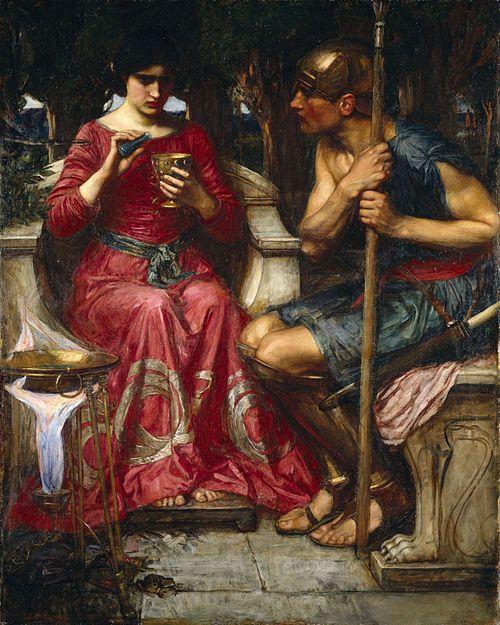
Medea
The relationship between Medea and Jason in the myth of the Argonauts is one of passion, betrayal, and tragedy. Their story, deeply embedded in Greek mythology, showcases themes of love, loyalty, and vengeance.
Meeting and Alliance
Jason, the leader of the Argonauts, embarks on a perilous quest to retrieve the Golden Fleece from Colchis. Medea, a powerful sorceress and daughter of King Aeëtes, falls in love with Jason, largely due to the intervention of Aphrodite, who ensures her devotion. Medea aids Jason in overcoming the impossible tasks set by her father, including taming fire-breathing bulls and defeating the sleepless dragon guarding the fleece. Her magical abilities and cunning prove essential to Jason’s success.
Escape and Betrayal
After securing the fleece, Medea and Jason flee Colchis, pursued by her father. In a desperate act, Medea kills her own brother Absyrtus, dismembering his body to delay their pursuers. This act marks the beginning of Medea’s descent into moral ambiguity, as she prioritizes Jason over her own family.
Upon their return to Iolcus, Jason seeks to reclaim his rightful throne from Pelias, the usurper. Medea orchestrates Pelias’ death by deceiving his daughters into believing they could rejuvenate him through magic. However, this act leads to their exile, forcing them to seek refuge in Corinth.
Jason’s Betrayal and Medea’s Revenge
In Corinth, Jason abandons Medea, choosing to marry Glauce, the daughter of King Creon, for political gain. Medea, enraged by his betrayal, exacts a horrifying revenge. She sends Glauce a poisoned robe, which kills her and Creon. In an ultimate act of vengeance, Medea murders her own children, denying Jason any legacy.
Conclusion
The relationship between Medea and Jason is a tragic tale of love turned to hatred. Medea’s unwavering devotion transforms into ruthless vengeance, illustrating the destructive power of betrayal. Their story remains one of the most compelling narratives in Greek mythology, exploring themes of fate, loyalty, and the consequences of broken trust.
Today's Artwork: Jason and Medea
Painted by: John William Waterhouse (1849–1917)
Source: www.jwwaterhouse.com
Here is a text only version. (See below for an interactive version)
12 At Medea, regis filia, Iasonem adamavit et ubi audivit eum tantum periculum subiturum esse rem aegre ferebat. Intellegebat enim patrem suum hunc laborem proposuisse eo ipso consilio, ut Iason moreretur. Quae cum ita essent, Medea, quae summam scientiam medicinae habebat, hoc consilium iniit.
Media nocte clam patre ex urbe evasit et postquam in montis finitimos venit herbas quasdam carpsit; tum suco expresso unguentum paravit quod vi sua corpus aleret nervosque confirmaret. Hoc facto Iasoni unguentum dedit, praecepit autem ut eo die quo isti labores conficiendi essent corpus suum et arma mane oblineret.
Iason, etsi paene omnis magnitudine et viribus corporis antecellebat, vita enim omnis in venationibus atque in studiis rei militaris constiterat, censebat tamen hoc consilium non neglegendum esse.
How To Read the Interactive Text
To Read the Interactive Text Below Without a Dictionary-
On a Computer: you hover over a word and get all the possible parts of speech; declensions; and conjugations of every word.
How To Read the Interactive Text
To Read the Interactive Text Below Without a Dictionary-
On a Phone or Tablet: don't 'hover' -'tap' the word. To remove the 'definition box' you 'tap' to the side of the text box.
INTERACTIVE DICTIONARY FREE TEXT
12 At Medea, regis filia, Iasonem adamavit et ubi audivit eum tantum periculum subiturum esse rem aegre ferebat.
You Need to be a Member to Access the Interactive Dictionary
Intellegebat enim patrem suum hunc laborem proposuisse eo ipso consilio, ut Iason moreretur.
Quae cum ita essent, Medea, quae summam scientiam medicinae habebat, hoc consilium iniit.
Media nocte clam patre ex urbe evasit et postquam in montis finitimos venit herbas quasdam carpsit; tum suco expresso unguentum paravit quod vi sua corpus aleret nervosque confirmaret.
Hoc facto Iasoni unguentum dedit, praecepit autem ut eo die quo isti labores conficiendi essent corpus suum et arma mane oblineret.
Iason, etsi paene omnis magnitudine et viribus corporis antecellebat, vita enim omnis in venationibus atque in studiis rei militaris constiterat, censebat tamen hoc consilium non neglegendum esse.
Recent Comments