
LESSON 1 — HOW LATIN SENTENCES WORK (REALLY)
The idea that makes every other lesson easier.
Latin doesn’t behave like English.
It does not depend on word order.
It does not tell its story in a straight line.
And it does not reveal structure by position.
Latin shows meaning through structure.
You read the job each word is doing — not where it is sitting.
This first lesson gives you the one idea that makes every other lesson, and the entire Highlighter Stripping System, finally make sense.
We will use real Latin, from Caesar, trimmed only enough to keep it beginner-friendly.
🔶 1. The Reader’s Problem
Most Latin learners begin with English expectations:
- read left to right
- look for the subject at the start
- hope meaning will appear as they go
- trust word order to guide them
This works in English.
In Latin, it collapses immediately.
Why?
Because Latin sentences almost always hide the core meaning amid description, context, or detail.
We fix that now.
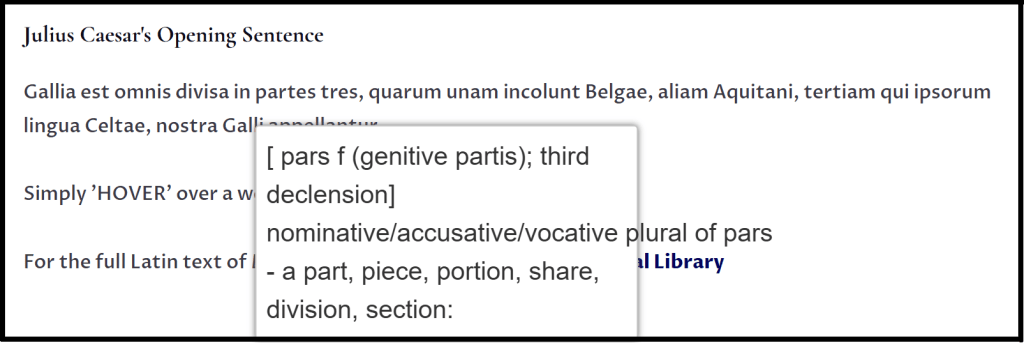
Below is a well-known Latin Sentence taken from Caesar's Opening Sentence with Control and Division on this website, showing the 'Hover-Text' in action over the word 'partes'.
🔷 2.How Latin Sentences Work at the Structural Level
Every Latin sentence has:
- A core claim: someone does something.
- Supporting information: how, when, why, with what purpose, with what result.
- Optional decoration: extra colour, description, scene setting.
The key is:
You must find the core claim first.
Once you find that, everything else attaches cleanly.
🔶 3. The Reader’s Decision
This is the single most important habit you will learn:
Ask: Is this word part of the core meaning, or is it supporting material?
This is the same logic the Highlighter Stripping System uses.
You don’t need to know every form.
You only need to decide:
Core job? (subject–verb–object)
Supporting job? (time, cause, circumstance, purpose, description…)
Decoration? (removable without breaking meaning)
This is structure first reading.
🔷 4. The Structural Role
(How Latin Actually Works)
We anchor this using the Minimum Viable Toolkit you already learned:
The core always contains:
A verb you know ( t or nt or perfect it / erunt)
A subject (often obvious, often a noun you already recognise)
Possibly an object ( am, um, em, as, os, es)
Everything else is secondary.
This is not grammar theory —
it is how you read real Latin without panic.
🍃 5. Mini HSS Demonstration Using Authentic Caesar
We now show this pattern using genuine Caesar, lightly trimmed to keep it beginner friendly but not artificial.
⭐ Example 1 — Pure Core Claim
Original Caesar vocabulary, minimal form:
Oppidum tenent.
→ “They hold the town.”
Why this works:
tenent = “they hold” ( nt)
oppidum = a town (neuter um)
This is everything you need to understand core meaning.
There is no stripping required because the sentence is pure core.
⭐ Example 2 — Add a Perfect Passive Participle (Still Easy)
Authentic Caesar style:
Oppidum captum tenent.
→ “They hold the captured town.”
Minimum viable analysis:
oppidum = town (neuter noun)
captum = captured (PPP neuter, matches um)
tenent = they hold
Core claim:
They hold the town.
Supporting information:
captum (the town is described as “captured”)
If we performed a Yellow strip:
Oppidum captum tenent.
→ Oppidum tenent. (core)
→ reintroduce captum (description)
The learner understands everything through patterns, not tables.
⭐ Example 3 — Real Caesar, Lightly Trimmed
Caesar (BG 2.33) describes towns taken or defended.
We adapt cleanly:
Oppidum defensum erat.
→ “The defended town was [there].”
This introduces:
oppidum (neuter)
defensum (PPP neuter)
erat (“was”) ← no need to discuss imperfect yet
Core vs support:
Core: oppidum erat (“the town was”)
Support: defensum (“defended”)
This is Real Latin — readable now.
⭐ Example 4 — Slightly Richer, Still Minimum Viable
Based on Caesar’s use of invenire + corpus:
Corpus inventum ostendit.
→ “He shows the discovered body.”
Analysis:
corpus = body (neuter noun learners immediately ‘get’)
inventum = PPP neuter (recognisable by ending)
ostendit = he/she shows ( t)
Core claim:
He shows the body.
Support:
inventum (“discovered”)
Again: real Latin, fully readable.
What You Realise in This Lesson
By the end of this lesson, something important happens —
you discover that real Latin is already within your reach.
You realise that:
- You can read authentic Latin sentences far sooner than you ever expected.
- You only needed a handful of endings to make sense of what’s going on.
- You don’t need full declension or conjugation charts to understand the basics of structure.
- You can now spot the core meaning — the who‑does‑what — in almost any simple sentence.
- You can tell the difference between the essential message and the supporting detail, even if you don’t know every word.
- Your brain is already beginning to read Latin structurally, the same way the Highlighter Stripping System will teach you to do deliberately and powerfully.
This is the moment early learners rarely get.
And the confidence you feel now isn’t an illusion —
it’s the direct result of learning Latin the way you find it, not the way textbooks organise it.
❓ Beginner FAQ (Lesson 1)
Q. Should I always look for the verb first?
It helps — verbs are structural anchors — but you don’t have to.
Q. How do I know what the subject is?
Pick the noun that matches the number — and that’s usually your subject.
Q. What if the sentence has lots of extra words?
Everything else becomes clearer once the core is established.
Q. Why are we using Caesar already? Isn’t that too hard?
These trimmed examples use Caesar’s real vocabulary and forms —
but without the clauses that make him difficult.
This gives you authentic Latin that is still readable.
Q. How does this connect to the Highlighter Stripping System?
core → support → decoration.
Later, HSS makes this visible with colour and structure.
Recent Comments