
quidam - a certain someone
The word quidam, meaning ‘a certain one’ or ‘someone’, functions as both pronoun and adjective, often introducing unspecified or lightly characterized individuals in narrative, legal, or philosophical contexts. Its use allows authors to highlight generality while preserving specificity, making quidam an instrument of implication, modesty, or ambiguity.
In Cicero’s orations, quidam appears frequently to identify a person without fully naming them—often for strategic or rhetorical effect. In Pro Caelio, Cicero refers to quidam mulier when implying the behavior of Clodia without initial direct accusation. The term softens the delivery while clearly signaling the target. Elsewhere, quidam is used to suggest anonymous critics, unverified claims, or peripheral actors. This usage permits Cicero to dismantle arguments without legitimizing them by naming their origin.
In historical prose, Livy employs quidam to distinguish secondary participants or narrators of uncertain reliability. By introducing reports with quidam dicunt, Livy grants some distance between himself and his sources, allowing skepticism without full dismissal. The term thus facilitates historiographical nuance: quidam lets writers record without wholly endorsing.
In philosophical works, such as Cicero’s Tusculanae Disputationes, quidam often appears in discussions of general behavior or theoretical figures. He may write of quidam sapiens to illustrate Stoic reasoning, or quidam existimant when introducing an alternative view. These constructions enable exploration of concepts without rigid attribution.
Quidam also reflects modesty or tact in personal letters. In the Epistulae ad Atticum, Cicero uses it to cloak references to controversial figures or delicate topics, suggesting awareness of surveillance and decorum.
Thus, quidam serves classical Latin authors as a subtle pointer—identifying without overstating, engaging without naming, and allowing flexibility of tone and judgment. It is a quiet but powerful word, shaping dialogue, distancing the speaker, and giving form to uncertainty or discretion.
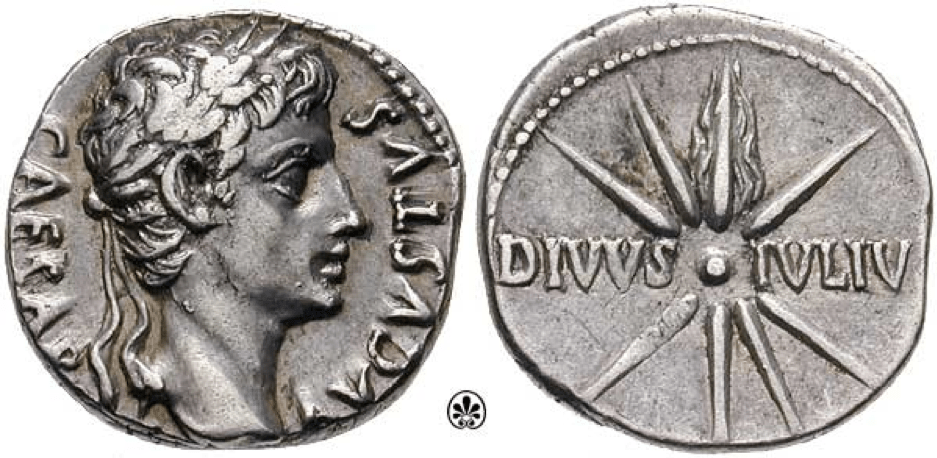
Today's Image: Denarius minted by Augustus depicting himself on the obverse, the comet of 44 and divus Iulius (the divine Julius) on the reverse, c. 19-18 BC (http://numismatics.org/collection/1944.100.39033)
Source: jhiblog.org
Here is a text only version. (See below for an interactive version)
19 Erat in navi Argonautarum filius quidam regis Aeetae, nomine Absyrtus, quem, ut supra demonstravimus, Medea ex urbe fugiens secum abduxerat. Hunc puerum Medea constituit interficere eo consilio ut membris eius in mare coniectis cursum Colchorum impediret; pro certo enim sciebat Aeetem, cum membra fili vidisset, non longius prosecuturum esse, neque opinio eam fefellit; omnia enim ita evenerunt ut Medea speraverat.
Aeetes, ubi primum membra vidit, ad ea conligenda navem statui iussit; dum tamen ea geruntur, Argonautae non intermisso remigandi labore, mox, quod necesse fuit, e conspectu hostium remoti sunt neque prius fugere destiterunt quam ad flumen Eridanum pervenerunt. At Aeetes nihil sibi profuturum esse arbitratus, si longius progressus esset, animo demisso domum revertit, ut fili corpus ad sepulturam daret.
Red and Green Vocab
The words in red and green are found among the 3057 Most Common Words in the Classical Latin texts that we will explore on CentumVerba.com and are essential to your understanding of the texts of Caesar, Vergil and Cicero. The green words appear frequently (at least five times) among Vergil's Aeneid (books I-VI), Caesar de bello Gallico (books I-V) and in Cicero's works - in Catilinam (books I-IV), de lege Manilia (also known as de Imperio Cn. Pompei), and pro Achia. These works constituted the curriculum for Latin over 4 years in American High Schools at the start of the 20th Century. The bulk of my information is taken from The Vocabulary of High School Latin by Gonzalez Lodge. I have added to these 2000 words from varioius other sources to compile my own list of The 3057 Most Common Latin Words.
The black words do not appear frequently in Classical Latin.
The red words are the first occurrences of these words in this author and this word will appear as green the next time you encounter it.
If you are serious about building your vocabulary then you should learn the red words as they occur and you should already know the green ones!
I have provided a FLASHCARD set to help - see below.
How To Read the Interactive Text
To Read the Interactive Text Below Without a Dictionary-
On a Computer: you hover over a word and get all the possible parts of speech; declensions; and conjugations of every word.
Red and Green Vocab
The words in red and green are found among the 3057 Most Common Words in the Classical Latin texts that we will explore on CentumVerba.com and are essential to your understanding of the texts of Caesar, Vergil and Cicero. The green words appear frequently (at least five times) among Vergil's Aeneid (books I-VI), Caesar de bello Gallico (books I-V) and in Cicero's works - in Catilinam (books I-IV), de lege Manilia (also known as de Imperio Cn. Pompei), and pro Achia. These works constituted the curriculum for Latin over 4 years in American High Schools at the start of the 20th Century. The bulk of my information is taken from The Vocabulary of High School Latin by Gonzalez Lodge. I have added to these 2000 words from varioius other sources to compile my own list of The 3057 Most Common Latin Words.
The black words do not appear frequently in Classical Latin.
The red words are the first occurrences of these words in this author and this word will appear as green the next time you encounter it.
If you are serious about building your vocabulary then you should learn the red words as they occur and you should already know the green ones!
I have provided a FLASHCARD set to help - see below.
How To Read the Interactive Text
To Read the Interactive Text Below Without a Dictionary-
On a Phone or Tablet: don't 'hover' -'tap' the word. To remove the 'definition box' you 'tap' to the side of the text box.
INTERACTIVE DICTIONARY FREE TEXT
19 Erat in navi Argonautarum filius quidam regis Aeetae, nomine Absyrtus, quem, ut supra demonstravimus, Medea ex urbe fugiens secum abduxerat. You Need to be a Member to Access the Interactive Dictionary
Hunc puerum Medea constituit interficere eo consilio ut membris eius in mare coniectis cursum Colchorum impediret;
pro certo enim sciebat Aeetem, cum membra fili vidisset, non longius prosecuturum esse, neque opinio eam fefellit; omnia enim ita evenerunt ut Medea speraverat.
Aeetes, ubi primum membra vidit, ad ea conligenda navem statui iussit; dum tamen ea geruntur, Argonautae non intermisso remigandi labore, mox, quod necesse fuit, e conspectu hostium remoti sunt neque prius fugere destiterunt quam ad flumen Eridanum pervenerunt.
At Aeetes nihil sibi profuturum esse arbitratus, si longius progressus esset, animo demisso domum revertit, ut fili corpus ad sepulturam daret.
I have prepared online Flashcards at CRAM.com to make learning the vocabulary much easier. I have no financial gain from you using the app as it is FREE to use.
I have created a stack of the 16 new words in this passage.
YOU NEED TO SIGN UP AS A TRIAL MEMBER TO ACCESS THE FLASHCARDS
Here is the link to the FLASHCARDS
USING THE FLASHCARD APP:
To make the most of the online Flashcards use the "Click or use spacebar to begin" and the Latin word should appear. (The 'Shuffle' button will take the cards out of alphabetical order.) Type 'H' to get the conjugation / declension of the word if you want to see it. 'H' takes tyou back to the word. Click 'See Answer' or use the Spacebar to see the English.
If you were correct or close enough then select "I was right" or else "I was wrong". After you have completed the set it will start again but it will only display the ones you got wrong.
Continue through this process to learn all the words. I hope this is helpful!
Recent Comments