
filius - my son
The noun filius, meaning ‘son’, occupies a central position in Roman thought, often entwined with legal identity, moral duty, lineage, and political expectation. Its appearances in classical texts are rarely incidental; filius marks both familial relationships and the transmission of values, status, and conflict.
In Cicero’s speeches, filius carries juridical and rhetorical significance. In Pro Caelio, Cicero frames Caelius as filius not only of a biological father, but of Roman civic expectation—his alleged misconduct is weighed against the decorum expected of a Roman filius. In Pro Roscio Amerino, the wrongful accusation against Sextus Roscius hinges on his role as filius, suggesting betrayal of familial trust. Filius becomes a moral lens: to be a son is to be accountable not only to kin but to public virtue.
In Livy’s historical narrative, filius anchors dynastic continuity. The filius inherits not just property but public responsibility. Livy recounts episodes where fathers instruct their filii in virtue and military discipline, with filius serving as a vessel through which tradition is renewed or questioned. When a Roman father sacrifices his filius for the state, as in the tale of Brutus, filius embodies the tension between affection and civic duty.
Virgil’s Aeneid offers a poetic treatment of filius, especially in the relationship between Aeneas and Ascanius. Filius here is both heir and hope—Ascanius is portrayed as the future of Troy and the living thread that binds past to promise. When Aeneas calls Ascanius filius, it is not a casual term but one steeped in generational burden and divine narrative. The son represents Rome’s destiny.
In philosophical prose, Cicero again invokes filius to explore ethical responsibility. In De Officiis, he discusses the obligations of a filius to parents and the state, using the term to frame questions of duty and gratitude.
Thus, filius in classical Latin literature does more than denote a biological relation—it activates themes of legacy, loyalty, sacrifice, and projection. Whether in courtrooms, battlefields, or philosophical dialogues, it marks the intersection of private identity and public consequence.
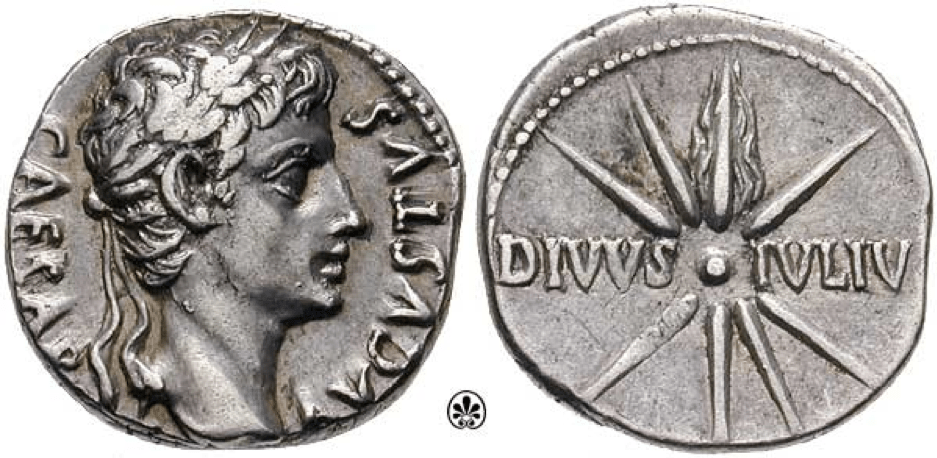
Today's Image: Denarius minted by Augustus depicting himself on the obverse, the comet of 44 and divus Iulius (the divine Julius) on the reverse, c. 19-18 BC (http://numismatics.org/collection/1944.100.39033)
Source: jhiblog.org
Here is a text only version. (See below for an interactive version)
19 Erat in navi Argonautarum filius quidam regis Aeetae, nomine Absyrtus, quem, ut supra demonstravimus, Medea ex urbe fugiens secum abduxerat. Hunc puerum Medea constituit interficere eo consilio ut membris eius in mare coniectis cursum Colchorum impediret; pro certo enim sciebat Aeetem, cum membra fili vidisset, non longius prosecuturum esse, neque opinio eam fefellit; omnia enim ita evenerunt ut Medea speraverat.
Aeetes, ubi primum membra vidit, ad ea conligenda navem statui iussit; dum tamen ea geruntur, Argonautae non intermisso remigandi labore, mox, quod necesse fuit, e conspectu hostium remoti sunt neque prius fugere destiterunt quam ad flumen Eridanum pervenerunt. At Aeetes nihil sibi profuturum esse arbitratus, si longius progressus esset, animo demisso domum revertit, ut fili corpus ad sepulturam daret.
How To Read the Interactive Text
To Read the Interactive Text Below Without a Dictionary-
On a Computer: you hover over a word and get all the possible parts of speech; declensions; and conjugations of every word.
How To Read the Interactive Text
To Read the Interactive Text Below Without a Dictionary-
On a Phone or Tablet: don't 'hover' -'tap' the word. To remove the 'definition box' you 'tap' to the side of the text box.
INTERACTIVE DICTIONARY FREE TEXT
19 Erat in navi Argonautarum filius quidam regis Aeetae, nomine Absyrtus, quem, ut supra demonstravimus, Medea ex urbe fugiens secum abduxerat.
You Need to be a Member to Access the Interactive Dictionary
Hunc puerum Medea constituit interficere eo consilio ut membris eius in mare coniectis cursum Colchorum impediret;
pro certo enim sciebat Aeetem, cum membra fili vidisset, non longius prosecuturum esse, neque opinio eam fefellit; omnia enim ita evenerunt ut Medea speraverat.
Aeetes, ubi primum membra vidit, ad ea conligenda navem statui iussit; dum tamen ea geruntur, Argonautae non intermisso remigandi labore, mox, quod necesse fuit, e conspectu hostium remoti sunt neque prius fugere destiterunt quam ad flumen Eridanum pervenerunt.
At Aeetes nihil sibi profuturum esse arbitratus, si longius progressus esset, animo demisso domum revertit, ut fili corpus ad sepulturam daret.
Recent Comments