
interim- in the meanwhile
The adverb interim, meaning ‘in the meantime’ or ‘meanwhile’, serves as a temporal hinge throughout classical Latin prose. Often appearing in transitional moments, interim allows authors to mark narrative pauses, shifts in action, or the suspension of judgment without rhetorical flourish. It is not ornamental but functional, offering clarity in sequencing and pacing.
In Caesar’s Commentarii de Bello Gallico, interim frequently introduces interludes during campaigns. When describing movements across Gaul or diplomatic exchanges, he uses interim to separate simultaneous events. For example, while legions prepare for battle, Caesar notes that interim he negotiates with local leaders. This usage underscores Caesar’s tactical multitasking and the compressed tempo of his narrative. The adverb reflects the parallel structure of logistics and diplomacy, emphasizing Caesar’s control over time and information.
Cicero uses interim as part of his argumentative architecture. In speeches, it helps to manage flow, distinguishing immediate facts from what will follow. In Pro Milone, Cicero breaks into a long exposition, interjecting interim to hold the audience in a state of anticipation. The adverb creates space for reflection or insinuation while the argument unfolds. Philosophically, in texts like De Officiis, interim often introduces provisional ideas—ethical principles that hold ‘for now’, pending further inquiry.
Historians like Livy and Tacitus employ interim to signal narrative branching. Livy, in Ab Urbe Condita, uses it to juxtapose domestic decisions with external warfare. Tacitus is more pointed: interim becomes a tool of irony, illustrating dissonance between imperial delay and public urgency. While the Senate debates, interim the provinces burn. The adverb here becomes critical, not neutral.
Even in poetry, interim is used sparingly but effectively. In Ovid’s Metamorphoses, it marks intervals between transformations or during suspensions in divine action. Though more common in prose, its poetic appearances show its utility in highlighting pause before change.
Ultimately, interim structures time. It is a marker of latency, control, and division—suggesting not just ‘while waiting’ but the negotiation of parallel events and subtle intentions. In classical literature, it signifies precision, rhythm, and the quiet power of narrative timing.
Today's Image
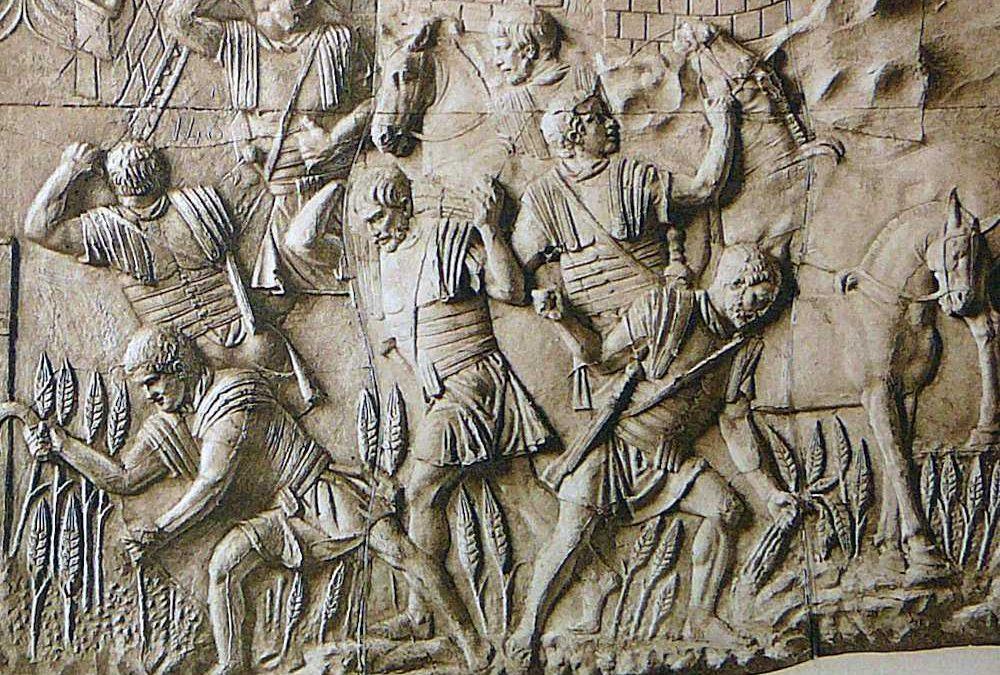
A reconstructed relief panel from the original on the Column of Trajan, Rome. The scene, showing the frumentarii at work gathering wheat.
Source: thehistorianshut.com
Red and Green Vocab
The words in red and green are found among the 3057 Most Common Words in the Classical Latin texts that we will explore on CentumVerba.com and are essential to your understanding of the texts of Caesar, Vergil and Cicero. The green words appear frequently (at least five times) among Vergil's Aeneid (books I-VI), Caesar de bello Gallico (books I-V) and in Cicero's works - in Catilinam (books I-IV), de lege Manilia (also known as de Imperio Cn. Pompei), and pro Achia. These works constituted the curriculum for Latin over 4 years in American High Schools at the start of the 20th Century. The bulk of my information is taken from The Vocabulary of High School Latin by Gonzalez Lodge. I have added to these 2000 words from varioius other sources to compile my own list of The 3057 Most Common Latin Words.
The black words do not appear frequently in Classical Latin.
The red words are the first occurrences of these words in this author and this word will appear as green the next time you encounter it.
If you are serious about building your vocabulary then you should learn the red words as they occur and you should already know the green ones!
I have provided a FLASHCARD set to help - see below.
How To Read the Interactive Text
To Read the Interactive Text Below Without a Dictionary-
On a Computer: you hover over a word and get all the possible parts of speech; declensions; and conjugations of every word.
Red and Green Vocab
The words in red and green are found among the 3057 Most Common Words in the Classical Latin texts that we will explore on CentumVerba.com and are essential to your understanding of the texts of Caesar, Vergil and Cicero. The green words appear frequently (at least five times) among Vergil's Aeneid (books I-VI), Caesar de bello Gallico (books I-V) and in Cicero's works - in Catilinam (books I-IV), de lege Manilia (also known as de Imperio Cn. Pompei), and pro Achia. These works constituted the curriculum for Latin over 4 years in American High Schools at the start of the 20th Century. The bulk of my information is taken from The Vocabulary of High School Latin by Gonzalez Lodge. I have added to these 2000 words from varioius other sources to compile my own list of The 3057 Most Common Latin Words.
The black words do not appear frequently in Classical Latin.
The red words are the first occurrences of these words in this author and this word will appear as green the next time you encounter it.
If you are serious about building your vocabulary then you should learn the red words as they occur and you should already know the green ones!
I have provided a FLASHCARD set to help - see below.
How To Read the Interactive Text
To Read the Interactive Text Below Without a Dictionary-
On a Phone or Tablet: don't 'hover' -'tap' the word. To remove the 'definition box' you 'tap' to the side of the text box.
INTERACTIVE DICTIONARY FREE TEXT
16 Interim cotidie Caesar Haeduos frumentum, quod essent publice polliciti, flagitare.
You Need to be a Member to Access the Interactive Dictionary
Nam propter frigora [quod Gallia sub septentrionibus, ut ante dictum est, posita est,] non modo frumenta in agris matura non erant, sed ne pabuli quidem satis magna copia suppetebat;
eo autem frumento quod flumine Arari navibus subvexerat propterea uti minus poterat quod iter ab Arari Helvetii averterant, a quibus discedere nolebat.
Diem ex die ducere Haedui: conferri, comportari, adesse dicere.
Ubi se diutius duci intellexit et diem instare quo die frumentum militibus metiri oporteret, convocatis eorum principibus, quorum magnam copiam in castris habebat,
in his Diviciaco et Lisco, qui summo magistratui praeerat, quem vergobretum appellant Haedui, qui creatur annuus et vitae necisque in suos habet potestatem, graviter eos accusat,
You Need to be a Member to Access the Interactive Dictionary
I have prepared online Flashcards at CRAM.com to make learning the vocabulary much easier. I have no financial gain from you using the app as it is FREE to use.
I have created a stack of the 24 new words in this passage.
Here is the link to the FLASHCARDS
USING THE FLASHCARD APP:
To make the most of the online Flashcards use the "Click or use spacebar to begin" and the Latin word should appear. (The 'Shuffle' button will take the cards out of alphabetical order.) Type 'H' to get the conjugation / declension of the word if you want to see it. 'H' takes tyou back to the word. Click 'See Answer' or use the Spacebar to see the English.
If you were correct or close enough then select "I was right" or else "I was wrong". After you have completed the set it will start again but it will only display the ones you got wrong.
Continue through this process to learn all the words. I hope this is helpful!
Recent Comments