
by Ian | Jul 28, 2025 | Argonauts Vocab
multus - much ado about nothing The adjective multus, meaning ‘much’ or ‘many’, appears frequently across classical Latin texts, serving not just a quantitative function but also conveying emotional, rhetorical, and philosophical emphasis. Its utility spans prose,...
by Ian | Jul 25, 2025 | Mark SbS
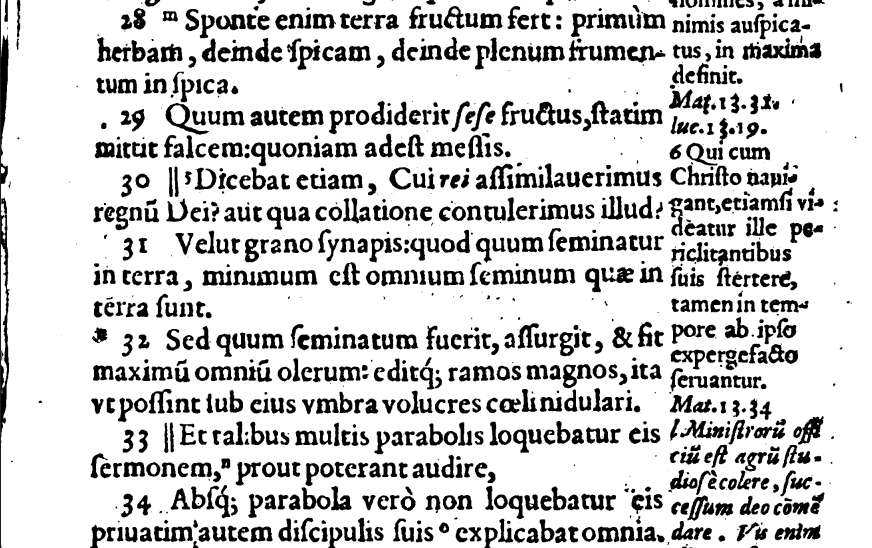
CHAPTER 4 28 For the earth bringeth foorth fruite of herselfe, first the blade, then the eare, after that the full corne in the eare.29 But when the fruite is brought foorth, immediately he putteth in the sickle, because the haruest is come.30 And he said, Wherunto...
by Ian | Jul 25, 2025 | Mark Vocab
ultro - to go beyond expectation The adverb ultro—often translated as ‘voluntarily’, ‘of one’s own accord’, or ‘beyond expectation’—reveals a surprising dynamism in Latin literary usage. Far from a passive modifier, ultro consistently signals movement, initiative, or...
by Ian | Jul 24, 2025 | Aeneid Translation
The fleet he hides close in embosoming groves beneath a caverned rock, amid shivering shadow of the woodland; himself, Achates alone following, he strides forward, clenching in his hand two broad-headed spears. And amid the forest his mother crossed his way, wearing...

by Ian | Jul 24, 2025 | Aeneid Vocab
in - the accusative or ablative? The Latin preposition in is deceptively simple yet remarkably versatile, appearing across classical Latin literature with a range of syntactic and semantic functions. Its primary role is to indicate location or direction, either...
by Ian | Jul 23, 2025 | Cicero in Catilinam-SbS
Make a motion, say you, to the senate, (for that is what you demand) and if thus body votes that you ought to go into banishment, you say that you will obey. I will not make such a motion, it is contrary to my principles, and yet I will let you see what these men...

Recent Comments