
ultro - to go beyond expectation
The adverb ultro—often translated as ‘voluntarily’, ‘of one’s own accord’, or ‘beyond expectation’—reveals a surprising dynamism in Latin literary usage. Far from a passive modifier, ultro consistently signals movement, initiative, or reversal. Its presence within Latin texts tends to shift tone or meaning sharply, drawing attention to characters who act independently, sometimes irrationally, and always with dramatic consequence.
Virgil’s Aeneid contains some of the most nuanced deployments of ultro. When Aeneas speaks ultro to Dido, it’s not mere dialogue—it’s a rupture. By acting before being prompted, he creates tension; the initiative conveys urgency and emotional charge. Likewise, in scenes of divine-human interaction, gods intervening ultro transcend natural order, underscoring the arbitrary or willful nature of fate and divine will. Ultro thereby becomes a marker of both autonomy and cosmic disturbance.
Historians like Livy and Tacitus use ultro to reveal motives behind political decisions. A commander responding ultro to a perceived insult or provocation is not merely reacting but reshaping events. The word spotlights characters whose actions are decisive, audacious, or unprovoked, allowing moral judgment or narrative irony. Livy’s generals who attack ultro may gain military advantage, but at the cost of diplomatic stability—a pattern not lost on discerning readers.
In comedic literature, ultro often serves to exaggerate character folly. Plautus crafts scenarios where a slave ultro volunteers for punishment or a lover pursues rejection with gusto. The adverb amplifies absurdity, layering humor with social critique. These instances reflect a culture attentive to decorum and inversion, where initiative taken ultro implies recklessness or desperation.
Cicero uses ultro in forensic rhetoric to highlight overreach. A litigant who accuses ultro or intervenes without cause risks undermining his own case. Thus ultro becomes a rhetorical weapon, signaling that an opponent has acted beyond reason or necessity.
Across genres, ultro is not neutral. It punctuates decisions, exposes intent, and destabilizes expectations. Writers wield it to animate their narratives—to show not just what happens, but why it matters.
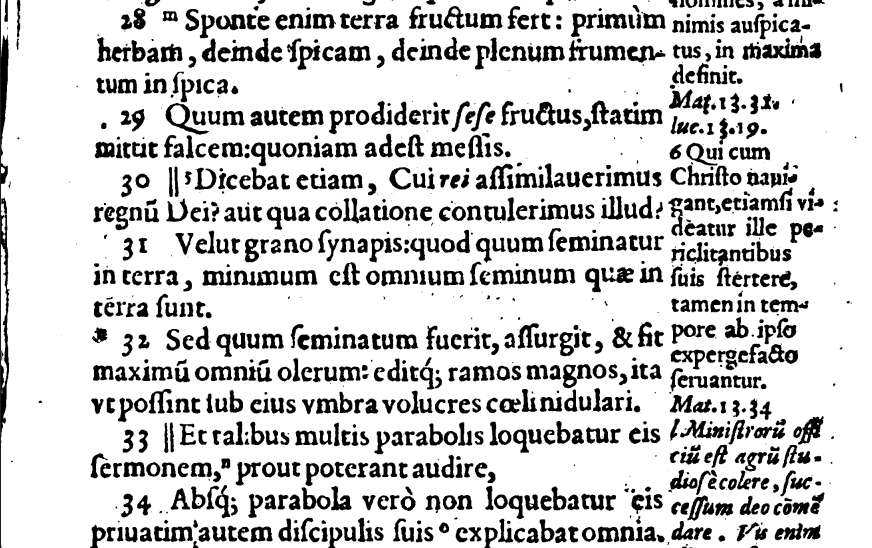
The images for these posts on Mark's gospel
Screenshots taken from the Nouum Testamentum of Théodore de Bèze, (1519-1605) ( Londini : Thomas Vautrollerius, typographus, 1587 )
Accessed from the Post Reformation Digital Library
Red and Green Vocab
The words in red and green are found among the 3057 Most Common Words in the Classical Latin texts that we will explore on CentumVerba.com and are essential to your understanding of the texts of Caesar, Vergil and Cicero. The green words appear frequently (at least five times) among Vergil's Aeneid (books I-VI), Caesar de bello Gallico (books I-V) and in Cicero's works - in Catilinam (books I-IV), de lege Manilia (also known as de Imperio Cn. Pompei), and pro Achia. These works constituted the curriculum for Latin over 4 years in American High Schools at the start of the 20th Century. The bulk of my information is taken from The Vocabulary of High School Latin by Gonzalez Lodge. I have added to these 2000 words from varioius other sources to compile my own list of The 3057 Most Common Latin Words.
The black words do not appear frequently in Classical Latin.
The red words are the first occurrences of these words in this author and this word will appear as green the next time you encounter it.
If you are serious about building your vocabulary then you should learn the red words as they occur and you should already know the green ones!
I have provided a FLASHCARD set to help - see below.
How To Read the Interactive Text
To Read the Interactive Text Below Without a Dictionary-
On a Computer: you hover over a word and get all its possible parts of speech; declensions; and conjugations.
On a Tablet: 'Tap' the word to see the definition, and to remove the 'definition box' you simply 'Tap' anywhere to the side.
Red and Green Vocab
The words in red and green are found among the 3057 Most Common Words in the Classical Latin texts that we will explore on CentumVerba.com and are essential to your understanding of the texts of Caesar, Vergil and Cicero. The green words appear frequently (at least five times) among Vergil's Aeneid (books I-VI), Caesar de bello Gallico (books I-V) and in Cicero's works - in Catilinam (books I-IV), de lege Manilia (also known as de Imperio Cn. Pompei), and pro Achia. These works constituted the curriculum for Latin over 4 years in American High Schools at the start of the 20th Century. The bulk of my information is taken from The Vocabulary of High School Latin by Gonzalez Lodge. I have added to these 2000 words from varioius other sources to compile my own list of The 3057 Most Common Latin Words.
The black words do not appear frequently in Classical Latin.
The red words are the first occurrences of these words in this author and this word will appear as green the next time you encounter it.
If you are serious about building your vocabulary then you should learn the red words as they occur and you should already know the green ones!
I have provided a FLASHCARD set to help - see below.
How To Read the Interactive Text
To Read the Interactive Text Below Without a Dictionary-
On a Phone or Tablet: ''TAP' the word to see the definition, and to remove the 'definition box' you simply 'TAP' anywhere to the side.
INTERACTIVE DICTIONARY FREE TEXT
Caput IV
28 Ultro terra fructificat primum herbam, deinde spicam, deinde plenum frumentum in spica.
You Need to be at least a Trial Member to Access the Interactive Dictionary
29 Et cum se produxerit fructus, statim mittit falcem, quoniam adest messis.
30 Et dicebat Quomodo assimilabimus regnum Dei aut in qua parabola ponemus illud?
31 Sicut granum sinapis, quod cum seminatum fuerit in terra, minus est omnibus seminibus, quae sunt in terra
32 et cum seminatum fuerit, ascendit et fit maius omnibus holeribus et facit ramos magnos, ita ut possint sub umbra eius aves caeli habitare.
33 Et talibus multis parabolis loquebatur eis verbum, prout poterant audire
34 sine parabola autem non loquebatur eis. Seorsum autem discipulis suis disserebat omnia.
INTERACTIVE DICTIONARY FREE TEXT
Caput IV
14 Qui seminat, verbum seminat.
You Need to be at least a Trial Member to Access the Interactive Dictionary
15 Hi autem sunt, qui circa viam, ubi seminatur verbum et cum audierint, confestim venit Satanas et aufert verbum, quod seminatum est in eos.
16 Et hi sunt, qui super petrosa seminantur qui cum audierint verbum, statim cum gaudio accipiunt illud
17 et non habent radicem in se, sed temporales sunt deinde orta tribulatione vel persecutione propter verbum, confestim scandalizantur.
18 Et alii sunt, qui in spinis seminantur hi sunt, qui verbum audierunt,
19 et aerumnae saeculi et deceptio divitiarum et circa reliqua concupiscentiae introeuntes suffocant verbum, et sine fructu efficitur.
20 Et hi sunt, qui super terram bonam seminati sunt qui audiunt verbum et suscipiunt et fructificant unum triginta et unum sexaginta et unum centum.
I have prepared online Flashcards at CRAM.com to make learning the vocabulary much easier. I have no financial gain as the app is FREE to use.
I have created a stack of the 12 new words in this passage.
YOU NEED TO SIGN UP AS A TRIAL MEMBER TO ACCESS THE FLASHCARDS
Here is the link to the FLASHCARDS
USING THE FLASHCARD APP:
To make the most of the online Flashcards use the "Click or use spacebar to begin" and the Latin word should appear. (The 'Shuffle' button will take the cards out of alphabetical order.) Type 'H' to get the conjugation / declension of the word if you want to see it. 'H' takes tyou back to the word. Click 'See Answer' or use the Spacebar to see the English.
If you were correct or close enough then select "I was right" or else "I was wrong". After you have completed the set it will start again but it will only display the ones you got wrong.
Continue through this process to learn all the words. I hope this is helpful!
Recent Comments