by Ian | Aug 13, 2025 | in Catilinam
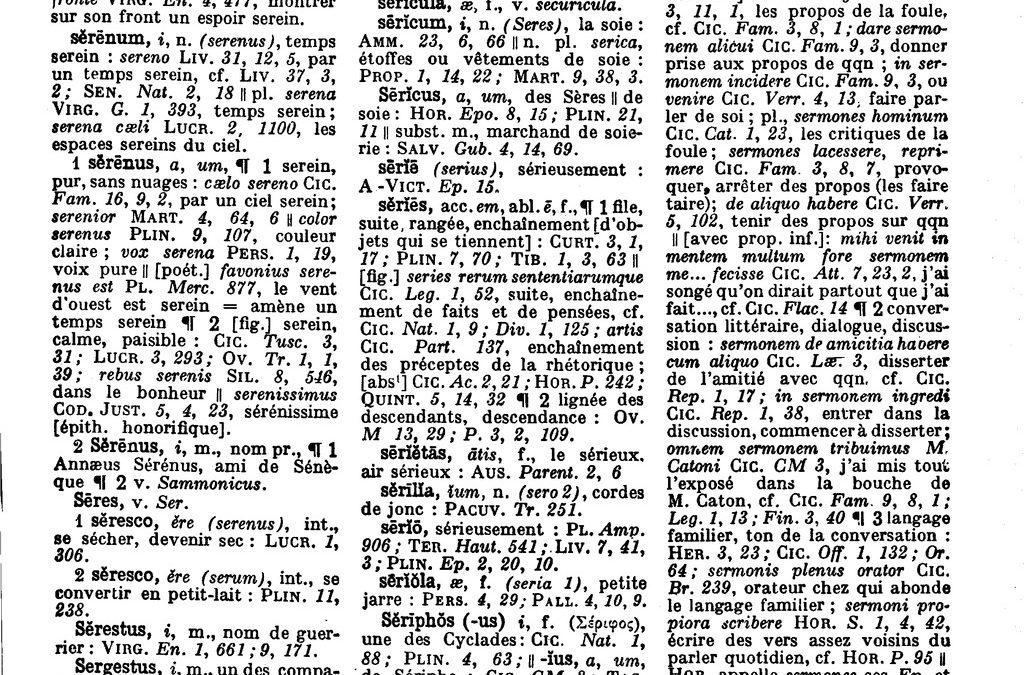
sermo - let's have a word The Latin noun sermo (genitive sermonis) refers primarily to spoken discourse, conversation, or dialogue, and is distinct from more formal or elevated terms like oratio or dictio. In classical Latin literature, sermo often connotes informal,...

by Ian | Aug 6, 2025 | in Catilinam
induco - follow my lead The Latin verb induco, meaning 'to lead in', 'to bring forward', or 'to introduce', appears in a variety of contexts in Cicero’s corpus, often with rhetorical or philosophical nuance. Its basic sense of physical or metaphorical introduction...

by Ian | Jul 30, 2025 | in Catilinam
quiesco - I take a rest The Latin verb quiesco, meaning 'to rest', 'to be quiet', or 'to be inactive', is derived from quies, denoting rest or repose. In classical Latin literature, quiesco often conveys more than mere physical stillness—it suggests a withdrawal from...

by Ian | Jul 23, 2025 | in Catilinam
refero - bring it back The verb refero, meaning ‘to bring back’, ‘to report’, or ‘to relate’, is densely woven into the rhetorical and narrative texture of classical Latin literature. It is a compound of fero with the prefix re-, marking return or repetition, and its...

by Ian | Jul 16, 2025 | in Catilinam
receptus - are you receiving me? The Latin word receptus, derived from the verb recipio, functions both as a noun meaning ‘retreat’, ‘shelter’, or ‘haven’, and as a participle denoting the act of receiving or having been received. Cicero’s prose utilizes both meanings...

by Ian | Jul 9, 2025 | in Catilinam
quaestio - what do you want to know? In Latin, quaestio primarily means ‘question,’ ‘inquiry,’ or ‘investigation,’ originating from the verb quaerere—‘to seek’ or ‘to ask.’ Its scope extends far beyond casual interrogation, becoming a technical term across grammar,...

Recent Comments