
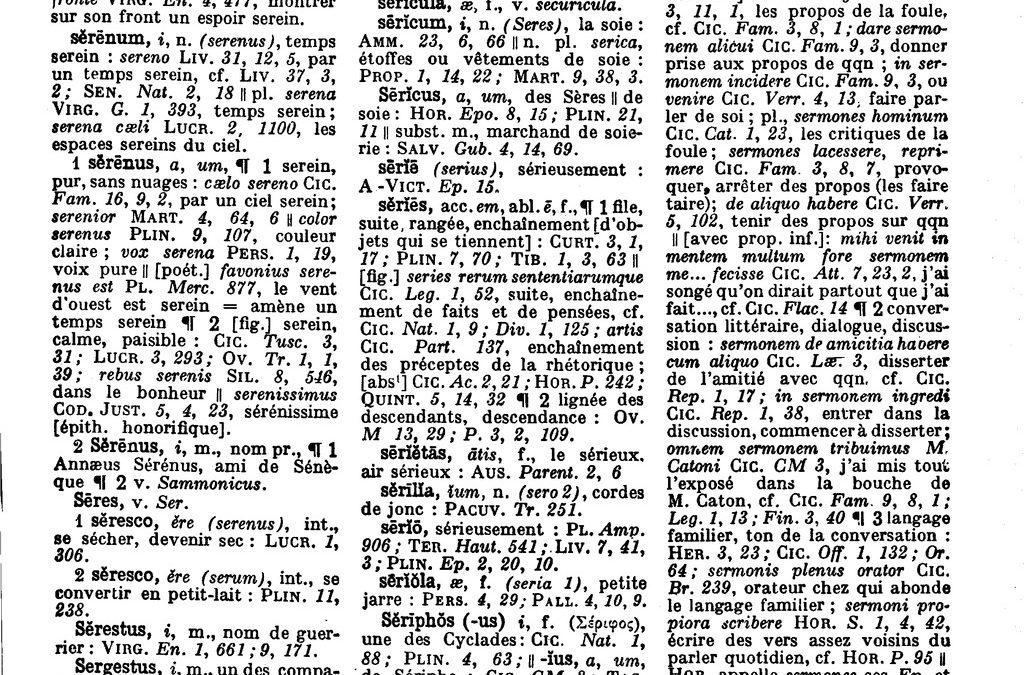
sermo - let's have a word
The Latin noun sermo (genitive sermonis) refers primarily to spoken discourse, conversation, or dialogue, and is distinct from more formal or elevated terms like oratio or dictio. In classical Latin literature, sermo often connotes informal, everyday speech, and is frequently used to contrast with stylized or rhetorical language.
Cicero employs sermo in philosophical dialogues to denote the exchange of ideas in a conversational tone, as opposed to declamatory or forensic speech. In works such as De Oratore and De Natura Deorum, sermo serves as a vehicle for philosophical inquiry, allowing for a more fluid and exploratory mode of discussion. Cicero also distinguishes between sermo Latinus and sermo vulgaris, highlighting the tension between refined and popular usage.
In poetic contexts, sermo appears less frequently but is not absent. Horace, for instance, uses sermo in his Satires to describe the colloquial style he adopts, one that mirrors everyday Roman speech. This stylistic choice aligns with his broader poetic aim of blending moral reflection with accessible language. Sermo here becomes a marker of authenticity and immediacy, distancing his work from the grandiosity of epic.
Seneca, in his prose writings, particularly in the Epistulae Morales, uses sermo to reflect the Stoic ideal of clear, honest communication. He often contrasts sermo with verba, suggesting that true wisdom lies not in ornate expression but in sincere dialogue. This ethical dimension of sermo—as a medium for truth rather than ornament—is central to his philosophical outlook.
In early Christian Latin, sermo begins to take on theological significance, referring to divine speech or preaching, though this usage becomes more prominent in later Latin. Even in classical texts, however, the word occasionally hints at moral or spiritual instruction, especially in didactic contexts.
Overall, sermo in classical Latin literature is a versatile term, encompassing casual conversation, philosophical dialogue, poetic realism, and ethical discourse. Its use reflects a concern with language as a social and intellectual tool, rather than merely a rhetorical instrument.
Today's Image: Dictionnaire Gaffiot (1934)
Source: Dictionnaire Latin-Francais
Here is a text only version
vix feram sermones hominum, si id feceris, vix molem istius invidiae, si in exsilium iussu consulis iveris, sustinebo. sin autem servire meae laudi et gloriae mavis, egredere cum importuna sceleratorum manu, confer te ad Manlium, concita perditos civis, secerne te a bonis, infer patriae bellum, exsulta impio latrocinio, ut a me non eiectus ad alienos, sed invitatus ad tuos isse videaris.
[24] quamquam quid ego te invitem, a quo iam sciam esse praemissos qui tibi ad forum Aurelium praestolarentur armati, cui sciam pactam et constitutam cum Manlio diem, a quo etiam aquilam illam argenteam quam tibi ac tuis omnibus confido perniciosam ac funestam futuram, cui domi tuae sacrarium sceleratum constitutum fuit, sciam esse praemissam?
Need Help Understanding the Latin?
You might find it helpful to start with the Side-by-Side Version which allows you to see my own very literal translation of the text which is almost a word-for-word translation - in an attempt to make it easier to understand the Latin!
Finally come back to this page - Classical Text and you should be able to better understand and competently read the original Latin text.
Vocabulary Version
I have prepared a Vocabulary Version of the passage (link at bottom of the page) which highlights the 3057 Most Common Words in the texts of Vergil, Caesar and Cicero that we will explore on CentumVerba.com
If you are serious about building your vocabulary, the FLASHCARD set should help you learn them.
How To Read the Interactive Text
To Read the Interactive Text Below Without a Dictionary-
On a Computer: you hover over a word and get all the possible parts of speech; declensions; and conjugations of every word.
Need Help Understanding the Latin?
You might find it helpful to start with the Side-by-Side Version which allows you to see my own very literal translation of the text which is almost a word-for-word translation - in an attempt to make it easier to understand the Latin!
Finally come back to this page - Classical Text and you should be able to better understand and competently read the original Latin text.
Vocabulary Version
I have prepared a Vocabulary Version of the passage (link at bottom of the page) which highlights the 3057 Most Common Words in the texts of Vergil, Caesar and Cicero that we will explore on CentumVerba.com
If you are serious about building your vocabulary, the FLASHCARD set should help you learn them.
How To Read the Interactive Text
To Read the Interactive Text Below Without a Dictionary-
On a Phone or Tablet: don't 'hover' -'tap' the word. To remove the 'definition box' you 'tap' to the side of the text box.
INTERACTIVE DICTIONARY FREE TEXT
vix feram sermones hominum, si id feceris, vix molem istius invidiae, si in exsilium iussu consulis iveris, sustinebo.
You Need to be a Member to Access the Interactive Dictionary
Become a Member
sin autem servire meae laudi et gloriae mavis, egredere cum importuna sceleratorum manu,
confer te ad Manlium, concita perditos civis, secerne te a bonis, infer patriae bellum, exsulta impio latrocinio,
ut a me non eiectus ad alienos, sed invitatus ad tuos isse videaris.
[24] quamquam quid ego te invitem, a quo iam sciam esse praemissos qui tibi ad forum Aurelium praestolarentur armati, cui sciam pactam et constitutam cum Manlio diem,
a quo etiam aquilam illam argenteam quam tibi ac tuis omnibus confido perniciosam ac funestam futuram, cui domi tuae sacrarium sceleratum constitutum fuit, sciam esse praemissam?
Recent Comments