
iste - near the L-ISTE-NER
The Latin demonstrative iste (feminine ista, neuter istud) is used to indicate something near the person addressed, often with a tone that reflects the speaker’s attitude toward the referent. Unlike hic, which points to something near the speaker, and ille, which refers to something more remote or elevated, iste frequently carries a nuance of disdain, criticism, or emotional distance in classical Latin literature.
In Cicero’s speeches, iste is often deployed with rhetorical sharpness. When addressing opponents in court, Cicero uses iste to refer to them or their arguments with a tone of contempt or moral disapproval. This usage is particularly evident in his invectives, where iste becomes a tool of distancing and accusation. The demonstrative thus functions not merely as a spatial marker but as a vehicle for ethical and emotional judgment.
In Plautus and Terence, iste appears in dialogue to reflect colloquial speech and interpersonal dynamics. Characters use it to refer to others with irritation, sarcasm, or suspicion. The dramatic context allows iste to convey subtle shades of social tension, often marking a shift in tone or attitude. Its use in comedy underscores its flexibility in expressing relational proximity tinged with emotional coloration.
Tacitus employs iste sparingly but effectively, especially in passages where he critiques imperial figures or policies. In such contexts, iste can signal a veiled condemnation, allowing Tacitus to maintain a tone of restrained irony. The demonstrative thus contributes to his complex narrative voice, which often balances factual reporting with implicit judgment.
In philosophical prose, such as Seneca’s letters, iste may be used to refer to abstract concepts or interlocutors with a tone of challenge or correction. When Seneca contrasts Stoic ideals with popular misconceptions, iste can mark the latter as misguided or inferior. This rhetorical strategy reinforces the moral clarity of his philosophical stance.
Overall, iste in classical Latin is more than a grammatical demonstrative; it is a subtle instrument of tone, capable of expressing proximity, opposition, irony, or disdain. Its interpretive weight depends heavily on context, speaker, and genre, making it a rich subject for literary and rhetorical analysis.
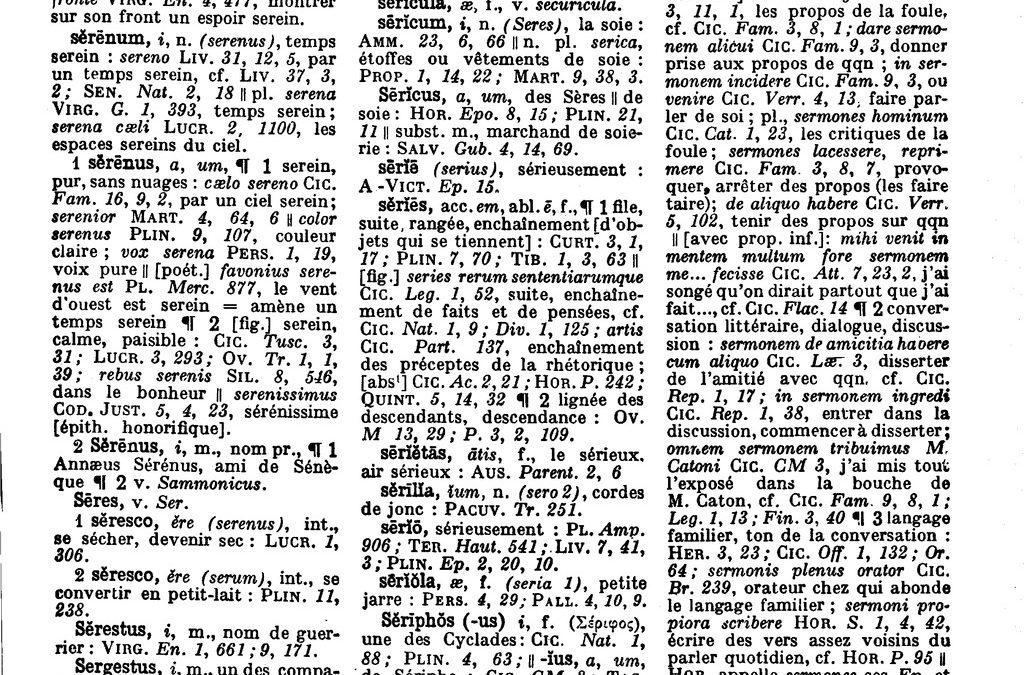
Today's Image: Dictionnaire Gaffiot (1934)
Source: Dictionnaire Latin-Francais
Red and Green Vocab
The words in red and green are found among the 3057 Most Common Words in the Classical Latin texts that we will explore on CentumVerba.com and are essential to your understanding of the texts of Caesar, Vergil and Cicero. The green words appear frequently (at least five times) among Vergil's Aeneid (books I-VI), Caesar de bello Gallico (books I-V) and in Cicero's works - in Catilinam (books I-IV), de lege Manilia (also known as de Imperio Cn. Pompei), and pro Achia. These works constituted the curriculum for Latin over 4 years in American High Schools at the start of the 20th Century. The bulk of my information is taken from The Vocabulary of High School Latin by Gonzalez Lodge. I have added to these 2000 words from varioius other sources to compile my own list of The 3057 Most Common Latin Words.
The black words do not appear frequently in Classical Latin.
The red words are the first occurrences of these words in this author and this word will appear as green the next time you encounter it.
If you are serious about building your vocabulary then you should learn the red words as they occur and you should already know the green ones!
I have provided a FLASHCARD set to help - see below.
How To Read the Interactive Text
To Read the Interactive Text Below Without a Dictionary-
On a Computer: you hover over a word and get all the possible parts of speech; declensions; and conjugations of every word.
Red and Green Vocab
The words in red and green are found among the 3057 Most Common Words in the Classical Latin texts that we will explore on CentumVerba.com and are essential to your understanding of the texts of Caesar, Vergil and Cicero. The green words appear frequently (at least five times) among Vergil's Aeneid (books I-VI), Caesar de bello Gallico (books I-V) and in Cicero's works - in Catilinam (books I-IV), de lege Manilia (also known as de Imperio Cn. Pompei), and pro Achia. These works constituted the curriculum for Latin over 4 years in American High Schools at the start of the 20th Century. The bulk of my information is taken from The Vocabulary of High School Latin by Gonzalez Lodge. I have added to these 2000 words from varioius other sources to compile my own list of The 3057 Most Common Latin Words.
The black words do not appear frequently in Classical Latin.
The red words are the first occurrences of these words in this author and this word will appear as green the next time you encounter it.
If you are serious about building your vocabulary then you should learn the red words as they occur and you should already know the green ones!
I have provided a FLASHCARD set to help - see below.
How To Read the Interactive Text
To Read the Interactive Text Below Without a Dictionary-
On a Phone or Tablet: don't 'hover' -'tap' the word. To remove the 'definition box' you 'tap' to the side of the text box.
INTERACTIVE DICTIONARY FREE TEXT
vix feram sermones hominum, si id feceris, vix molem istius invidiae, si in exsilium iussu consulis iveris, sustinebo.
You Need to be a Member to Access the Interactive Dictionary
sin autem servire meae laudi et gloriae mavis, egredere cum importuna sceleratorum manu,
confer te ad Manlium, concita perditos civis, secerne te a bonis, infer patriae bellum, exsulta impio latrocinio,
ut a me non eiectus ad alienos, sed invitatus ad tuos isse videaris.
[24] quamquam quid ego te invitem, a quo iam sciam esse praemissos qui tibi ad forum Aurelium praestolarentur armati, cui sciam pactam et constitutam cum Manlio diem,
a quo etiam aquilam illam argenteam quam tibi ac tuis omnibus confido perniciosam ac funestam futuram, cui domi tuae sacrarium sceleratum constitutum fuit, sciam esse praemissam?
I have prepared online Flashcards at CRAM.com to make learning the vocabulary much easier. I have no financial gain from you using the app as it is FREE to use.
I have created a stack of the 17 new words in this passage.
Here is the link to the FLASHCARDS
USING THE FLASHCARD APP:
To make the most of the online Flashcards use the "Click or use spacebar to begin" and the Latin word should appear. (The 'Shuffle' button will take the cards out of alphabetical order.) Type 'H' to get the conjugation / declension of the word if you want to see it. 'H' takes tyou back to the word. Click 'See Answer' or use the Spacebar to see the English.
If you were correct or close enough then select "I was right" or else "I was wrong". After you have completed the set it will start again but it will only display the ones you got wrong.
Continue through this process to learn all the words. I hope this is helpful!
Recent Comments