
by Ian | Sep 10, 2025 | in Catilinam
etenim - for indeed The Latin conjunction etenim functions as a nuanced connective, typically translated as 'for indeed' or 'and in fact'. It combines et and enim, reinforcing the causal or explanatory force of a statement while also signalling its rhetorical...

by Ian | Sep 3, 2025 | in Catilinam
patrius - inherited duty The Latin verb careo (first person careo, infinitive carere, perfect carui) means ‘to be without’, ‘to lack’, or ‘to be free from’, and it governs the ablative case. It is used in classical Latin literature to express absence, deprivation, or...

by Ian | Aug 27, 2025 | in Catilinam
careo - nothing to do with care The Latin verb careo (first person careo, infinitive carere, perfect carui) means ‘to be without’, ‘to lack’, or ‘to be free from’, and it governs the ablative case. It is used in classical Latin literature to express absence,...

by Ian | Aug 20, 2025 | in Catilinam
careo - nothing to do with care The Latin verb careo (first person careo, infinitive carere, perfect carui) means ‘to be without’, ‘to lack’, or ‘to be free from’, and it governs the ablative case. It is used in classical Latin literature to express absence,...
by Ian | Aug 13, 2025 | in Catilinam
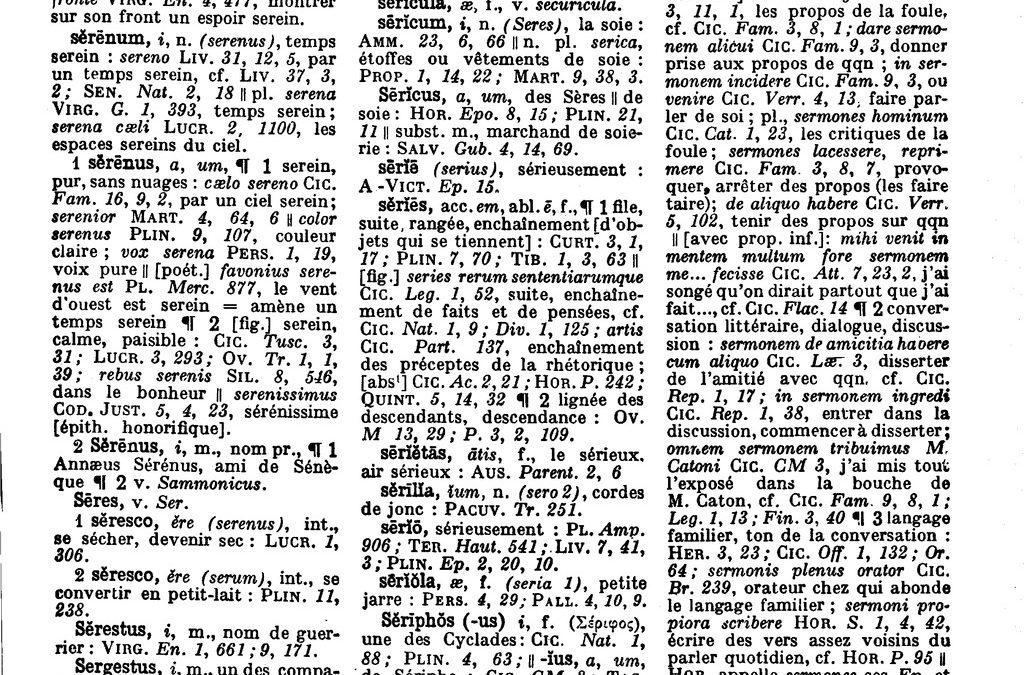
sermo - let's have a word The Latin noun sermo (genitive sermonis) refers primarily to spoken discourse, conversation, or dialogue, and is distinct from more formal or elevated terms like oratio or dictio. In classical Latin literature, sermo often connotes informal,...

by Ian | Aug 6, 2025 | in Catilinam
induco - follow my lead The Latin verb induco, meaning 'to lead in', 'to bring forward', or 'to introduce', appears in a variety of contexts in Cicero’s corpus, often with rhetorical or philosophical nuance. Its basic sense of physical or metaphorical introduction...

Recent Comments