
quaestio - what do you want to know?
In Latin, quaestio primarily means ‘question,’ ‘inquiry,’ or ‘investigation,’ originating from the verb quaerere—‘to seek’ or ‘to ask.’ Its scope extends far beyond casual interrogation, becoming a technical term across grammar, science, philosophy, and law. Fundamentally, quaestio represents the disciplined pursuit of knowledge—a notion central to Roman intellectual culture.
Grammatically, quaestio is a feminine noun of the third declension. It is often paired with verbs like ponere, proponere, or solvere—'to pose,’ ‘to propose,’ or ‘to solve a question.’ In grammatical treatises, quaestio refers to interrogative structures. Donatus, in his fourth-century Ars Grammatica, distinguishes between quaestio absoluta (a yes/no question) and quaestio ex parte (open-ended). Here, the term identifies syntactic forms, not just intellectual puzzles.
In philosophy and science, quaestio was a formal component of debate. Cicero uses the term in Academica and Tusculanae Disputationes to describe philosophical problems posed for resolution: quaestiones in utramque partem disputantur, or ‘questions are debated on both sides.’ This dialectical use foreshadows the scholastic method of the medieval period. In fact, later Latin preserves quaestio disputata—a “disputed question”—as a core element of academic reasoning. Thinkers such as Boethius and Thomas Aquinas would pose a quaestio, raise objections, and resolve it with systematic logic.
In Roman law, quaestio took on a judicial dimension. It could refer to an inquiry into criminal activity or a tribunal itself, as in quaestio de veneficiis (‘investigation concerning poisonings’). Tacitus, in Annales, describes senators convening to address a quaestio maiestatis—a ‘question of treason.’ Thus, the term oscillates between intellectual, judicial, and institutional meanings, unified by the theme of formal inquiry.
Literarily, quaestio is not frequently dramatized, but it shapes structure and rhetoric. In Cicero’s oratory, rhetorical questions—quaestiones oratoriae—are tools of persuasion and rhythm. Meanwhile, in Lucan’s Pharsalia, quaestio can denote existential interrogation, asking not merely what happened, but what it means. Even in poetry, then, quaestio can create tension and reflection.
In sum, quaestio is more than a question—it is the architecture of inquiry. Whether parsing grammar, decoding natural philosophy, rendering verdicts, or framing argument, the Roman world treated the quaestio as the essential unit of intellectual work: a mechanism for truth-seeking that endures across disciplines and centuries.
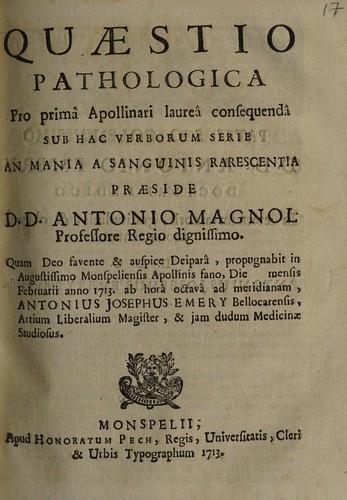
Today's Image: Quaestio Pathologica Book coversheet
Early 18th Century medical book dealing with mental disorders associated with blood.
Source: openlibrary.org Published 1713 in France
Here is a text only version
...tu non solum ad neglegendas leges et quaestiones verum etiam ad evertendas perfringendasque valuisti. superiora illa, quamquam ferenda non fuerunt, tamen ut potui tuli; nunc vero me totam esse in metu propter unum te, quicquid increpuerit, Catilinam timeri, nullum videri contra me consilium iniri posse quod a tuo scelere abhorreat, non est ferendum. quam ob rem discede atque hunc mihi timorem eripe; si est verus, ne opprimar, sin falsus, ut tandem aliquando timere desinam.'
CAPUT 8
[19] haec si tecum, ut dixi, patria loquatur, nonne impetrare debeat, etiam si vim adhibere non possit? quid, quod tu te in custodiam dedisti, quod vitandae suspicionis causa ad M'. Lepidum te habitare velle dixisti?
Need Help Understanding the Latin?
You might find it helpful to start with the Side-by-Side Version which allows you to see my own very literal translation of the text which is almost a word-for-word translation - in an attempt to make it easier to understand the Latin!
Finally come back to this page - Classical Text and you should be able to better understand and competently read the original Latin text.
Vocabulary Version
I have prepared a Vocabulary Version of the passage (link at bottom of the page) which highlights the 3057 Most Common Words in the texts of Vergil, Caesar and Cicero that we will explore on CentumVerba.com
If you are serious about building your vocabulary, the FLASHCARD set should help you learn them.
How To Read the Interactive Text
To Read the Interactive Text Below Without a Dictionary-
On a Computer: you hover over a word and get all the possible parts of speech; declensions; and conjugations of every word.
Need Help Understanding the Latin?
You might find it helpful to start with the Side-by-Side Version which allows you to see my own very literal translation of the text which is almost a word-for-word translation - in an attempt to make it easier to understand the Latin!
Finally come back to this page - Classical Text and you should be able to better understand and competently read the original Latin text.
Vocabulary Version
I have prepared a Vocabulary Version of the passage (link at bottom of the page) which highlights the 3057 Most Common Words in the texts of Vergil, Caesar and Cicero that we will explore on CentumVerba.com
If you are serious about building your vocabulary, the FLASHCARD set should help you learn them.
How To Read the Interactive Text
To Read the Interactive Text Below Without a Dictionary-
On a Phone or Tablet: don't 'hover' -'tap' the word. To remove the 'definition box' you 'tap' to the side of the text box.
INTERACTIVE DICTIONARY FREE TEXT
...tu non solum ad neglegendas leges et quaestiones verum etiam ad evertendas perfringendasque valuisti.
You Need to be a Member to Access the Interactive Dictionary
Become a Member
superiora illa, quamquam ferenda non fuerunt, tamen ut potui tuli; nunc vero me totam esse in metu propter unum te,
quicquid increpuerit, Catilinam timeri, nullum videri contra me consilium iniri posse quod a tuo scelere abhorreat, non est ferendum.
quam ob rem discede atque hunc mihi timorem eripe; si est verus, ne opprimar, sin falsus, ut tandem aliquando timere desinam.'
CAPUT 8
[19] haec si tecum, ut dixi, patria loquatur, nonne impetrare debeat, etiam si vim adhibere non possit?
quid, quod tu te in custodiam dedisti, quod vitandae suspicionis causa ad M'. Lepidum te habitare velle dixisti?
Recent Comments