
receptus - are you receiving me?
The Latin word receptus, derived from the verb recipio, functions both as a noun meaning ‘retreat’, ‘shelter’, or ‘haven’, and as a participle denoting the act of receiving or having been received. Cicero’s prose utilizes both meanings with distinct rhetorical intention, shaping arguments around refuge, acceptance, and strategic withdrawal.
In his speeches and legal defenses, Cicero uses receptus to highlight civic protection and ethical asylum. In Pro Sestio, when describing the violent clashes between political factions, he refers to the receptus of honest citizens as a shield against lawlessness. Here, receptus connotes more than mere physical safety—it serves as a metaphor for the Roman state's responsibility to protect virtue from chaos. The word thus becomes a pivot in Cicero’s political vocabulary, anchoring arguments in notions of legitimacy and public trust.
In Pro Milone, Cicero refers to the absence of receptus for Milo during the ambush on the Appian Way, underscoring his isolation and vulnerability. The lack of receptus is crucial—it illustrates that Milo had no planned escape or shelter, a detail Cicero exploits to reject accusations of premeditated violence. The rhetorical force of receptus lies in its contrast between defenselessness and guilt.
Philosophical texts offer a subtler use. In De Officiis, Cicero speaks of the receptus of duties, using the participial sense to suggest the moral acceptance of obligations. One may receptus honor or receptus responsibility, implying not just passive reception but a conscious act of internalization. Here, Cicero’s Latin constructs a moral lexicon in which receptus marks the threshold between external expectation and personal ethics.
Cicero also adapts receptus in correspondence, especially in his Epistulae ad Familiares, to describe moments of retreat or strategic withdrawal from public life. Whether referencing a literal withdrawal from political danger or the emotional receptus offered by a friend’s villa, the term suggests measured disengagement rather than defeat.
In sum, Cicero’s use of receptus is varied yet deliberate—ranging from juridical sanctuary to moral reception, from tactical movement to private solace. The term allows him to shape space and agency, aligning physical and ethical boundaries in pursuit of rhetorical clarity.
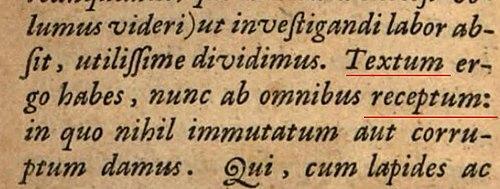
Today's Image: Elzevier 1633 edition
"A text therefore you have, that has now by everyone been received" (emphasis added): the words from the Elzevier 1633 edition, in Latin, from which the term "Textus receptus" was derived
Source: wikipedia.org
Here is a text only version
A quo non receptus etiam ad me venire ausus es, atque ut domi meae te adservarem rogasti. cum a me quoque id responsum tulisses, me nullo modo posse isdem parietibus tuto esse tecum, quia magno in periculo essem quod isdem moenibus contineremur, ad Q. Metellum praetorem venisti:
A quo repudiatus ad sodalem tuum, virum optimum, M. Metellum demigrasti, quem tu videlicet et ad custodiendum te diligentissimum et ad suspicandum sagacissimum et ad vindicandum fortissimum fore putasti. sed quam longe videtur a carcere atque a vinculis abesse debere qui se ipse iam dignum custodia iudicarit?
[20] quae cum ita sint, Catilina, dubitas, si emori aequo animo non potes, abire in aliquas terras et vitam istam multis suppliciis iustis debitisque ereptam fugae solitudinique mandare?
Need Help Understanding the Latin?
You might find it helpful to start with the Side-by-Side Version which allows you to see my own very literal translation of the text which is almost a word-for-word translation - in an attempt to make it easier to understand the Latin!
Finally come back to this page - Classical Text and you should be able to better understand and competently read the original Latin text.
Vocabulary Version
I have prepared a Vocabulary Version of the passage (link at bottom of the page) which highlights the 3057 Most Common Words in the texts of Vergil, Caesar and Cicero that we will explore on CentumVerba.com
If you are serious about building your vocabulary, the FLASHCARD set should help you learn them.
How To Read the Interactive Text
To Read the Interactive Text Below Without a Dictionary-
On a Computer: you hover over a word and get all the possible parts of speech; declensions; and conjugations of every word.
Need Help Understanding the Latin?
You might find it helpful to start with the Side-by-Side Version which allows you to see my own very literal translation of the text which is almost a word-for-word translation - in an attempt to make it easier to understand the Latin!
Finally come back to this page - Classical Text and you should be able to better understand and competently read the original Latin text.
Vocabulary Version
I have prepared a Vocabulary Version of the passage (link at bottom of the page) which highlights the 3057 Most Common Words in the texts of Vergil, Caesar and Cicero that we will explore on CentumVerba.com
If you are serious about building your vocabulary, the FLASHCARD set should help you learn them.
How To Read the Interactive Text
To Read the Interactive Text Below Without a Dictionary-
On a Phone or Tablet: don't 'hover' -'tap' the word. To remove the 'definition box' you 'tap' to the side of the text box.
INTERACTIVE DICTIONARY FREE TEXT
A quo non receptus etiam ad me venire ausus es, atque ut domi meae te adservarem rogasti.
You Need to be a Member to Access the Interactive Dictionary
cum a me quoque id responsum tulisses, me nullo modo posse isdem parietibus tuto esse tecum, quia magno in periculo essem quod isdem moenibus contineremur, ad Q. Metellum praetorem venisti:
A quo repudiatus ad sodalem tuum, virum optimum, M. Metellum demigrasti, quem tu videlicet et ad custodiendum te diligentissimum et ad suspicandum sagacissimum et ad vindicandum fortissimum fore putasti.
sed quam longe videtur a carcere atque a vinculis abesse debere qui se ipse iam dignum custodia iudicarit?
[20] quae cum ita sint, Catilina, dubitas, si emori aequo animo non potes, abire in aliquas terras et vitam istam multis suppliciis iustis debitisque ereptam fugae solitudinique mandare?
Recent Comments