
domus - a house no matter the delension
The Latin noun domus (house, home) is unique in its declension, as it exhibits forms from both the second and fourth declensions. This variability makes it one of the most distinctive nouns in Latin grammar.
Variable Declension
Domus is primarily a fourth-declension noun, but it also adopts second-declension endings in certain cases. Here is an overview of its forms:
| Case | Singular | Plural |
|---|---|---|
| Nominative | domus | domūs |
| Accusative | domum | domūs / domōs |
| Genitive | domūs / domī | domuum / domōrum |
| Dative | domuī / domō | domibus |
| Ablative | domō / domū | domibus |
| Locative | domī | — |
The locative case (domī) is particularly notable, as it is used to indicate "at home," a rare survival of an archaic grammatical feature.
Usage in Classical Literature
The word domus appears frequently in Roman literature, reflecting its importance in Roman society. It was not just a physical structure but also a symbol of family, stability, and status.
- Vergil’s Aeneid – Domus is used to describe both grand palaces and humble dwellings, emphasizing the contrast between exile and settlement.
- Ovid’s Metamorphoses – The term appears in stories of transformation, often signifying a change in identity or fate.
- Cicero’s Pro Caelio – Cicero uses domus metaphorically to discuss reputation and honor, linking the household to personal virtue.
- Seneca’s Epistulae Morales – The philosopher employs domus in discussions of simplicity and material wealth, contrasting luxurious homes with philosophical ideals.
Cultural Significance
In Roman society, domus was more than a residence—it was the center of family life and social hierarchy. The domus of wealthy Romans, such as the domus aurea of Nero, symbolized power and prestige, while the humble domus of common citizens reflected everyday life.
Thus, domus is a word rich in grammatical complexity and literary significance, embodying both the physical and symbolic aspects of Roman civilization.
The images for these posts on Mark's gospel
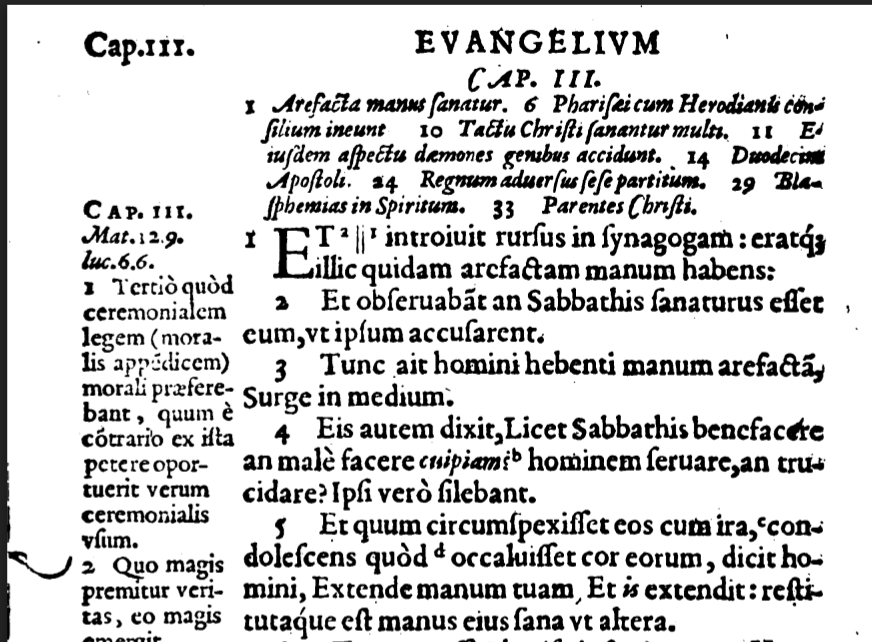
Screenshots taken from the Nouum Testamentum of Théodore de Bèze, (1519-1605) ( Londini : Thomas Vautrollerius, typographus, 1587 )
Accessed from the Post Reformation Digital Library
Red and Green Vocab
The words in red and green are found among the 3057 Most Common Words in the Classical Latin texts that we will explore on CentumVerba.com and are essential to your understanding of the texts of Caesar, Vergil and Cicero. The green words appear frequently (at least five times) among Vergil's Aeneid (books I-VI), Caesar de bello Gallico (books I-V) and in Cicero's works - in Catilinam (books I-IV), de lege Manilia (also known as de Imperio Cn. Pompei), and pro Achia. These works constituted the curriculum for Latin over 4 years in American High Schools at the start of the 20th Century. The bulk of my information is taken from The Vocabulary of High School Latin by Gonzalez Lodge. I have added to these 2000 words from varioius other sources to compile my own list of The 3057 Most Common Latin Words.
The black words do not appear frequently in Classical Latin.
The red words are the first occurrences of these words in this author and this word will appear as green the next time you encounter it.
If you are serious about building your vocabulary then you should learn the red words as they occur and you should already know the green ones!
I have provided a FLASHCARD set to help - see below.
How To Read the Interactive Text
To Read the Interactive Text Below Without a Dictionary-
On a Computer: you hover over a word and get all its possible parts of speech; declensions; and conjugations.
On a Tablet: 'Tap' the word to see the definition, and to remove the 'definition box' you simply 'Tap' anywhere to the side.
Red and Green Vocab
The words in red and green are found among the 3057 Most Common Words in the Classical Latin texts that we will explore on CentumVerba.com and are essential to your understanding of the texts of Caesar, Vergil and Cicero. The green words appear frequently (at least five times) among Vergil's Aeneid (books I-VI), Caesar de bello Gallico (books I-V) and in Cicero's works - in Catilinam (books I-IV), de lege Manilia (also known as de Imperio Cn. Pompei), and pro Achia. These works constituted the curriculum for Latin over 4 years in American High Schools at the start of the 20th Century. The bulk of my information is taken from The Vocabulary of High School Latin by Gonzalez Lodge. I have added to these 2000 words from varioius other sources to compile my own list of The 3057 Most Common Latin Words.
The black words do not appear frequently in Classical Latin.
The red words are the first occurrences of these words in this author and this word will appear as green the next time you encounter it.
If you are serious about building your vocabulary then you should learn the red words as they occur and you should already know the green ones!
I have provided a FLASHCARD set to help - see below.
How To Read the Interactive Text
To Read the Interactive Text Below Without a Dictionary-
On a Phone or Tablet: ''TAP' the word to see the definition, and to remove the 'definition box' you simply 'TAP' anywhere to the side.
INTERACTIVE DICTIONARY FREE TEXT
Caput 2
26 Quomodo introivit in domum Dei sub Abiathar principe sacerdotum et panes propositionis manducavit, quos non licet manducare nisi sacerdotibus, et dedit etiam eis, qui cum eo erant?
You Need to be at least a Trial Member to Access the Interactive Dictionary
27 Et dicebat eis Sabbatum propter hominem factum est, et non homo propter sabbatum
28 itaque dominus est Filius hominis etiam sabbati.
CAPUT 3
Et introivit iterum in synagogam. Et erat ibi homo habens manum aridam
2 et observabant eum, si sabbatis curaret illum, ut accusarent eum.
3 Et ait homini habenti manum aridam Surge in medium.
4 Et dicit eis Licet sabbatis bene facere an male? Animam salvam facere an perdere? At illi tacebant.
5 Et circumspiciens eos cum ira, contristatus super caecitate cordis eorum, dicit homini Extende manum. Et extendit, et restituta est manus eius.
I have prepared online Flashcards at CRAM.com to make learning the vocabulary much easier. I have no financial gain as the app is FREE to use.
I have created a stack of the 12 new words in this passage.
YOU NEED TO SIGN UP AS A TRIAL MEMBER TO ACCESS THE FLASHCARDS
Here is the link to the FLASHCARDS
USING THE FLASHCARD APP:
To make the most of the online Flashcards use the "Click or use spacebar to begin" and the Latin word should appear. (The 'Shuffle' button will take the cards out of alphabetical order.) Type 'H' to get the conjugation / declension of the word if you want to see it. 'H' takes tyou back to the word. Click 'See Answer' or use the Spacebar to see the English.
If you were correct or close enough then select "I was right" or else "I was wrong". After you have completed the set it will start again but it will only display the ones you got wrong.
Continue through this process to learn all the words. I hope this is helpful!
Recent Comments