
Legalism
Legalism is the target of Jesus in Mark 2:26-3:5, combined with His authority over religious traditions, and His emphasis on mercy over legalism. The passage begins with Jesus referencing an event from the Old Testament, where David and his men ate the consecrated bread in the house of God when they were hungry. Jesus uses this example to challenge the Pharisees’ rigid interpretation of the Sabbath, emphasizing that human need takes precedence over strict ritual observance - the definitioin of legalism. He declares, "The Sabbath was made for man, not man for the Sabbath." This statement underscores His authority over religious law, asserting that the Sabbath should serve people rather than burden them.
In Mark 3:1-5, Jesus enters a synagogue where He encounters a man with a withered hand. The Pharisees watch closely, hoping to accuse Him if He heals on the Sabbath. Jesus, aware of their intentions, asks, "Is it lawful to do good or to do harm on the Sabbath, to save life or to kill?" His question exposes their hypocrisy—while they focus on legalism and technicalities, they ignore the deeper purpose of the law, which is to promote goodness and life.
Jesus, grieved by their hardness of heart, commands the man to stretch out his hand, and he is healed. This act of healing demonstrates Jesus’ authority and compassion, reinforcing His message that mercy outweighs rigid legalism. The Pharisees, instead of recognizing His divine power, conspire to destroy Him, revealing their resistance to His teachings.
"This passage highlights Jesus’ challenge to religious authorities, His emphasis on compassion, and the growing opposition He faces. His actions redefine the purpose of the Sabbath, shifting the focus from strict adherence to legalism toward love and restoration.These verses show us our Lord again working a miracle. He heals a man in the synagogue, "who had a withered hand." Always about His Father's business—always doing good—doing it in the sight of enemies as well as of friends —such was the daily tenor of our Lord's earthly ministry.
Let us observe in these verses, how our Lord Jesus Christ was watched by His enemies who were keen on legalism. We read that "they watched Him, whether He would heal him on the Sabbath day, that they might accuse Him."
What a melancholy proof we have here of the wickedness of human nature! It was the Sabbath day,
when these things happened. It was in the synagogue, where men were assembled to hear the word and worship God. Yet even on the day of God, and at the time of worshiping God, these wretched formalists were plotting mischief against our Lord. The very men who pretended to such strictness and, sanctity in little things, were full of malicious and angry thoughts in the midst of the congregation."
Adapted from 'Expository Thoughts on Mark' by J.C.Ryle (1857)
The images for these posts on Mark's gospel
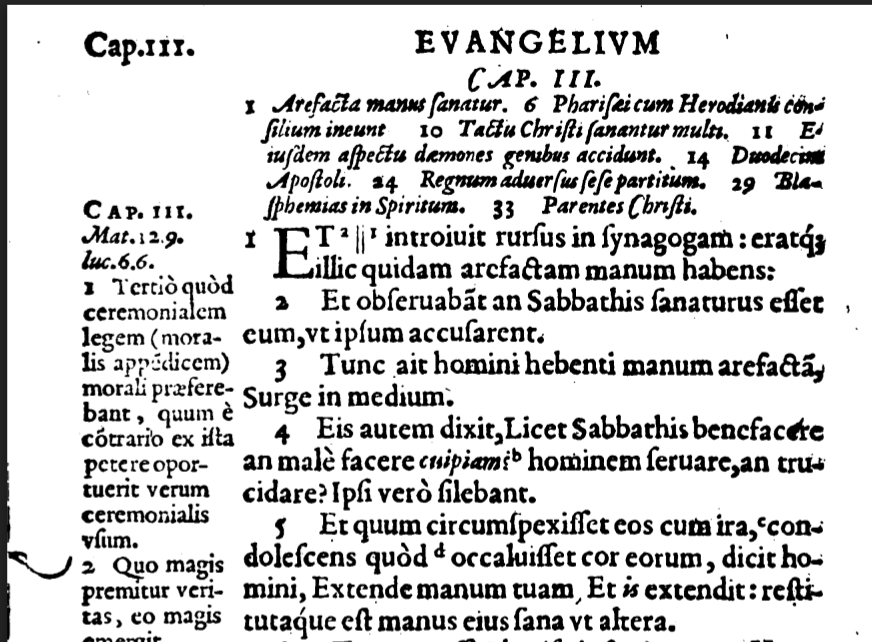
Screenshots taken from the Nouum Testamentum of Théodore de Bèze, (1519-1605) ( Londini : Thomas Vautrollerius, typographus, 1587 )
Accessed from the Post Reformation Digital Library
JUMP To Dictionary Free Interactive Text
Here is a text only version.
EVANGELIUM MARCUM
CAPUT 2
26 Quomodo introivit in domum Dei sub Abiathar principe sacerdotum et panes propositionis manducavit, quos non licet manducare nisi sacerdotibus, et dedit etiam eis, qui cum eo erant?
27 Et dicebat eis Sabbatum propter hominem factum est, et non homo propter sabbatum
28 itaque dominus est Filius hominis etiam sabbati.
CAPUT 3
1 Et introivit iterum in synagogam. Et erat ibi homo habens manum aridam
2 et observabant eum, si sabbatis curaret illum, ut accusarent eum.
3 Et ait homini habenti manum aridam Surge in medium.
4 Et dicit eis Licet sabbatis bene facere an male? Animam salvam facere an perdere? At illi tacebant.
5 Et circumspiciens eos cum ira, contristatus super caecitate cordis eorum, dicit homini Extende manum. Et extendit, et restituta est manus eius.
How To Read the Interactive Text Without a Dictionary
On a Computer:
Hover over a word to get all its possible parts of speech, declensions, or conjugations.
On a Tablet:
'TAP' the word to see the definition, and to remove the 'definition box' you simply 'TAP' anywhere to the side.
How To Read the Interactive Text
'Tap' the word to see the definition and to remove the 'definition box' you simply 'tap' antwhere to the side.
EVANGELIUM MARCUM
CAPUT 2
26 Quomodo introivit in domum Dei sub Abiathar principe sacerdotum et panes propositionis manducavit, quos non licet manducare nisi sacerdotibus, et dedit etiam eis, qui cum eo erant?
You Need to be at least a Trial Member to Access the Interactive Dictionary
27 Et dicebat eis Sabbatum propter hominem factum est, et non homo propter sabbatum
28 itaque dominus est Filius hominis etiam sabbati.
Caput 3
1 Et introivit iterum in synagogam. Et erat ibi homo habens manum aridam
2 et observabant eum, si sabbatis curaret illum, ut accusarent eum.
3 Et ait homini habenti manum aridam Surge in medium.
4 Et dicit eis Licet sabbatis bene facere an male? Animam salvam facere an perdere? At illi tacebant.
5 Et circumspiciens eos cum ira, contristatus super caecitate cordis eorum, dicit homini Extende manum. Et extendit, et restituta est manus eius.
EVANGELIUM MARCUM
CAPUT 2
26 Quomodo introivit in domum Dei sub Abiathar principe sacerdotum et panes propositionis manducavit, quos non licet manducare nisi sacerdotibus, et dedit etiam eis, qui cum eo erant?
You Need to be at least a Trial Member to Access the Interactive Dictionary
27 Et dicebat eis Sabbatum propter hominem factum est, et non homo propter sabbatum
28 itaque dominus est Filius hominis etiam sabbati.
Chapter 3
1 Et introivit iterum in synagogam. Et erat ibi homo habens manum aridam
2 et observabant eum, si sabbatis curaret illum, ut accusarent eum.
3 Et ait homini habenti manum aridam Surge in medium.
4 Et dicit eis Licet sabbatis bene facere an male? Animam salvam facere an perdere? At illi tacebant.
5 Et circumspiciens eos cum ira, contristatus super caecitate cordis eorum, dicit homini Extende manum. Et extendit, et restituta est manus eius.
Recent Comments