
adversus - confrontation
The Latin word adversus carries meanings of opposition, confrontation, and directionality, making it a significant term in both classical Latin literature and Vulgate writings.
Classical Latin Usage
In classical Latin, adversus functions as both an adjective and a preposition. As an adjective, it means ‘opposite’ or ‘set against,’ often describing physical or ideological opposition. For example, Livy uses adversa pugna to describe a battle turned against the Romans. Tacitus employs adversus in a geographical sense, referring to the vast ocean stretching beyond known territories.
As a preposition, adversus takes the accusative case and means ‘against’ or ‘towards.’ It frequently appears in military and political contexts, such as adversus hostes (‘against the enemy’) or adversus leges (‘against the laws’). Cicero and Seneca use adversus metaphorically to describe struggles against fate or adversity.
Vulgate Usage
In the Vulgate, adversus retains its classical meanings but is often used in theological and moral contexts. It appears in passages discussing opposition to divine will or resistance against sin. For example, adversus Dominum (‘against the Lord’) is used to describe rebellion against God. The term also conveys hostility in spiritual battles, such as adversus spiritus malignos (‘against evil spirits’).
The Vulgate’s use of adversus reflects its broader application in Christian teachings, emphasizing moral and doctrinal opposition. It aligns with classical Latin’s usage but adapts to a religious framework, reinforcing themes of righteousness and struggle.
Legacy and Influence
The word adversus has influenced many Romance languages, appearing as adverso in Italian, adverso in Spanish, and adverse in French. In English, derivatives like ‘adverse’ and ‘adversary’ retain its core meaning of opposition.
Whether in classical literature or biblical texts, adversus remains a powerful term, encapsulating conflict, resistance, and directionality in Latin discourse. Its enduring presence highlights its importance in shaping expressions of opposition across different eras and contexts.
The images for these posts on Mark's gospel
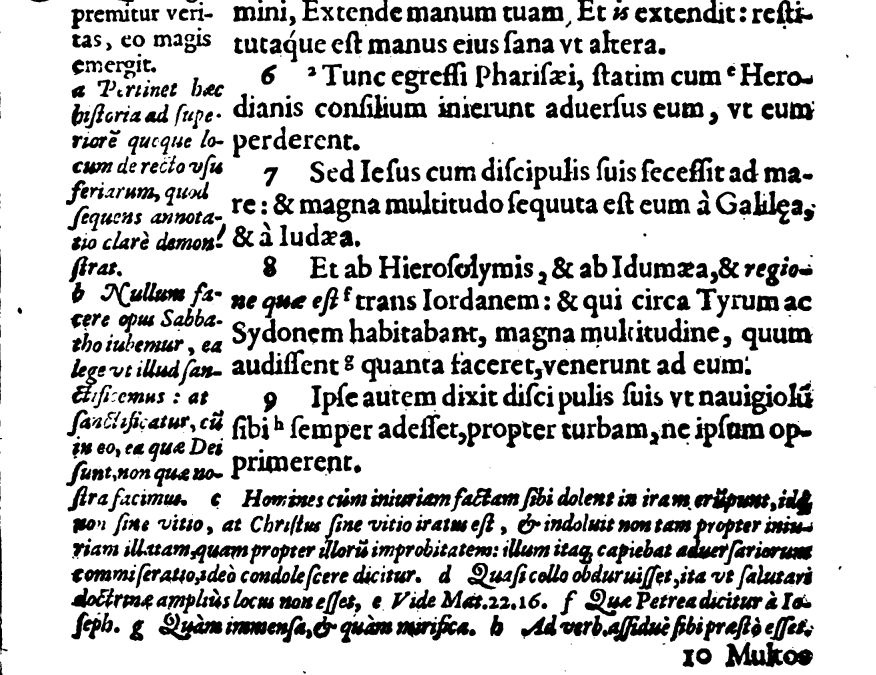
Screenshots taken from the Nouum Testamentum of Théodore de Bèze, (1519-1605) ( Londini : Thomas Vautrollerius, typographus, 1587 )
Accessed from the Post Reformation Digital Library
Red and Green Vocab
The words in red and green are found among the 3057 Most Common Words in the Classical Latin texts that we will explore on CentumVerba.com and are essential to your understanding of the texts of Caesar, Vergil and Cicero. The green words appear frequently (at least five times) among Vergil's Aeneid (books I-VI), Caesar de bello Gallico (books I-V) and in Cicero's works - in Catilinam (books I-IV), de lege Manilia (also known as de Imperio Cn. Pompei), and pro Achia. These works constituted the curriculum for Latin over 4 years in American High Schools at the start of the 20th Century. The bulk of my information is taken from The Vocabulary of High School Latin by Gonzalez Lodge. I have added to these 2000 words from varioius other sources to compile my own list of The 3057 Most Common Latin Words.
The black words do not appear frequently in Classical Latin.
The red words are the first occurrences of these words in this author and this word will appear as green the next time you encounter it.
If you are serious about building your vocabulary then you should learn the red words as they occur and you should already know the green ones!
I have provided a FLASHCARD set to help - see below.
How To Read the Interactive Text
To Read the Interactive Text Below Without a Dictionary-
On a Computer: you hover over a word and get all its possible parts of speech; declensions; and conjugations.
On a Tablet: 'Tap' the word to see the definition, and to remove the 'definition box' you simply 'Tap' anywhere to the side.
Red and Green Vocab
The words in red and green are found among the 3057 Most Common Words in the Classical Latin texts that we will explore on CentumVerba.com and are essential to your understanding of the texts of Caesar, Vergil and Cicero. The green words appear frequently (at least five times) among Vergil's Aeneid (books I-VI), Caesar de bello Gallico (books I-V) and in Cicero's works - in Catilinam (books I-IV), de lege Manilia (also known as de Imperio Cn. Pompei), and pro Achia. These works constituted the curriculum for Latin over 4 years in American High Schools at the start of the 20th Century. The bulk of my information is taken from The Vocabulary of High School Latin by Gonzalez Lodge. I have added to these 2000 words from varioius other sources to compile my own list of The 3057 Most Common Latin Words.
The black words do not appear frequently in Classical Latin.
The red words are the first occurrences of these words in this author and this word will appear as green the next time you encounter it.
If you are serious about building your vocabulary then you should learn the red words as they occur and you should already know the green ones!
I have provided a FLASHCARD set to help - see below.
How To Read the Interactive Text
To Read the Interactive Text Below Without a Dictionary-
On a Phone or Tablet: ''TAP' the word to see the definition, and to remove the 'definition box' you simply 'TAP' anywhere to the side.
INTERACTIVE DICTIONARY FREE TEXT
Caput 3
6 Et exeuntes pharisaei statim cum herodianis consilium faciebant adversus eum quomodo eum perderent.
You Need to be at least a Trial Member to Access the Interactive Dictionary
7 Et Iesus cum discipulis suis secessit ad mare. Et multa turba a Galilaea secuta est et a Iudaea
8 et ab Hierosolymis et ab Idumaea et, qui trans Iordanem et circa Tyrum et Sidonem, multitudo magna, audientes, quae faciebat, venerunt ad eum.
9 Et dixit discipulis suis, ut navicula sibi praesto esset propter turbam, ne comprimerent eum.
10 Multos enim sanavit, ita ut irruerent in eum, ut illum tangerent, quotquot habebant plagas.
11 Et spiritus immundi, cum illum videbant, procidebant ei et clamabant dicentes Tu es Filius Dei!
12 Et vehementer comminabatur eis, ne manifestarent illum.
13 Et ascendit in montem et vocat ad se, quos voluit ipse, et venerunt ad eum.
I have prepared online Flashcards at CRAM.com to make learning the vocabulary much easier. I have no financial gain as the app is FREE to use.
I have created a stack of the 15 new words in this passage.
YOU NEED TO SIGN UP AS A TRIAL MEMBER TO ACCESS THE FLASHCARDS
Here is the link to the FLASHCARDS
USING THE FLASHCARD APP:
To make the most of the online Flashcards use the "Click or use spacebar to begin" and the Latin word should appear. (The 'Shuffle' button will take the cards out of alphabetical order.) Type 'H' to get the conjugation / declension of the word if you want to see it. 'H' takes tyou back to the word. Click 'See Answer' or use the Spacebar to see the English.
If you were correct or close enough then select "I was right" or else "I was wrong". After you have completed the set it will start again but it will only display the ones you got wrong.
Continue through this process to learn all the words. I hope this is helpful!
Recent Comments