
venio - I come, approach
The Latin verb venio (venire, veni, ventum) belongs to the fourth conjugation and primarily means ‘to come’ or ‘to arrive.’ However, its usage in Vulgate Latin, the Latin translation of the Bible by St. Jerome, carries several nuanced meanings that extend beyond simple movement.
Core Meaning and Variations
In classical Latin, venio is often used to describe physical arrival at a location. However, in the Vulgate, it frequently conveys spiritual or metaphorical arrival, such as coming into grace, judgment, or revelation. For example, in Matthew 11:28, ‘Venite ad me, omnes qui laboratis et onerati estis, et ego reficiam vos,’ (Come to me, all who labor and are burdened, and I will refresh you), the verb venite (imperative plural) signifies an invitation to spiritual renewal rather than mere physical movement.
Theological and Symbolic Uses
The verb venio is often used in eschatological contexts, referring to the coming of Christ or divine intervention. In John 1:11, ‘In propria venit, et sui eum non receperunt,’ (He came to his own, and his own did not receive him), venit expresses Christ’s arrival in the world, emphasizing rejection rather than simple movement.
Additionally, venio appears in expressions of divine will, such as ‘Fiat voluntas tua, sicut in caelo et in terra,’ where the implied meaning is ‘Let your will come to pass.’ This demonstrates how venio can signify fulfillment rather than mere arrival.
Conclusion
In Vulgate Latin, venio transcends its basic meaning of movement, often carrying theological, metaphorical, and eschatological significance. Its usage reflects the broader spiritual themes of arrival, fulfillment, and divine presence, making it a key verb in biblical Latin.
The images for these posts on Mark's gospel
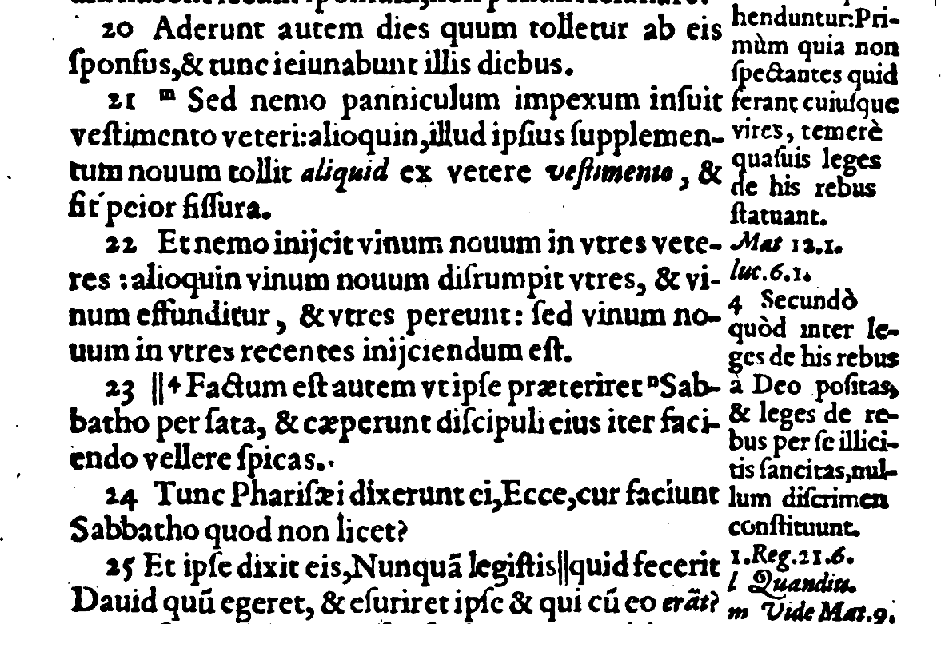
Screenshots taken from the Nouum Testamentum of Théodore de Bèze, (1519-1605) ( Londini : Thomas Vautrollerius, typographus, 1587 )
Accessed from the Post Reformation Digital Library
Red and Green Vocab
The words in red and green are found among the 3057 Most Common Words in the Classical Latin texts that we will explore on CentumVerba.com and are essential to your understanding of the texts of Caesar, Vergil and Cicero. The green words appear frequently (at least five times) among Vergil's Aeneid (books I-VI), Caesar de bello Gallico (books I-V) and in Cicero's works - in Catilinam (books I-IV), de lege Manilia (also known as de Imperio Cn. Pompei), and pro Achia. These works constituted the curriculum for Latin over 4 years in American High Schools at the start of the 20th Century. The bulk of my information is taken from The Vocabulary of High School Latin by Gonzalez Lodge. I have added to these 2000 words from varioius other sources to compile my own list of The 3057 Most Common Latin Words.
The black words do not appear frequently in Classical Latin.
The red words are the first occurrences of these words in this author and this word will appear as green the next time you encounter it.
If you are serious about building your vocabulary then you should learn the red words as they occur and you should already know the green ones!
I have provided a FLASHCARD set to help - see below.
How To Read the Interactive Text
To Read the Interactive Text Below Without a Dictionary-
On a Computer: you hover over a word and get all its possible parts of speech; declensions; and conjugations.
On a Tablet: 'Tap' the word to see the definition, and to remove the 'definition box' you simply 'Tap' anywhere to the side.
Red and Green Vocab
The words in red and green are found among the 3057 Most Common Words in the Classical Latin texts that we will explore on CentumVerba.com and are essential to your understanding of the texts of Caesar, Vergil and Cicero. The green words appear frequently (at least five times) among Vergil's Aeneid (books I-VI), Caesar de bello Gallico (books I-V) and in Cicero's works - in Catilinam (books I-IV), de lege Manilia (also known as de Imperio Cn. Pompei), and pro Achia. These works constituted the curriculum for Latin over 4 years in American High Schools at the start of the 20th Century. The bulk of my information is taken from The Vocabulary of High School Latin by Gonzalez Lodge. I have added to these 2000 words from varioius other sources to compile my own list of The 3057 Most Common Latin Words.
The black words do not appear frequently in Classical Latin.
The red words are the first occurrences of these words in this author and this word will appear as green the next time you encounter it.
If you are serious about building your vocabulary then you should learn the red words as they occur and you should already know the green ones!
I have provided a FLASHCARD set to help - see below.
How To Read the Interactive Text
To Read the Interactive Text Below Without a Dictionary-
On a Phone or Tablet: ''TAP' the word to see the definition, and to remove the 'definition box' you simply 'TAP' anywhere to the side.
INTERACTIVE DICTIONARY FREE TEXT
Caput 2
20 venient autem dies, cum auferetur ab eis sponsus, et tunc ieiunabunt in illa die.
You Need to be at least a Trial Member to Access the Interactive Dictionary
21 Nemo assumentum panni rudis assuit vestimento veteri alioquin supplementum aufert aliquid ab eo, novum a veteri, et peior scissura fit.
22 Et nemo mittit vinum novellum in utres veteres, alioquin dirumpet vinum utres et vinum perit et utres sed vinum novum in utres novos.
23 Et factum est, cum ipse sabbatis ambularet per sata, discipuli eius coeperunt praegredi vellentes spicas.
24 Pharisaei autem dicebant ei Ecce, quid faciunt sabbatis, quod non licet?
25 Et ait illis Numquam legistis quid fecerit David, quando necessitatem habuit et esuriit ipse et qui cum eo erant?
I have prepared online Flashcards at CRAM.com to make learning the vocabulary much easier. I have no financial gain as the app is FREE to use.
I have created a stack of the 14 new words in this passage.
YOU NEED TO SIGN UP AS A TRIAL MEMBER TO ACCESS THE FLASHCARDS
Here is the link to the FLASHCARDS
USING THE FLASHCARD APP:
To make the most of the online Flashcards use the "Click or use spacebar to begin" and the Latin word should appear. (The 'Shuffle' button will take the cards out of alphabetical order.) Type 'H' to get the conjugation / declension of the word if you want to see it. 'H' takes tyou back to the word. Click 'See Answer' or use the Spacebar to see the English.
If you were correct or close enough then select "I was right" or else "I was wrong". After you have completed the set it will start again but it will only display the ones you got wrong.
Continue through this process to learn all the words. I hope this is helpful!
Recent Comments