
aut - a deceptively simple conjunction
The Latin conjunction aut—meaning ‘or’ in a disjunctive sense—is deceptively simple but holds significant syntactic and stylistic importance across Latin literature. Distinguished from vel, which often suggests a softer alternative or possibility, aut implies clear-cut exclusivity: one option or the other, not both. This sharpness allows writers to delineate ideas, weigh choices, and build tension with linguistic precision.
In philosophical texts, aut serves to sharpen dichotomies. Cicero employs aut to construct structured argumentation, as in aut virtus aut vitium, pressing the reader to confront binary moral evaluations. His rhetoric benefits from the clarity aut brings, reinforcing that intermediate stances are illusory or inadequate.
Poets too make strategic use of aut. Virgil in the Aeneid uses aut to frame emotional or existential dilemmas, especially in speeches or moments of decision. When a character faces internal division—whether to fight aut flee, love aut abandon—aut becomes a vessel for dramatic conflict. It maintains poetic economy while serving psychological realism.
In comedy, aut often underpins punchlines or verbal misunderstandings. Plautus may set up humorous scenarios where characters misconstrue alternatives, and aut structures the misdirection. The stark contrast it introduces reinforces comedic tension and release.
In legal and religious texts, aut frequently functions with binding force. Roman legal formulas incorporate aut to stipulate conditional outcomes: aut solvit aut poenam dat. Similarly, early Christian writers like Tertullian wield aut in apologetic discourse to define orthodoxy against heresy. One believes correctly aut deviates perilously—ambiguity is not permitted.
Beyond content, aut shapes rhythm and cadence. Its monosyllabic weight punctuates clauses, allowing prose and verse to maintain balance or deliberately unsettle. Latin stylists exploit this for effect: drawing attention, signaling transition, or provoking judgment.
Throughout Latin literature, aut stands as a tool of decision, division, and expression. Though small, its force reverberates through the logic, emotion, and artistry of the language.
The images for these posts on Mark's gospel
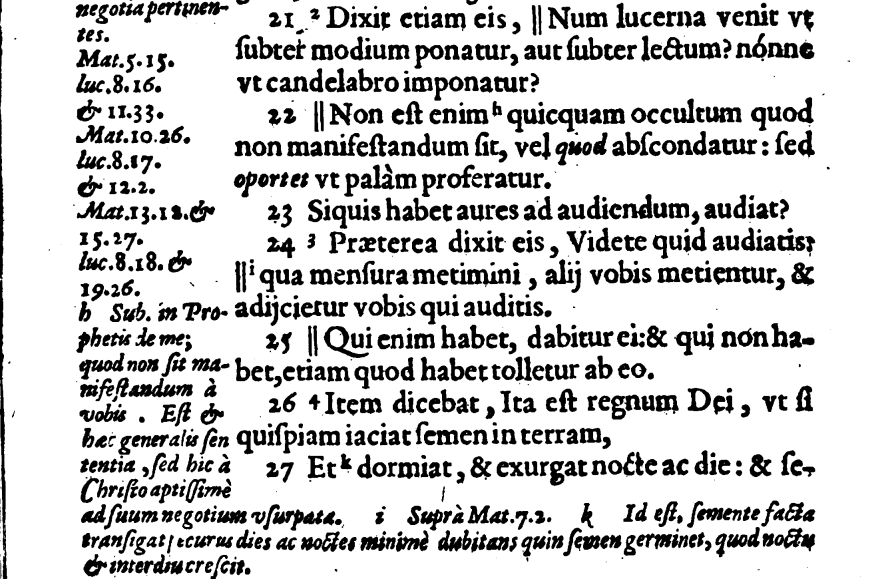
Screenshots taken from the Nouum Testamentum of Théodore de Bèze, (1519-1605) ( Londini : Thomas Vautrollerius, typographus, 1587 )
Accessed from the Post Reformation Digital Library
Red and Green Vocab
The words in red and green are found among the 3057 Most Common Words in the Classical Latin texts that we will explore on CentumVerba.com and are essential to your understanding of the texts of Caesar, Vergil and Cicero. The green words appear frequently (at least five times) among Vergil's Aeneid (books I-VI), Caesar de bello Gallico (books I-V) and in Cicero's works - in Catilinam (books I-IV), de lege Manilia (also known as de Imperio Cn. Pompei), and pro Achia. These works constituted the curriculum for Latin over 4 years in American High Schools at the start of the 20th Century. The bulk of my information is taken from The Vocabulary of High School Latin by Gonzalez Lodge. I have added to these 2000 words from varioius other sources to compile my own list of The 3057 Most Common Latin Words.
The black words do not appear frequently in Classical Latin.
The red words are the first occurrences of these words in this author and this word will appear as green the next time you encounter it.
If you are serious about building your vocabulary then you should learn the red words as they occur and you should already know the green ones!
I have provided a FLASHCARD set to help - see below.
How To Read the Interactive Text
To Read the Interactive Text Below Without a Dictionary-
On a Computer: you hover over a word and get all its possible parts of speech; declensions; and conjugations.
On a Tablet: 'Tap' the word to see the definition, and to remove the 'definition box' you simply 'Tap' anywhere to the side.
Red and Green Vocab
The words in red and green are found among the 3057 Most Common Words in the Classical Latin texts that we will explore on CentumVerba.com and are essential to your understanding of the texts of Caesar, Vergil and Cicero. The green words appear frequently (at least five times) among Vergil's Aeneid (books I-VI), Caesar de bello Gallico (books I-V) and in Cicero's works - in Catilinam (books I-IV), de lege Manilia (also known as de Imperio Cn. Pompei), and pro Achia. These works constituted the curriculum for Latin over 4 years in American High Schools at the start of the 20th Century. The bulk of my information is taken from The Vocabulary of High School Latin by Gonzalez Lodge. I have added to these 2000 words from varioius other sources to compile my own list of The 3057 Most Common Latin Words.
The black words do not appear frequently in Classical Latin.
The red words are the first occurrences of these words in this author and this word will appear as green the next time you encounter it.
If you are serious about building your vocabulary then you should learn the red words as they occur and you should already know the green ones!
I have provided a FLASHCARD set to help - see below.
How To Read the Interactive Text
To Read the Interactive Text Below Without a Dictionary-
On a Phone or Tablet: ''TAP' the word to see the definition, and to remove the 'definition box' you simply 'TAP' anywhere to the side.
INTERACTIVE DICTIONARY FREE TEXT
Caput IV
21 Et dicebat illis Numquid venit lucerna, ut sub modio ponatur aut sub lecto? Nonne ut super candelabrum ponatur?
You Need to be at least a Trial Member to Access the Interactive Dictionary
22 Non enim est aliquid absconditum, nisi ut manifestetur, nec factum est occultum, nisi ut in palam veniat.
23 Si quis habet aures audiendi, audiat.
24 Et dicebat illis Videte quid audiatis. In qua mensura mensi fueritis, remetietur vobis et adicietur vobis.
25 Qui enim habet, dabitur illi et, qui non habet, etiam quod habet, auferetur ab illo.
26 Et dicebat Sic est regnum Dei, quemadmodum si homo iaciat sementem in terram
27 et dormiat et exsurgat nocte ac die, et semen germinet et increscat, dum nescit ille.
INTERACTIVE DICTIONARY FREE TEXT
Caput IV
14 Qui seminat, verbum seminat.
You Need to be at least a Trial Member to Access the Interactive Dictionary
15 Hi autem sunt, qui circa viam, ubi seminatur verbum et cum audierint, confestim venit Satanas et aufert verbum, quod seminatum est in eos.
16 Et hi sunt, qui super petrosa seminantur qui cum audierint verbum, statim cum gaudio accipiunt illud
17 et non habent radicem in se, sed temporales sunt deinde orta tribulatione vel persecutione propter verbum, confestim scandalizantur.
18 Et alii sunt, qui in spinis seminantur hi sunt, qui verbum audierunt,
19 et aerumnae saeculi et deceptio divitiarum et circa reliqua concupiscentiae introeuntes suffocant verbum, et sine fructu efficitur.
20 Et hi sunt, qui super terram bonam seminati sunt qui audiunt verbum et suscipiunt et fructificant unum triginta et unum sexaginta et unum centum.
I have prepared online Flashcards at CRAM.com to make learning the vocabulary much easier. I have no financial gain as the app is FREE to use.
I have created a stack of the 11 new words in this passage.
YOU NEED TO SIGN UP AS A TRIAL MEMBER TO ACCESS THE FLASHCARDS
Here is the link to the FLASHCARDS
USING THE FLASHCARD APP:
To make the most of the online Flashcards use the "Click or use spacebar to begin" and the Latin word should appear. (The 'Shuffle' button will take the cards out of alphabetical order.) Type 'H' to get the conjugation / declension of the word if you want to see it. 'H' takes tyou back to the word. Click 'See Answer' or use the Spacebar to see the English.
If you were correct or close enough then select "I was right" or else "I was wrong". After you have completed the set it will start again but it will only display the ones you got wrong.
Continue through this process to learn all the words. I hope this is helpful!
Recent Comments