
confestim - immediately without delay!
In Latin, confestim is an adverb meaning 'immediately', 'at once', or 'without delay'. It conveys urgency and swift action, and is frequently used in classical prose and poetry to mark decisive moments. The word is formed from the prefix con- (intensifying) and a root related to festinare ('to hasten'), suggesting a reinforced sense of speed or immediacy.
In Caesar’s Commentarii de Bello Gallico, confestim is used to describe rapid military maneuvers. For example, confestim legiones subsequi iussit ('he immediately ordered the legions to follow') shows how the term underscores tactical responsiveness. Caesar’s style relies on such adverbs to convey discipline and efficiency in Roman warfare.
In Cicero’s speeches, confestim often appears in legal or political contexts, emphasizing the need for swift justice or reaction. In Pro Cluentio, Cicero describes a mother rushing to her son’s funeral: confestim exanimata venit, highlighting emotional immediacy and maternal urgency.
Virgil uses confestim in the Aeneid to dramatize sudden shifts in action or emotion. In Book IX, confestim alacres admittier orant ('they eagerly ask to be admitted at once') captures the fervor of Nisus and Euryalus as they volunteer for a dangerous mission. The adverb adds intensity to their bravery and impulsiveness.
Synonyms of confestim include statim, protinus, extemplo, and ilicet, each with subtle differences in tone or usage. Statim is more neutral, while protinus often implies continuity. Confestim tends to carry a sense of deliberate urgency, often in formal or elevated contexts.
In later Latin and ecclesiastical usage, confestim retained its meaning and appeared in historical and theological texts. Though less common in Romance languages, its influence persists in expressions of immediacy and haste.
Overall, confestim is a vivid and forceful adverb that enriches Latin narrative and rhetorical style. Whether describing military orders, emotional reactions, or divine interventions, it signals that something must happen now—without hesitation, without delay.
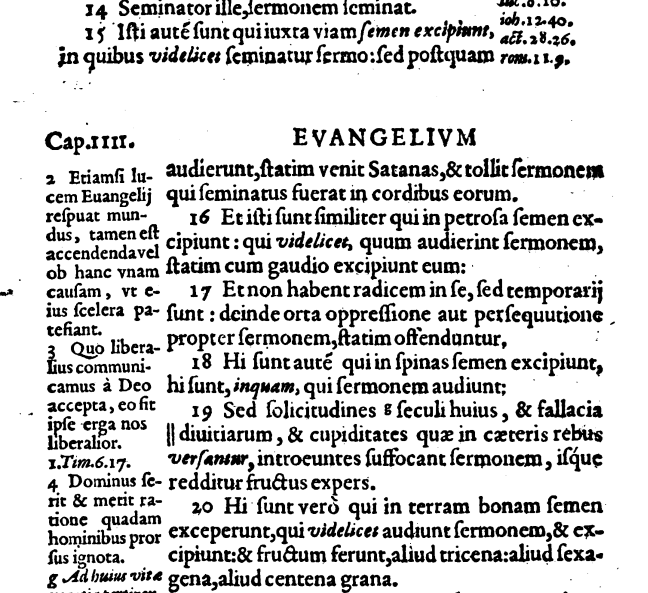
The images for these posts on Mark's gospel
Screenshots taken from the Nouum Testamentum of Théodore de Bèze, (1519-1605) ( Londini : Thomas Vautrollerius, typographus, 1587 )
Accessed from the Post Reformation Digital Library
Red and Green Vocab
The words in red and green are found among the 3057 Most Common Words in the Classical Latin texts that we will explore on CentumVerba.com and are essential to your understanding of the texts of Caesar, Vergil and Cicero. The green words appear frequently (at least five times) among Vergil's Aeneid (books I-VI), Caesar de bello Gallico (books I-V) and in Cicero's works - in Catilinam (books I-IV), de lege Manilia (also known as de Imperio Cn. Pompei), and pro Achia. These works constituted the curriculum for Latin over 4 years in American High Schools at the start of the 20th Century. The bulk of my information is taken from The Vocabulary of High School Latin by Gonzalez Lodge. I have added to these 2000 words from varioius other sources to compile my own list of The 3057 Most Common Latin Words.
The black words do not appear frequently in Classical Latin.
The red words are the first occurrences of these words in this author and this word will appear as green the next time you encounter it.
If you are serious about building your vocabulary then you should learn the red words as they occur and you should already know the green ones!
I have provided a FLASHCARD set to help - see below.
How To Read the Interactive Text
To Read the Interactive Text Below Without a Dictionary-
On a Computer: you hover over a word and get all its possible parts of speech; declensions; and conjugations.
On a Tablet: 'Tap' the word to see the definition, and to remove the 'definition box' you simply 'Tap' anywhere to the side.
Red and Green Vocab
The words in red and green are found among the 3057 Most Common Words in the Classical Latin texts that we will explore on CentumVerba.com and are essential to your understanding of the texts of Caesar, Vergil and Cicero. The green words appear frequently (at least five times) among Vergil's Aeneid (books I-VI), Caesar de bello Gallico (books I-V) and in Cicero's works - in Catilinam (books I-IV), de lege Manilia (also known as de Imperio Cn. Pompei), and pro Achia. These works constituted the curriculum for Latin over 4 years in American High Schools at the start of the 20th Century. The bulk of my information is taken from The Vocabulary of High School Latin by Gonzalez Lodge. I have added to these 2000 words from varioius other sources to compile my own list of The 3057 Most Common Latin Words.
The black words do not appear frequently in Classical Latin.
The red words are the first occurrences of these words in this author and this word will appear as green the next time you encounter it.
If you are serious about building your vocabulary then you should learn the red words as they occur and you should already know the green ones!
I have provided a FLASHCARD set to help - see below.
How To Read the Interactive Text
To Read the Interactive Text Below Without a Dictionary-
On a Phone or Tablet: ''TAP' the word to see the definition, and to remove the 'definition box' you simply 'TAP' anywhere to the side.
INTERACTIVE DICTIONARY FREE TEXT
Caput IV
14 Qui seminat, verbum seminat.
You Need to be at least a Trial Member to Access the Interactive Dictionary
15 Hi autem sunt, qui circa viam, ubi seminatur verbum et cum audierint, confestim venit Satanas et aufert verbum, quod seminatum est in eos.
16 Et hi sunt, qui super petrosa seminantur qui cum audierint verbum, statim cum gaudio accipiunt illud
17 et non habent radicem in se, sed temporales sunt deinde orta tribulatione vel persecutione propter verbum, confestim scandalizantur.
18 Et alii sunt, qui in spinis seminantur hi sunt, qui verbum audierunt,
19 et aerumnae saeculi et deceptio divitiarum et circa reliqua concupiscentiae introeuntes suffocant verbum, et sine fructu efficitur.
20 Et hi sunt, qui super terram bonam seminati sunt qui audiunt verbum et suscipiunt et fructificant unum triginta et unum sexaginta et unum centum.
I have prepared online Flashcards at CRAM.com to make learning the vocabulary much easier. I have no financial gain as the app is FREE to use.
I have created a stack of the 12 new words in this passage.
YOU NEED TO SIGN UP AS A TRIAL MEMBER TO ACCESS THE FLASHCARDS
Here is the link to the FLASHCARDS
USING THE FLASHCARD APP:
To make the most of the online Flashcards use the "Click or use spacebar to begin" and the Latin word should appear. (The 'Shuffle' button will take the cards out of alphabetical order.) Type 'H' to get the conjugation / declension of the word if you want to see it. 'H' takes tyou back to the word. Click 'See Answer' or use the Spacebar to see the English.
If you were correct or close enough then select "I was right" or else "I was wrong". After you have completed the set it will start again but it will only display the ones you got wrong.
Continue through this process to learn all the words. I hope this is helpful!
Recent Comments