
deinde - then, who is next?
In Latin, deinde is an adverb meaning 'then', 'next', or 'afterwards', and it plays a vital role in structuring narrative, argument, and sequence across classical literature. Formed from the preposition de ('from') and the demonstrative inde ('from there'), deinde literally means 'from that point' and is used to indicate temporal or logical progression.
In prose, deinde is a staple of historical and rhetorical writing. Caesar frequently uses it in Commentarii de Bello Gallico to mark the unfolding of military events: primum legiones collocavit, deinde castra munivit—'first he positioned the legions, then he fortified the camp'. This sequencing gives clarity and momentum to his accounts. Cicero, in his speeches and philosophical works, employs deinde to build arguments step by step, often pairing it with primum or postremo to guide the listener through a structured progression.
In poetry, deinde appears in both epic and elegiac contexts. Virgil uses it to transition between scenes or emotional states, as in deinde lacrimas dedit—'then he shed tears'. The adverb helps maintain rhythm and narrative flow, especially in longer passages where temporal shifts must be clear yet elegant.
Deinde also appears in idiomatic expressions and formal constructions. In philosophical texts, it can signal logical consequence: primum virtus, deinde felicitas—'first virtue, then happiness'. In legal and religious contexts, it marks procedural order, such as in rituals or decrees: sacrificium factum est, deinde haruspices consulti sunt—'the sacrifice was made, then the soothsayers were consulted'.
Synonyms include postea, tum, protinus, and extemplo, each with subtle distinctions. Postea often implies a longer delay, while protinus suggests immediacy. Deinde occupies a middle ground—neutral, flexible, and widely applicable.
Its legacy persists in Romance languages and English derivatives. Though deinde itself is not preserved directly, its sense survives in words like 'then', 'next', and 'subsequently'. In Latin texts, deinde is more than a connector—it is a signal of order, causality, and movement, guiding readers through time, thought, and action with clarity and grace.
The images for these posts on Mark's gospel
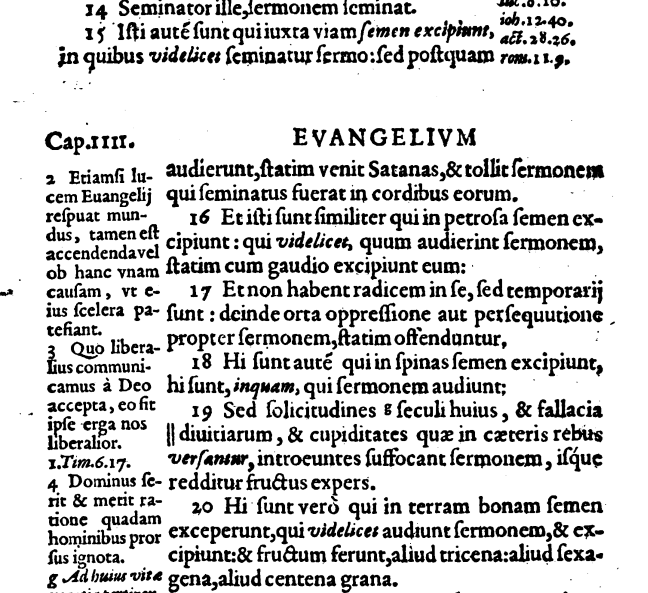
Screenshots taken from the Nouum Testamentum of Théodore de Bèze, (1519-1605) ( Londini : Thomas Vautrollerius, typographus, 1587 )
Accessed from the Post Reformation Digital Library
JUMP To Dictionary Free Interactive Text
Here is a text only version.
EVANGELIUM MARCUM
CAPUT IV
14 qui seminat verbum seminat
15 hii autem sunt qui circa viam ubi seminatur verbum et cum audierint confestim venit Satanas et aufert verbum quod seminatum est in corda eorum
16 et hii sunt similiter qui super petrosa seminantur qui cum audierint verbum statim cum gaudio accipiunt illud
17 et non habent radicem in se sed temporales sunt deinde orta tribulatione et persecutione propter verbum confestim scandalizantur
18 et alii sunt qui in spinis seminantur hii sunt qui verbum audiunt
19 et aerumnae saeculi et deceptio divitiarum et circa reliqua concupiscentiae introeuntes suffocant verbum et sine fructu efficitur
20 et hii sunt qui super terram bonam seminati sunt qui audiunt verbum et suscipiunt et fructificant unum triginta et unum sexaginta et unum centum
How To Read the Interactive Text Without a Dictionary
On a Computer:
Hover over a word to get all its possible parts of speech, declensions, or conjugations.
On a Tablet:
'TAP' the word to see the definition, and to remove the 'definition box' you simply 'TAP' anywhere to the side.
How To Read the Interactive Text
'Tap' the word to see the definition and to remove the 'definition box' you simply 'tap' antwhere to the side.
EVANGELIUM MARCUM
CAPUT IV
14 Qui seminat, verbum seminat.
You Need to be at least a Trial Member to Access the Interactive Dictionary
15 Hi autem sunt, qui circa viam, ubi seminatur verbum et cum audierint, confestim venit Satanas et aufert verbum, quod seminatum est in eos.
16 Et hi sunt, qui super petrosa seminantur qui cum audierint verbum, statim cum gaudio accipiunt illud
17 et non habent radicem in se, sed temporales sunt deinde orta tribulatione vel persecutione propter verbum, confestim scandalizantur.
18 Et alii sunt, qui in spinis seminantur hi sunt, qui verbum audierunt,
19 et aerumnae saeculi et deceptio divitiarum et circa reliqua concupiscentiae introeuntes suffocant verbum, et sine fructu efficitur.
20 Et hi sunt, qui super terram bonam seminati sunt qui audiunt verbum et suscipiunt et fructificant unum triginta et unum sexaginta et unum centum.
Recent Comments