
radix - the root of all things
In Latin, radix means 'root' and serves both literal and metaphorical functions across classical literature. A third-declension feminine noun, its forms include radix, radicis, radici, radicem, radice in the singular and radices, radicum, radicibus, radices, radicibus in the plural. The word derives from Proto-Indo-European wréh₂ds, meaning 'root', and is cognate with Sanskrit vṛ́dhas and Old English wyrt, showing its deep linguistic ancestry.
In Roman poetry and prose, radix often refers to the physical root of a plant or tree. Virgil, in the Aeneid, uses radicibus to describe trees torn from the earth, symbolizing upheaval and divine wrath. Ovid’s Metamorphoses includes vivid imagery of magical herbs taking root—radicibus actis—to evoke transformation and enchantment.
Beyond botany, radix carries metaphorical weight. Cicero employs it in philosophical contexts to describe foundational principles, as in radices virtutis, the 'roots of virtue'. In Pro Caelio, he speaks of moral corruption taking hold through radicibus vitiorum, suggesting that vice grows from deep-seated causes. The term thus becomes a symbol of origin, essence, and underlying truth.
In military and civic texts, radix can denote the base or source of power. Caesar uses it to describe strategic positions at the foot of mountains—sub radicibus montis—emphasizing terrain and tactical advantage. The word also appears in discussions of genealogy and social structure, where radix signifies ancestral lineage or the root of a family tree.
The influence of radix extends into modern languages. English derivatives include 'radical', 'eradicate', and 'radish', all reflecting the idea of roots—whether botanical, ideological, or structural. In mathematics, radix refers to the base of a numeral system, such as base ten or base two, preserving the metaphor of foundational structure.
Ultimately, radix in Latin literature is more than a botanical term. It is a conceptual anchor, used to explore themes of origin, growth, and transformation. Whether describing nature, morality, or identity, radix roots the Roman worldview in a language of depth and connection.
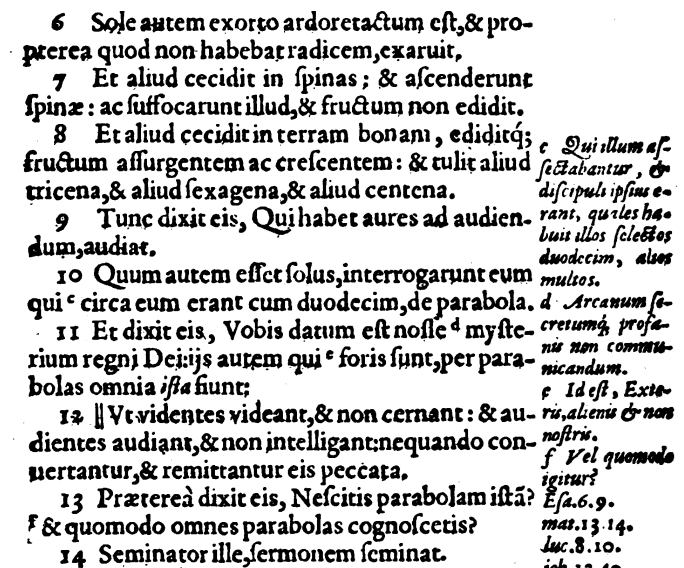
The images for these posts on Mark's gospel
Screenshots taken from the Nouum Testamentum of Théodore de Bèze, (1519-1605) ( Londini : Thomas Vautrollerius, typographus, 1587 )
Accessed from the Post Reformation Digital Library
JUMP To Dictionary Free Interactive Text
Here is a text only version.
EVANGELIUM MARCUM
CAPUT IV
6 et quando exortus est sol exaestuavit et eo quod non haberet radicem exaruit
7 et aliud cecidit in spinas et ascenderunt spinae et offocaverunt illud et fructum non dedit
8 et aliud cecidit in terram bonam et dabat fructum ascendentem et crescentem et adferebat unum triginta et unum sexaginta et unum centum
9 et dicebat qui habet aures audiendi audiat
10 et cum esset singularis interrogaverunt eum hii qui cum eo erant cum duodecim parabolas
11 et dicebat eis vobis datum est mysterium regni Dei illis autem qui foris sunt in parabolis omnia fiunt
12 ut videntes videant et non videant et audientes audiant et non intellegant nequando convertantur et dimittantur eis peccata
13 et ait illis nescitis parabolam hanc et quomodo omnes parabolas cognoscetis
radix - the root of all things
In Latin, radix means 'root' and serves both literal and metaphorical functions across classical literature. A third-declension feminine noun, its forms include radix, radicis, radici, radicem, radice in the singular and radices, radicum, radicibus, radices, radicibus in the plural. The word derives from Proto-Indo-European wréh₂ds, meaning 'root', and is cognate with Sanskrit vṛ́dhas and Old English wyrt, showing its deep linguistic ancestry.
In Roman poetry and prose, radix often refers to the physical root of a plant or tree. Virgil, in the Aeneid, uses radicibus to describe trees torn from the earth, symbolizing upheaval and divine wrath. Ovid’s Metamorphoses includes vivid imagery of magical herbs taking root—radicibus actis—to evoke transformation and enchantment.
Beyond botany, radix carries metaphorical weight. Cicero employs it in philosophical contexts to describe foundational principles, as in radices virtutis, the 'roots of virtue'. In Pro Caelio, he speaks of moral corruption taking hold through radicibus vitiorum, suggesting that vice grows from deep-seated causes. The term thus becomes a symbol of origin, essence, and underlying truth.
In military and civic texts, radix can denote the base or source of power. Caesar uses it to describe strategic positions at the foot of mountains—sub radicibus montis—emphasizing terrain and tactical advantage. The word also appears in discussions of genealogy and social structure, where radix signifies ancestral lineage or the root of a family tree.
The influence of radix extends into modern languages. English derivatives include 'radical', 'eradicate', and 'radish', all reflecting the idea of roots—whether botanical, ideological, or structural. In mathematics, radix refers to the base of a numeral system, such as base ten or base two, preserving the metaphor of foundational structure.
Ultimately, radix in Latin literature is more than a botanical term. It is a conceptual anchor, used to explore themes of origin, growth, and transformation. Whether describing nature, morality, or identity, radix roots the Roman worldview in a language of depth and connection
The images for these posts on Mark's gospel
Screenshots taken from the Nouum Testamentum of Théodore de Bèze, (1519-1605) ( Londini : Thomas Vautrollerius, typographus, 1587 )
Accessed from the Post Reformation Digital Library
JUMP To Dictionary Free Interactive Text
Here is a text only version.
EVANGELIUM MARCUM
CAPUT IV
6 et quando exortus est sol exaestuavit et eo quod non haberet radicem exaruit
7 et aliud cecidit in spinas et ascenderunt spinae et offocaverunt illud et fructum non dedit
8 et aliud cecidit in terram bonam et dabat fructum ascendentem et crescentem et adferebat unum triginta et unum sexaginta et unum centum
9 et dicebat qui habet aures audiendi audiat
10 et cum esset singularis interrogaverunt eum hii qui cum eo erant cum duodecim parabolas
11 et dicebat eis vobis datum est mysterium regni Dei illis autem qui foris sunt in parabolis omnia fiunt
12 ut videntes videant et non videant et audientes audiant et non intellegant nequando convertantur et dimittantur eis peccata
13 et ait illis nescitis parabolam hanc et quomodo omnes parabolas cognoscetis
How To Read the Interactive Text Without a Dictionary
On a Computer:
Hover over a word to get all its possible parts of speech, declensions, or conjugations.
On a Tablet:
'TAP' the word to see the definition, and to remove the 'definition box' you simply 'TAP' anywhere to the side.
How To Read the Interactive Text
'Tap' the word to see the definition and to remove the 'definition box' you simply 'tap' antwhere to the side.
EVANGELIUM MARCUM
CAPUT IV
6 et quando exortus est sol, exaestuavit et, eo quod non haberet radicem, exaruit.
You Need to be at least a Trial Member to Access the Interactive Dictionary
7 Et aliud cecidit in spinas, et ascenderunt spinae et suffocaverunt illud, et fructum non dedit.
8 Et alia ceciderunt in terram bonam et dabant fructum ascendebant et crescebant et afferebant unum triginta et unum sexaginta et unum centum.
9 Et dicebat Qui habet aures audiendi, audiat.
10 Et cum esset singularis, interrogaverunt eum hi, qui circa eum erant cum Duodecim, parabolas.
11 Et dicebat eis Vobis datum est mysterium regni Dei illis autem, qui foris sunt, in parabolis omnia fiunt,
12 ut videntes videant et non videant, et audientes audiant et non intellegant, ne quando convertantur, et dimittatur eis.
13 Et ait illis Nescitis parabolam hanc, et quomodo omnes parabolas cognoscetis?
Recent Comments