
pono - put it in place
The Latin verb pono—meaning ‘to place,’ ‘put,’ ‘lay,’ or ‘establish’—holds exceptional utility and nuance in the text of the Vulgate. Deriving from a foundational semantic field of physical placement, pono stretches well beyond literal spatial arrangements and into the theological, moral, and rhetorical terrain of Jerome’s translation.
In straightforward narrative contexts, pono frequently describes physical positioning. Christ is described as positus in praesepio—laid in a manger—capturing not only his physical location but subtly underscoring humility and divine condescension. The verb’s simplicity becomes a tool for theological emphasis. Likewise, stones may be positi super altare in sacrificial scenes, signaling consecration and order, rather than mere construction.
Yet the true richness of pono emerges when its figurative layers are activated. Consider ponere in corde—to place in the heart. This usage, echoing Hebraic idiom, implies deliberate internalisation. When Mary posuit omnia verba haec conferens in corde suo, the verb does more than narrate memory; it conveys contemplation, cherishing, and the sacred act of interior witness. Similarly, ponere peccatum can denote an attribution of sin or its acceptance, tethering moral weight to linguistic precision.
Legal and covenantal language in the Vulgate often relies on pono to convey the establishment of divine law. God ponit testamentum suum with Noah—a placing of promise, but also a framing of cosmic structure. Such phrasing elevates pono to an architectural metaphor of divine-human relations.
Poignantly, in soteriological passages, pono encodes voluntary sacrifice. Christ proclaims animam suam ponit pro ovibus, revealing a depth to the verb that transcends corporeality. This is not mere placement but self-giving. In such verses, pono operates as a hinge between narrative event and theological revelation.
Throughout the Vulgate, pono bridges visible action and invisible intent. Jerome’s lexical choices—precise and inflected by biblical Hebrew and Greek—render pono an instrument of both clarity and mystery. It is used not only to situate objects and persons but to articulate spiritual transactions, choices, and truths that animate the sacred text.
The images for these posts on Mark's gospel
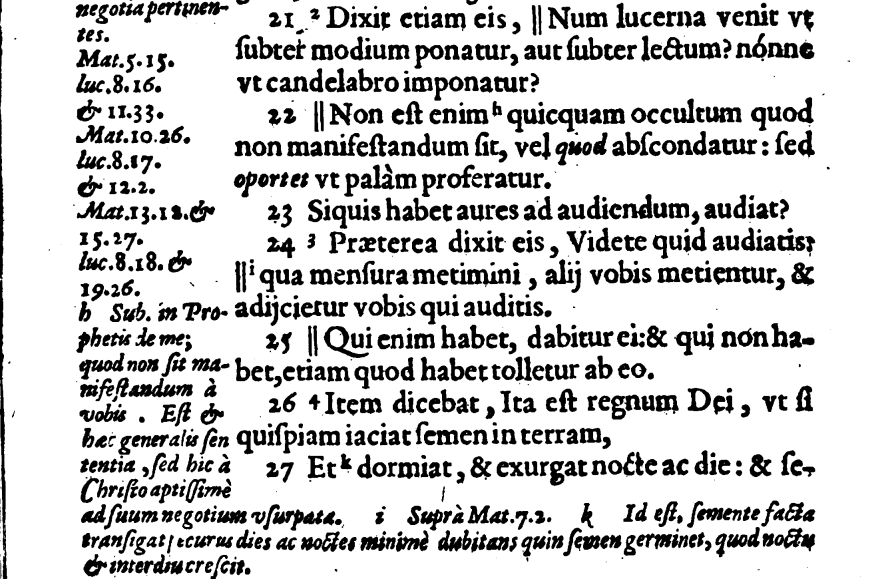
Screenshots taken from the Nouum Testamentum of Théodore de Bèze, (1519-1605) ( Londini : Thomas Vautrollerius, typographus, 1587 )
Accessed from the Post Reformation Digital Library
JUMP To Dictionary Free Interactive Text
Here is a text only version.
EVANGELIUM MARCUM
CAPUT IV
21 et dicebat illis numquid venit lucerna ut sub modio ponatur aut sub lecto nonne ut super candelabrum ponatur
22 non enim est aliquid absconditum quod non manifestetur nec factum est occultum sed ut in palam veniat
23 si quis habet aures audiendi audiat
24 et dicebat illis videte quid audiatis in qua mensura mensi fueritis remetietur vobis et adicietur vobis
25 qui enim habet dabitur illi et qui non habet etiam quod habet auferetur ab illo
26 et dicebat sic est regnum Dei quemadmodum si homo iaciat sementem in terram
27 et dormiat et exsurgat nocte ac die et semen germinet et increscat dum nescit ille
How To Read the Interactive Text Without a Dictionary
On a Computer:
Hover over a word to get all its possible parts of speech, declensions, or conjugations.
On a Tablet:
'TAP' the word to see the definition, and to remove the 'definition box' you simply 'TAP' anywhere to the side.
How To Read the Interactive Text
'Tap' the word to see the definition and to remove the 'definition box' you simply 'tap' antwhere to the side.
EVANGELIUM MARCUM
CAPUT IV
21 Et dicebat illis Numquid venit lucerna, ut sub modio ponatur aut sub lecto? Nonne ut super candelabrum ponatur?
You Need to be at least a Trial Member to Access the Interactive Dictionary
22 Non enim est aliquid absconditum, nisi ut manifestetur, nec factum est occultum, nisi ut in palam veniat.
23 Si quis habet aures audiendi, audiat.
24 Et dicebat illis Videte quid audiatis. In qua mensura mensi fueritis, remetietur vobis et adicietur vobis.
25 Qui enim habet, dabitur illi et, qui non habet, etiam quod habet, auferetur ab illo.
26 Et dicebat Sic est regnum Dei, quemadmodum si homo iaciat sementem in terram
27 et dormiat et exsurgat nocte ac die, et semen germinet et increscat, dum nescit ille.
Recent Comments