
coniunx - to have and to hold from this day forward
The Latin noun coniunx (also spelt coniux) denotes ‘spouse’, encompassing both ‘husband’ and ‘wife’. It derives from the verb coniungo, meaning ‘to join together’, and thus implies a bond formed through union—legal, emotional, or divine. In Latin literature, coniunx is not merely a social designation but a term rich in nuance, often used to explore themes of loyalty, separation, and identity.
In epic poetry, coniunx frequently appears in moments of emotional intensity. Virgil’s Aeneid uses the term to describe Creusa, Aeneas’ wife, whose sudden disappearance during Troy’s fall marks a rupture in both family and destiny. Her final appearance as a shade, still calling herself coniunx, emphasises the enduring nature of the bond despite death. Dido, too, refers to herself as coniunx in relation to Aeneas, though their union lacks formal sanction. Her use of the term reflects her belief in a spiritual and emotional marriage, heightening the tragedy of abandonment.
In Ovid’s Metamorphoses, coniunx is often employed to underscore sacrifice and transformation. Alcestis, who offers her life for her husband, embodies the ideal of coniunx as one whose identity is inseparable from devotion. The word also appears in tales of betrayal, where its use becomes ironic—highlighting the contrast between the ideal and the real.
Elegiac poets such as Propertius and Tibullus use coniunx aspirationally, imagining their beloveds as future spouses. This usage reflects both desire and frustration, as the poets navigate between romantic longing and societal constraints. The term becomes a projection of emotional fulfilment, often unattained.
In Roman comedy, coniunx serves a different function. Plautus and Terence use it to depict domestic tension, with wives portrayed as shrewd or domineering. Here, coniunx is a source of humour and conflict, revealing the everyday dynamics of Roman households.
Throughout Latin literature, coniunx is a word of depth and complexity. Whether in epic, elegy, or comedy, it captures the multifaceted nature of human relationships—binding characters in love, duty, and fate.
Today's Artwork:
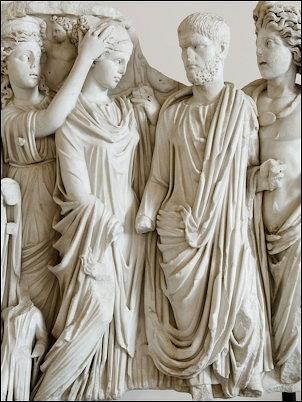
Image: Scene of dextrarum junctio, the ritual joining of hands of husband of wife during the wedding ceremony, with the Genius Populi Romani standing behind the man, and Venus Felix crowning the woman. Detail from the front panel of a sarcophage.
Museo Archeologico Nazionale di Napoli
Source: Europe facts and details
Here is a text only version. (See below for an interactive version)
“Huic coniunx Sychaeus erat, ditissimus agri
Phoenicum, et magno miserae dilectus amore,
cui pater intactam dederat, primisque iugarat
ominibus. Sed regna Tyri germanus habebat
Pygmalion, scelere ante alios immanior omnes.
Quos inter medius venit furor. Ille Sychaeum
impius ante aras, atque auri caecus amore,
clam ferro incautum superat, securus amorum
germanae; factumque diu celavit, et aegram,
multa malus simulans, vana spe lusit amantem.
Ipsa sed in somnis inhumati venit imago
coniugis, ora modis attollens pallida miris,
crudeles aras traiectaque pectora ferro
nudavit, caecumque domus scelus omne retexit.
Tum celerare fugam patriaque excedere suadet,
auxiliumque viae veteres tellure recludit
thesauros, ignotum argenti pondus et auri.
Need Help Understanding the Latin?
You might find it helpful to start with the Side-by-Side Version which allows you to see my own very literal translation of the text which is almost a word-for-word translation - in an attempt to make it easier to understand the Latin!
Finally come back to this page - Classical Text and you should be able to better understand and competently read the original Latin text.
Vocabulary Version
I have prepared a Vocabulary Version of the passage (link at bottom of the page) which highlights the 3057 Most Common Words in the texts of Vergil, Caesar and Cicero that we will explore on CentumVerba.com
If you are serious about building your vocabulary, the FLASHCARD set should help you learn them.
How To Read the Interactive Text
To Read the Interactive Text Below Without a Dictionary-
On a Computer: you hover over a word and get all the possible parts of speech; declensions; and conjugations of every word.
Need Help Understanding the Latin?
You might find it helpful to start with the Side-by-Side Version which allows you to see my own very literal translation of the text which is almost a word-for-word translation - in an attempt to make it easier to understand the Latin!
Finally come back to this page - Classical Text and you should be able to better understand and competently read the original Latin text.
Vocabulary Version
I have prepared a Vocabulary Version of the passage (link at bottom of the page) which highlights the 3057 Most Common Words in the texts of Vergil, Caesar and Cicero that we will explore on CentumVerba.com
If you are serious about building your vocabulary, the FLASHCARD set should help you learn them.
How To Read the Interactive Text
To Read the Interactive Text Below Without a Dictionary-
On a Phone or Tablet: don't 'hover' -'tap' the word. To remove the 'definition box' you 'tap' to the side of the text box.
INTERACTIVE DICTIONARY FREE TEXT
“Huic coniunx Sychaeus erat, ditissimus agri Phoenicum,
You Need to be a Member to Access the Interactive Dictionary
et magno miserae dilectus amore, cui pater intactam dederat, primisque iugarat ominibus.
Sed regna Tyri germanus habebat Pygmalion, scelere ante alios immanior omnes. Quos inter medius venit furor.
Ille Sychaeum impius ante aras, atque auri caecus amore, clam ferro incautum superat, securus amorum germanae; factumque diu celavit, et aegram, multa malus simulans, vana spe lusit amantem.
Ipsa sed in somnis inhumati venit imago coniugis, ora modis attollens pallida miris, crudeles aras traiectaque pectora ferro nudavit, caecumque domus scelus omne retexit.
Tum celerare fugam patriaque excedere suadet, auxiliumque viae veteres tellure recludit thesauros, ignotum argenti pondus et auri.
Recent Comments