
fuga - escape and flee to exile!
The Latin noun fuga (feminine, first declension) means ‘flight’, ‘escape’, or ‘exile’, and is used in classical Latin literature to convey both literal movement away from danger and metaphorical withdrawal from situations, obligations, or emotions. Its semantic range allows it to appear in epic, lyric, elegiac, and philosophical contexts, often with distinct tonal and thematic implications.
In Virgil’s Aeneid, fuga frequently denotes physical flight from war, disaster, or divine wrath. The Trojans’ fuga from Troy is not merely a retreat but the beginning of a divinely ordained journey. The word is often associated with chaos and loss, especially in scenes of battle or destruction. Yet fuga also marks transitions—moments when characters are forced to abandon one world in pursuit of another.
Ovid uses fuga in his elegiac poetry to express emotional and romantic escape. In the Amores and Heroides, lovers flee from rejection, obligation, or even themselves. Fuga becomes a metaphor for instability in relationships, often dramatized through sudden departures or imagined absences. In the Metamorphoses, fuga is central to many myths, especially those involving pursuit and transformation, such as Daphne’s flight from Apollo. Here, fuga is both a narrative device and a symbol of resistance.
In Horace’s lyric poetry, fuga may refer to philosophical withdrawal or avoidance of public life. The poet sometimes praises fuga from ambition or political entanglement, aligning it with Epicurean ideals. This usage reflects a cultivated detachment, where fuga is not cowardice but wisdom.
Cicero uses fuga in legal and rhetorical contexts to describe literal escape from justice or metaphorical evasion of duty. In his speeches, fuga often carries a negative connotation, associated with disgrace or fear. Philosophically, however, he may refer to fuga from pain or vice, aligning with Stoic or Academic ideals.
In historical prose, fuga marks turning points in battles or political upheavals. Livy and Tacitus use it to describe routs, betrayals, and strategic retreats, often with moral or symbolic undertones.
Thus, fuga in classical Latin literature is a multifaceted term, capable of expressing physical movement, emotional rupture, and philosophical choice, shaped by genre and authorial perspective.
Today's Artwork:
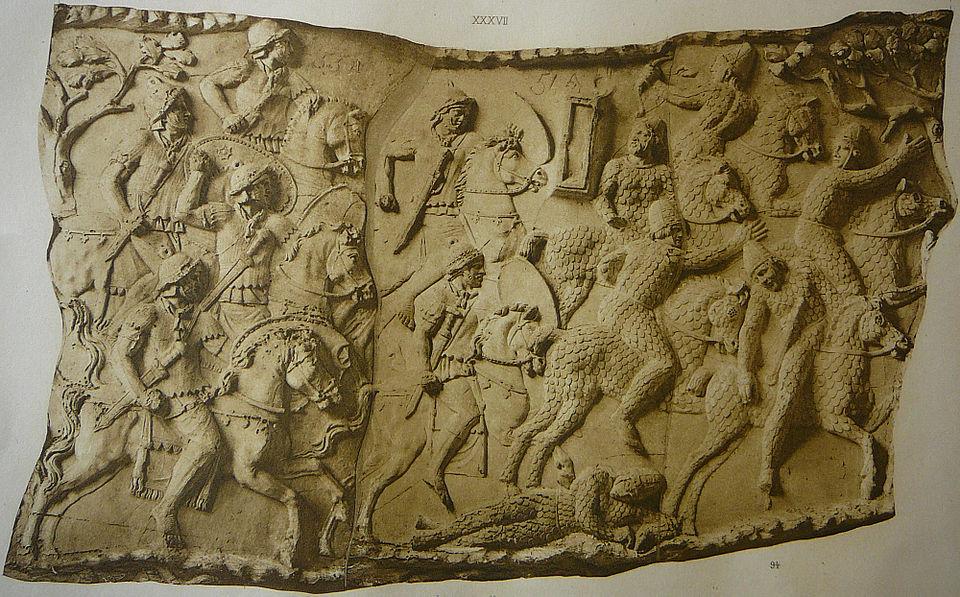
Image: Panel from Trajan's Column, Rome
Routed Sarmatian cataphracts (right), allied to the Dacian king Decebalus, flee from charging Roman alares (auxiliary cavalrymen), during the Dacian Wars (AD 101–6).
Source: https://commons.wikimedia.org/
Here is a text only version. (See below for an interactive version)
His commota fugam Dido sociosque parabat:
conveniunt, quibus aut odium crudele tyranni
aut metus acer erat; navis, quae forte paratae,
corripiunt, onerantque auro: portantur avari
Pygmalionis opes pelago; dux femina facti.
Devenere locos, ubi nunc ingentia cernis
moenia surgentemque novae Karthaginis arcem,
mercatique solum, facti de nomine Byrsam,
taurino quantum possent circumdare tergo.
Sed vos qui tandem, quibus aut venistis ab oris,
quove tenetis iter? “Quaerenti talibus ille
suspirans, imoque trahens a pectore vocem:
“O dea, si prima repetens ab origine pergam,
et vacet annalis nostrorum audire laborum,
ante diem clauso componat Vesper Olympo.
Nos Troia antiqua, si vestras forte per auris
Troiae nomen iit, diversa per aequora vectos
forte sua Libycis tempestas adpulit oris.
Need Help Understanding the Latin?
You might find it helpful to start with the Side-by-Side Version which allows you to see my own very literal translation of the text which is almost a word-for-word translation - in an attempt to make it easier to understand the Latin!
Finally come back to this page - Classical Text and you should be able to better understand and competently read the original Latin text.
Vocabulary Version
I have prepared a Vocabulary Version of the passage (link at bottom of the page) which highlights the 3057 Most Common Words in the texts of Vergil, Caesar and Cicero that we will explore on CentumVerba.com
If you are serious about building your vocabulary, the FLASHCARD set should help you learn them.
How To Read the Interactive Text
To Read the Interactive Text Below Without a Dictionary-
On a Computer: you hover over a word and get all the possible parts of speech; declensions; and conjugations of every word.
Need Help Understanding the Latin?
You might find it helpful to start with the Side-by-Side Version which allows you to see my own very literal translation of the text which is almost a word-for-word translation - in an attempt to make it easier to understand the Latin!
Finally come back to this page - Classical Text and you should be able to better understand and competently read the original Latin text.
Vocabulary Version
I have prepared a Vocabulary Version of the passage (link at bottom of the page) which highlights the 3057 Most Common Words in the texts of Vergil, Caesar and Cicero that we will explore on CentumVerba.com
If you are serious about building your vocabulary, the FLASHCARD set should help you learn them.
How To Read the Interactive Text
To Read the Interactive Text Below Without a Dictionary-
On a Phone or Tablet: don't 'hover' -'tap' the word. To remove the 'definition box' you 'tap' to the side of the text box.
INTERACTIVE DICTIONARY FREE TEXT
His commota fugam Dido sociosque parabat¹: conveniunt, quibus aut odium crudele tyranni aut metus acer erat;
You Need to be a Member to Access the Interactive Dictionary
navis, quae forte paratae, corripiunt, onerantque auro: portantur avari Pygmalionis opes pelago; dux femina facti.
Devenere locos, ubi nunc ingentia cernis moenia surgentemque novae Karthaginis arcem, mercatique solum, facti de nomine Byrsam, taurino quantum possent circumdare tergo.
"Sed vos qui tandem, quibus aut venistis ab oris, quove tenetis iter?" Quaerenti talibus ille suspirans, imoque trahens a pectore vocem:
“O dea, si prima repetens ab origine pergam, et vacet annalis nostrorum audire laborum, ante diem clauso componat Vesper Olympo.
Nos Troia antiqua, si vestras forte per auris Troiae nomen iit, diversa per aequora vectos forte sua Libycis tempestas adpulit oris.
Recent Comments