
pius - a dutiful son
In Virgil’s Aeneid, the adjective pius is most famously associated with Aeneas, who is repeatedly referred to as pius Aeneas. The term carries a rich and layered significance that extends beyond its basic meaning of ‘dutiful’ or ‘pious’. In the epic, pius encapsulates a complex set of virtues: devotion to the gods, loyalty to family, respect for fate, and commitment to civic duty. It is not limited to religious observance but includes moral integrity and self-sacrifice.
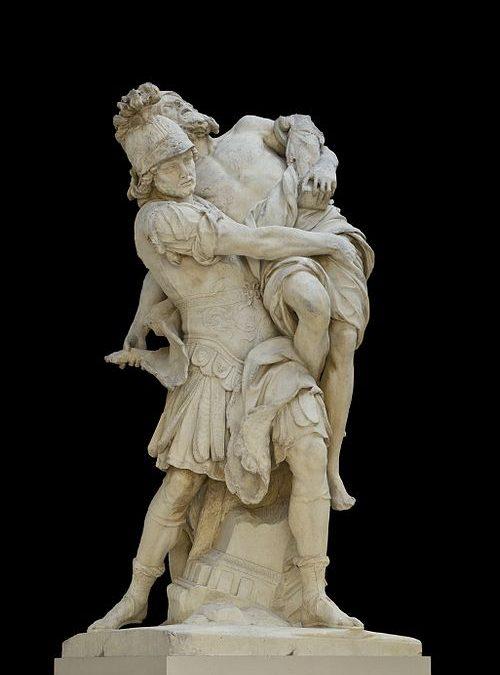
Aeneas’s pietas—the noun form of pius—is demonstrated in his actions throughout the poem. He carries his father, Anchises, from burning Troy, honours the gods with ritual offerings, and consistently places the needs of his people above personal desire. His abandonment of Dido, though emotionally painful, is framed as an act of pietas, since he must obey Jupiter’s command and fulfil his destiny in Italy. In this context, pius reflects submission to divine will and the prioritisation of communal over individual concerns.
The use of pius also serves a political function. By portraying Aeneas as pius, Virgil aligns him with Augustan ideals. Augustus, like Aeneas, is cast as a restorer of order and tradition, guided by divine favour and ancestral duty. The repetition of pius Aeneas reinforces this ideological link, making the hero a model of Roman virtue.
Beyond Aeneas, pius is applied to other characters, though less frequently. It may describe filial devotion, as in the case of Ascanius, or reverence toward the gods. However, its most resonant use remains with Aeneas, where it becomes almost a title, signalling his role as a moral and cultural exemplar.
The word also appears in contrast to its absence. Characters who defy the gods or act selfishly—such as Turnus or Dido—are implicitly impii, lacking the qualities that define Aeneas. Thus, pius functions not only as a descriptor but as a moral benchmark within the narrative.
In the Aeneid, pius is a key term that shapes the reader’s understanding of heroism, duty, and Roman identity. Its repeated use underscores the ethical framework of the epic and the values it seeks to promote.
Today's Artwork:
Image: Aeneas, supporting his old father Anchises, escapes from burning Troy
From a wax model by François Girardon. Sculpted in the Académie de France in Rome since 1697. Back to France in 1715, finished with help of Jacques Bousseau in 1716, then put in the Tuileries garden in 1717. Louvre Museum
Source: https://commons.wikimedia.org/
Here is a text only version. (See below for an interactive version)
Sum pius Aeneas, raptos qui ex hoste Penates
classe veho mecum, fama super aethera notus.
Italiam quaero patriam et genus ab Iove summo.
Bis denis Phrygium conscendi navibus aequor,
matre dea monstrante viam, data fata secutus;
vix septem convolsae undis Euroque supersunt.
Ipse ignotus, egens, Libyae deserta peragro,
Europa atque Asia pulsus.” Nec plura querentem
passa Venus medio sic interfata dolore est:
“Quisquis es, haud, credo, invisus caelestibus auras
vitalis carpis, Tyriam qui adveneris urbem.
Perge modo, atque hinc te reginae ad limina perfer,
Namque tibi reduces socios classemque relatam
nuntio, et in tutum versis aquilonibus actam,
ni frustra augurium vani docuere parentes.
Need Help Understanding the Latin?
You might find it helpful to start with the Side-by-Side Version which allows you to see my own very literal translation of the text which is almost a word-for-word translation - in an attempt to make it easier to understand the Latin!
Finally come back to this page - Classical Text and you should be able to better understand and competently read the original Latin text.
Vocabulary Version
I have prepared a Vocabulary Version of the passage (link at bottom of the page) which highlights the 3057 Most Common Words in the texts of Vergil, Caesar and Cicero that we will explore on CentumVerba.com
If you are serious about building your vocabulary, the FLASHCARD set should help you learn them.
How To Read the Interactive Text
To Read the Interactive Text Below Without a Dictionary-
On a Computer: you hover over a word and get all the possible parts of speech; declensions; and conjugations of every word.
Need Help Understanding the Latin?
You might find it helpful to start with the Side-by-Side Version which allows you to see my own very literal translation of the text which is almost a word-for-word translation - in an attempt to make it easier to understand the Latin!
Finally come back to this page - Classical Text and you should be able to better understand and competently read the original Latin text.
Vocabulary Version
I have prepared a Vocabulary Version of the passage (link at bottom of the page) which highlights the 3057 Most Common Words in the texts of Vergil, Caesar and Cicero that we will explore on CentumVerba.com
If you are serious about building your vocabulary, the FLASHCARD set should help you learn them.
How To Read the Interactive Text
To Read the Interactive Text Below Without a Dictionary-
On a Phone or Tablet: don't 'hover' -'tap' the word. To remove the 'definition box' you 'tap' to the side of the text box.
INTERACTIVE DICTIONARY FREE TEXT
Sum pius Aeneas, raptos qui ex hoste Penates classe veho mecum, fama super aethera notus.
You Need to be a Member to Access the Interactive Dictionary
Italiam quaero patriam et genus ab Iove summo.
Bis denis Phrygium conscendi navibus aequor, matre dea monstrante viam, data fata secutus; vix septem convolsae undis Euroque supersunt.
Ipse ignotus, egens, Libyae deserta peragro, Europa atque Asia pulsus.”
Nec plura querentem passa Venus medio sic interfata dolore est: “Quisquis es, haud, credo, invisus caelestibus auras vitalis carpis, Tyriam qui adveneris urbem.
Perge modo, atque hinc te reginae ad limina perfer, Namque tibi reduces socios classemque relatam nuntio, et in tutum versis aquilonibus actam, ni frustra augurium vani docuere parentes.
Recent Comments