
namque - a particle indeed for truly
The Latin particle namque—a compound of nam and -que, meaning ‘for indeed’ or ‘for truly’—plays a distinctive role in Virgil’s literary architecture. More emphatic than nam alone, namque introduces explanations, elaborations, or narrative expansions with a tone of solemnity or urgency. In Virgil’s epic style, it functions not merely as connective tissue but as a signal of narrative weight, often preceding moments of revelation, transition, or heightened emotion.
In the Aeneid, namque frequently appears at junctures where the poet shifts from action to background, or from event to cause. When Virgil writes namque, he invites the reader to pause and absorb context. For example, before recounting a character’s lineage or motive, namque marks the beginning of a digression that enriches the main narrative. These digressions are not ornamental—they deepen the reader’s understanding of fate, duty, and divine intervention.
Virgil also uses namque to introduce speeches or internal reflections. When a hero contemplates his path or a god reveals a prophecy, namque often precedes the moment, lending gravity and framing the utterance as consequential. This usage aligns with Virgil’s broader technique of layering narrative with philosophical and emotional resonance.
In battle scenes, namque may precede a sudden shift in fortune or the appearance of a key figure. It acts as a narrative hinge, turning the reader’s attention from general conflict to specific drama. The particle’s emphatic tone suits the epic’s elevated register, reinforcing the grandeur and inevitability of events.
Stylistically, namque contributes to Virgil’s rhythm and pacing. Its placement often slows the verse momentarily, allowing for reflection before the action resumes. This modulation of tempo is essential to Virgil’s control of tone and mood.
In Virgil’s hands, namque is not a mere explanatory tool—it is a marker of significance, a cue for depth, and a subtle guide through the layered terrain of epic storytelling.
Today's Artwork:
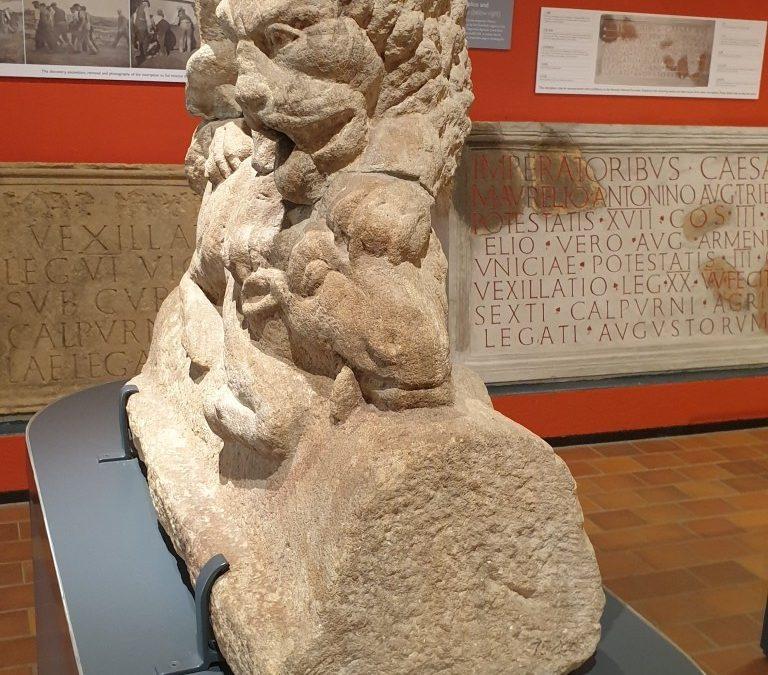
Image: The Corbridge Lion
Source: Corbridge Roman Town
My Own Image
Here is a text only version. (See below for an interactive version)
Namque haud tibi voltus
mortalis, nec vox hominem sonat: O, dea certe—
an Phoebi soror? an nympharum sanguinis una?—
sis felix, nostrumque leves, quaecumque, laborem,
et, quo sub caelo tandem, quibus orbis in oris
iactemur, doceas. Ignari hominumque locorumque
erramus, vento huc vastis et fluctibus acti:
multa tibi ante aras nostra cadet hostia dextra.”
Tum Venus: “Haud equidem tali me dignor honore;
virginibus Tyriis mos est gestare pharetram,
purpureoque alte suras vincire cothurno.
Punica regna vides, Tyrios et Agenoris urbem;
sed fines Libyci, genus intractabile bello.
Imperium Dido Tyria regit urbe profecta,
germanum fugiens. Longa est iniuria, longae
ambages; sed summa sequar fastigia rerum.
Need Help Understanding the Latin?
You might find it helpful to start with the Side-by-Side Version which allows you to see my own very literal translation of the text which is almost a word-for-word translation - in an attempt to make it easier to understand the Latin!
Finally come back to this page - Classical Text and you should be able to better understand and competently read the original Latin text.
Vocabulary Version
I have prepared a Vocabulary Version of the passage (link at bottom of the page) which highlights the 3057 Most Common Words in the texts of Vergil, Caesar and Cicero that we will explore on CentumVerba.com
If you are serious about building your vocabulary, the FLASHCARD set should help you learn them.
How To Read the Interactive Text
To Read the Interactive Text Below Without a Dictionary-
On a Computer: you hover over a word and get all the possible parts of speech; declensions; and conjugations of every word.
Need Help Understanding the Latin?
You might find it helpful to start with the Side-by-Side Version which allows you to see my own very literal translation of the text which is almost a word-for-word translation - in an attempt to make it easier to understand the Latin!
Finally come back to this page - Classical Text and you should be able to better understand and competently read the original Latin text.
Vocabulary Version
I have prepared a Vocabulary Version of the passage (link at bottom of the page) which highlights the 3057 Most Common Words in the texts of Vergil, Caesar and Cicero that we will explore on CentumVerba.com
If you are serious about building your vocabulary, the FLASHCARD set should help you learn them.
How To Read the Interactive Text
To Read the Interactive Text Below Without a Dictionary-
On a Phone or Tablet: don't 'hover' -'tap' the word. To remove the 'definition box' you 'tap' to the side of the text box.
INTERACTIVE DICTIONARY FREE TEXT
Namque haud tibi voltus mortalis, nec vox hominem sonat:
You Need to be a Member to Access the Interactive Dictionary
O, dea certe— an Phoebi soror? an nympharum sanguinis una?— sis felix, nostrumque leves, quaecumque, laborem, et, quo sub caelo tandem, quibus orbis in oris iactemur, doceas.
Ignari hominumque locorumque erramus, vento huc vastis et fluctibus acti: multa tibi ante aras nostra cadet hostia dextra.”
Tum Venus: “Haud equidem tali me dignor honore; virginibus Tyriis mos est gestare pharetram, purpureoque alte suras vincire cothurno.
Punica regna vides, Tyrios et Agenoris urbem; sed fines Libyci, genus intractabile bello.
Imperium Dido Tyria regit urbe profecta, germanum fugiens. Longa est iniuria, longae ambages; sed summa sequar fastigia rerum.
Recent Comments