
magnus - the bigger they are...
The Latin adjective magnus means ‘great’, ‘large’, or ‘important’, and its semantic range extends from physical size to moral stature, political power, and cosmic significance. It is one of the most frequently used adjectives in Latin literature, appearing across genres to elevate subjects, intensify emotions, or mark distinction. Its flexibility allows authors to shape tone and meaning with precision.
In epic poetry, magnus often signals heroic grandeur. Virgil uses magnus to describe Aeneas, Jupiter, and Rome itself. When Aeneas is called magnus, the term conveys not just physical prowess but destiny and moral weight. Rome is magna in its future glory, a city whose greatness is foretold and divinely sanctioned. The adjective thus becomes a tool of prophecy and national identity.
In historiography, magnus serves to distinguish figures of consequence. Livy and Tacitus apply it to generals, battles, and events that shift the course of history. The use of magnus is rarely neutral—it implies judgment. A magna clades (great defeat) is not merely large in scale but devastating in impact. A magnus vir is not just powerful but worthy of remembrance.
In philosophical texts, magnus acquires ethical resonance. Cicero and Seneca use it to describe the magnitudo animi—greatness of soul. Here, magnus transcends external attributes and points to inner virtue. The magnus animus is calm in adversity, generous in triumph, and guided by reason. This moral use reflects Stoic ideals and Roman conceptions of dignity.
In elegy and satire, magnus can be ironic or exaggerated. Ovid might call a lover’s gesture magna to mock its pretension. Juvenal uses magnus to expose hypocrisy, applying it to corrupt officials or hollow reputations. The adjective becomes a mirror, reflecting the gap between appearance and reality.
Even in comedy, magnus finds playful use. Plautus might describe a boastful character’s plans as magna, only to deflate them with comic failure. The word’s grandeur contrasts with the mundane, creating humor through dissonance.
Across Latin literature, magnus is a marker of scale, value, and perception. Whether sincere or ironic, it shapes how readers understand ambition, virtue, and consequence.
Today's Artwork:
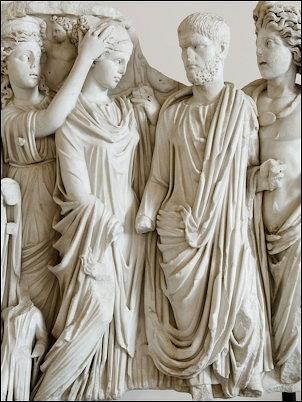
Image: Scene of dextrarum junctio, the ritual joining of hands of husband of wife during the wedding ceremony, with the Genius Populi Romani standing behind the man, and Venus Felix crowning the woman. Detail from the front panel of a sarcophage.
Museo Archeologico Nazionale di Napoli
Source: Europe facts and details
Red and Green Vocab
The words in red and green are found among the 3057 Most Common Words in the Classical Latin texts that we will explore on CentumVerba.com and are essential to your understanding of the texts of Caesar, Vergil and Cicero. The green words appear frequently (at least five times) among Vergil's Aeneid (books I-VI), Caesar de bello Gallico (books I-V) and in Cicero's works - in Catilinam (books I-IV), de lege Manilia (also known as de Imperio Cn. Pompei), and pro Achia. These works constituted the curriculum for Latin over 4 years in American High Schools at the start of the 20th Century. The bulk of my information is taken from The Vocabulary of High School Latin by Gonzalez Lodge. I have added to these 2000 words from varioius other sources to compile my own list of The 3057 Most Common Latin Words.
The black words do not appear frequently in Classical Latin.
The red words are the first occurrences of these words in this author and this word will appear as green the next time you encounter it.
If you are serious about building your vocabulary then you should learn the red words as they occur and you should already know the green ones!
I have provided a FLASHCARD set to help - see below.
How To Read the Interactive Text
To Read the Interactive Text Below Without a Dictionary-
On a Computer: you hover over a word and get all the possible parts of speech; declensions; and conjugations of every word.
Red and Green Vocab
The words in red and green are found among the 3057 Most Common Words in the Classical Latin texts that we will explore on CentumVerba.com and are essential to your understanding of the texts of Caesar, Vergil and Cicero. The green words appear frequently (at least five times) among Vergil's Aeneid (books I-VI), Caesar de bello Gallico (books I-V) and in Cicero's works - in Catilinam (books I-IV), de lege Manilia (also known as de Imperio Cn. Pompei), and pro Achia. These works constituted the curriculum for Latin over 4 years in American High Schools at the start of the 20th Century. The bulk of my information is taken from The Vocabulary of High School Latin by Gonzalez Lodge. I have added to these 2000 words from varioius other sources to compile my own list of The 3057 Most Common Latin Words.
The black words do not appear frequently in Classical Latin.
The red words are the first occurrences of these words in this author and this word will appear as green the next time you encounter it.
If you are serious about building your vocabulary then you should learn the red words as they occur and you should already know the green ones!
I have provided a FLASHCARD set to help - see below.
How To Read the Interactive Text
To Read the Interactive Text Below Without a Dictionary-
On a Phone or Tablet: don't 'hover' -'tap' the word. To remove the 'definition box' you 'tap' to the side of the text box.
INTERACTIVE DICTIONARY FREE TEXT
“Huic coniunx Sychaeus erat, ditissimus agri Phoenicum,
You Need to be a Member to Access the Interactive Dictionary
et magno miserae dilectus amore, cui pater intactam dederat, primisque iugarat ominibus.
Sed regna Tyri germanus habebat Pygmalion, scelere ante alios immanior omnes. Quos inter medius venit furor.
Ille Sychaeum impius ante aras, atque auri caecus amore, clam ferro incautum superat, securus amorum germanae; factumque diu celavit, et aegram, multa malus simulans, vana spe lusit amantem.
Ipsa sed in somnis inhumati venit imago coniugis, ora modis attollens pallida miris, crudeles aras traiectaque pectora ferro nudavit, caecumque domus scelus omne retexit.
Tum celerare fugam patriaque excedere suadet, auxiliumque viae veteres tellure recludit thesauros, ignotum argenti pondus et auri.
I have prepared online Flashcards at CRAM.com to make learning the vocabulary much easier. I have no financial gain from you using the app as it is FREE to use.
I have created a stack of the 28 new words in this passage.
Here is the link to the FLASHCARDS
USING THE FLASHCARD APP:
To make the most of the online Flashcards use the "Click or use spacebar to begin" and the Latin word should appear. (The 'Shuffle' button will take the cards out of alphabetical order.) Type 'H' to get the conjugation / declension of the word if you want to see it. 'H' takes tyou back to the word. Click 'See Answer' or use the Spacebar to see the English.
If you were correct or close enough then select "I was right" or else "I was wrong". After you have completed the set it will start again but it will only display the ones you got wrong.
Continue through this process to learn all the words. I hope this is helpful!
Recent Comments