
coepi - I have begun, so I'll finish
The Latin verb coepi means ‘I began’ or ‘I have begun’, and is used to mark the initiation of an action or process. It is a defective verb, appearing only in the perfect system, with no present tense forms. For present-tense meanings, Latin uses incipio, but coepi remains the preferred choice in classical prose and poetry when referring to completed or initiated actions.
In Cicero’s oratory, coepi is often used to structure argumentation. He might say coepi dicere to signal the beginning of a line of reasoning or a speech segment. This usage helps guide the audience through the rhetorical flow, marking transitions and developments in thought. The verb also appears in legal and political contexts, where coepi can indicate the start of a campaign, a trial, or a public initiative, lending a sense of formality and deliberation to the narrative.
In historical writing, authors such as Livy and Sallust use coepi to mark the onset of events—wars, reforms, conspiracies. For example, bellum coepit introduces not just a chronological point but a thematic shift, often foreshadowing conflict or transformation. The verb’s perfect aspect allows historians to present beginnings as established facts, anchoring their accounts in a sense of completed initiation.
Poets use coepi with emotional and narrative nuance. In Ovid’s elegiac verse, coepi amare or coepi sperare expresses the emergence of feeling or hope, often with a tone of vulnerability or reflection. The verb can also appear in prayers or invocations, where the speaker marks the start of a plea or lament. In epic poetry, coepi may signal the beginning of a heroic action or divine intervention, lending weight to the moment of initiation.
Overall, coepi in classical Latin is a verb of inception, used to frame beginnings with clarity and emphasis. Its perfect form gives it a retrospective quality, allowing writers to reflect on the moment something came into being—whether an idea, an emotion, or a historical turning point.
The images for these posts on Mark's gospel
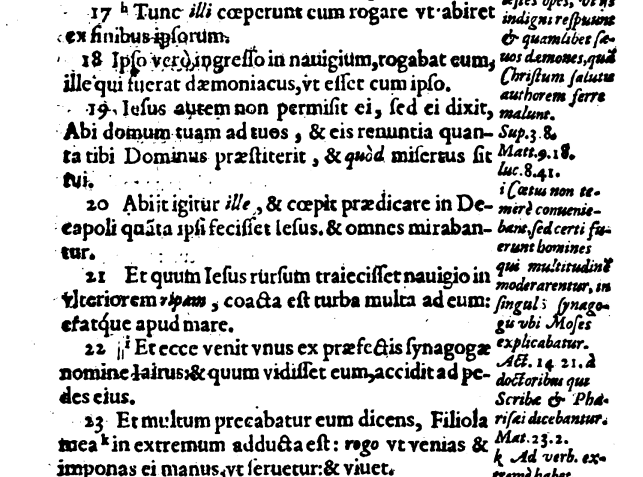
Screenshots taken from the Nouum Testamentum of Théodore de Bèze, (1519-1605) ( Londini : Thomas Vautrollerius, typographus, 1587 )
Accessed from the Post Reformation Digital Library
Red and Green Vocab
The words in red and green are found among the 3057 Most Common Words in the Classical Latin texts that we will explore on CentumVerba.com and are essential to your understanding of the texts of Caesar, Vergil and Cicero. The green words appear frequently (at least five times) among Vergil's Aeneid (books I-VI), Caesar de bello Gallico (books I-V) and in Cicero's works - in Catilinam (books I-IV), de lege Manilia (also known as de Imperio Cn. Pompei), and pro Achia. These works constituted the curriculum for Latin over 4 years in American High Schools at the start of the 20th Century. The bulk of my information is taken from The Vocabulary of High School Latin by Gonzalez Lodge. I have added to these 2000 words from varioius other sources to compile my own list of The 3057 Most Common Latin Words.
The black words do not appear frequently in Classical Latin.
The red words are the first occurrences of these words in this author and this word will appear as green the next time you encounter it.
If you are serious about building your vocabulary then you should learn the red words as they occur and you should already know the green ones!
I have provided a FLASHCARD set to help - see below.
How To Read the Interactive Text
To Read the Interactive Text Below Without a Dictionary-
On a Computer: you hover over a word and get all its possible parts of speech; declensions; and conjugations.
On a Tablet: 'Tap' the word to see the definition, and to remove the 'definition box' you simply 'Tap' anywhere to the side.
Red and Green Vocab
The words in red and green are found among the 3057 Most Common Words in the Classical Latin texts that we will explore on CentumVerba.com and are essential to your understanding of the texts of Caesar, Vergil and Cicero. The green words appear frequently (at least five times) among Vergil's Aeneid (books I-VI), Caesar de bello Gallico (books I-V) and in Cicero's works - in Catilinam (books I-IV), de lege Manilia (also known as de Imperio Cn. Pompei), and pro Achia. These works constituted the curriculum for Latin over 4 years in American High Schools at the start of the 20th Century. The bulk of my information is taken from The Vocabulary of High School Latin by Gonzalez Lodge. I have added to these 2000 words from varioius other sources to compile my own list of The 3057 Most Common Latin Words.
The black words do not appear frequently in Classical Latin.
The red words are the first occurrences of these words in this author and this word will appear as green the next time you encounter it.
If you are serious about building your vocabulary then you should learn the red words as they occur and you should already know the green ones!
I have provided a FLASHCARD set to help - see below.
How To Read the Interactive Text
To Read the Interactive Text Below Without a Dictionary-
On a Phone or Tablet: ''TAP' the word to see the definition, and to remove the 'definition box' you simply 'TAP' anywhere to the side.
INTERACTIVE DICTIONARY FREE TEXT
Caput V
17 Et rogare eum coeperunt, ut discederet a finibus eorum.
You Need to be at least a Trial Member to Access the Interactive Dictionary
18 Cumque ascenderet navem, qui daemonio vexatus fuerat, deprecabatur eum, ut esset cum illo.
19 Et non admisit eum, sed ait illi Vade in domum tuam ad tuos et annuntia illis quanta tibi Dominus fecerit et misertus sit tui.
20 Et abiit et coepit praedicare in Decapoli quanta sibi fecisset Iesus, et omnes mirabantur.
21 Et cum transcendisset Iesus in navi rursus trans fretum, convenit turba multa ad illum, et erat circa mare.
22 Et venit quidam de archisynagogis nomine Iairus et videns eum procidit ad pedes eius
23 et deprecatur eum multum dicens Filiola mea in extremis est veni, impone manus super eam, ut salva sit et vivat.
I have prepared online Flashcards at CRAM.com to make learning the vocabulary much easier. I have no financial gain as the app is FREE to use.
I have created a stack of the 6 new words in this passage.
YOU NEED TO SIGN UP AS A TRIAL MEMBER TO ACCESS THE FLASHCARDS
Here is the link to the FLASHCARDS
I have prepared online Flashcards at CRAM.com to make learning the vocabulary much easier. I have no financial gain as the app is FREE to use.
I have created a stack of the 6 new words in this passage.
YOU NEED TO SIGN UP AS A TRIAL MEMBER TO ACCESS THE FLASHCARDS
Here is the link to the FLASHCARDS
USING THE FLASHCARD APP:
To make the most of the online Flashcards use the "Click or use spacebar to begin" and the Latin word should appear. (The 'Shuffle' button will take the cards out of alphabetical order.) Type 'H' to get the conjugation / declension of the word if you want to see it. 'H' takes tyou back to the word. Click 'See Answer' or use the Spacebar to see the English.
If you were correct or close enough then select "I was right" or else "I was wrong". After you have completed the set it will start again but it will only display the ones you got wrong.
Continue through this process to learn all the words. I hope this is helpful!
Recent Comments