
rogo - any questions?
The Latin verb rogo means ‘I ask’, ‘I request’, or ‘I propose’, and its usage in classical literature spans legal, political, and poetic domains. It is a foundational term in Roman civic life, especially in the context of legislation, where rogare legem refers to proposing a law to the people. This formal sense of rogo is central to the language of the Republic and its institutions.
In Cicero’s speeches, rogo appears frequently, often in the first person, as part of his rhetorical strategy to engage the audience directly. When Cicero says vos, Quirites, rogo, he is not merely asking but invoking a civic bond, framing his appeal as a shared moral and political concern. The verb thus becomes a tool of persuasion, allowing the speaker to position himself as both advocate and servant of the public good.
In historical prose, such as Caesar’s Commentarii, rogo is used more sparingly but retains its formal tone. It may appear in reported speech or in the context of military or political negotiation, where requests are made to allies, enemies, or the Senate. The verb’s clarity and directness suit Caesar’s concise style, reinforcing the transactional nature of command and diplomacy.
Poets use rogo with greater emotional range. In Ovid’s elegiac verse, rogo often expresses romantic or personal pleading. The lover rogat his mistress for favour, forgiveness, or attention, and the verb becomes a vehicle for vulnerability and desire. In Virgil’s Aeneid, rogo may appear in scenes of supplication, where characters appeal to gods or rulers, highlighting the tension between human agency and divine will.
Overall, rogo in classical Latin is a verb of interaction—whether between citizen and state, speaker and audience, lover and beloved, or mortal and divine. Its simplicity belies its rhetorical power, and its recurrence across genres reflects its centrality to Roman thought and expression.
The images for these posts on Mark's gospel
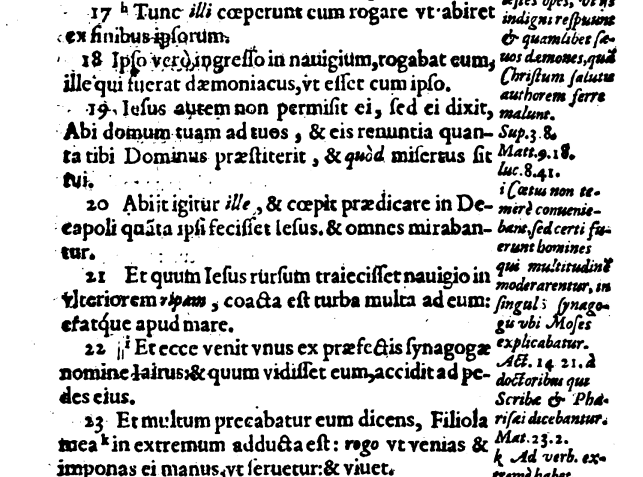
Screenshots taken from the Nouum Testamentum of Théodore de Bèze, (1519-1605) ( Londini : Thomas Vautrollerius, typographus, 1587 )
Accessed from the Post Reformation Digital Library
JUMP To Dictionary Free Interactive Text
Here is a text only version.
EVANGELIUM MARCUM
CAPUT V
17 Et rogare eum coeperunt, ut discederet a finibus eorum.
18 Cumque ascenderet navem, qui daemonio vexatus fuerat, deprecabatur eum, ut esset cum illo.
19 Et non admisit eum, sed ait illi Vade in domum tuam ad tuos et annuntia illis quanta tibi Dominus fecerit et misertus sit tui.
20 Et abiit et coepit praedicare in Decapoli quanta sibi fecisset Iesus, et omnes mirabantur.
21 Et cum transcendisset Iesus in navi rursus trans fretum, convenit turba multa ad illum, et erat circa mare.
22 Et venit quidam de archisynagogis nomine Iairus et videns eum procidit ad pedes eius
23 et deprecatur eum multum dicens Filiola mea in extremis est veni, impone manus super eam, ut salva sit et vivat.
How To Read the Interactive Text Without a Dictionary
On a Computer:
Hover over a word to get all its possible parts of speech, declensions, or conjugations.
On a Tablet:
'TAP' the word to see the definition, and to remove the 'definition box' you simply 'TAP' anywhere to the side.
How To Read the Interactive Text
'Tap' the word to see the definition and to remove the 'definition box' you simply 'tap' antwhere to the side.
EVANGELIUM MARCUM
CAPUT V
17 Et rogare eum coeperunt, ut discederet a finibus eorum.
You Need to be at least a Trial Member to Access the Interactive Dictionary
18 Cumque ascenderet navem, qui daemonio vexatus fuerat, deprecabatur eum, ut esset cum illo.
19 Et non admisit eum, sed ait illi Vade in domum tuam ad tuos et annuntia illis quanta tibi Dominus fecerit et misertus sit tui.
20 Et abiit et coepit praedicare in Decapoli quanta sibi fecisset Iesus, et omnes mirabantur.
21 Et cum transcendisset Iesus in navi rursus trans fretum, convenit turba multa ad illum, et erat circa mare.
22 Et venit quidam de archisynagogis nomine Iairus et videns eum procidit ad pedes eius
23 et deprecatur eum multum dicens Filiola mea in extremis est veni, impone manus super eam, ut salva sit et vivat.
Recent Comments