
abeo - I go away from here
The Latin verb abeo means ‘I go away’, ‘I depart’, or ‘I pass’. It is a compound of ab- and eo, and its primary sense is spatial, indicating movement away from a place or person. However, in classical literature, abeo acquires broader metaphorical and narrative functions, often signalling transition, disappearance, or transformation.
In Virgil’s Aeneid, abeo is used to describe both physical departure and metaphysical change. When souls abeunt from life to the underworld, the verb marks the passage from one realm to another. Similarly, when gods or spirits vanish from sight, abeo conveys their sudden and mysterious withdrawal. The verb’s brevity and rhythm suit moments of swift or solemn movement, often underscoring the fragility of presence.
Ovid employs abeo with particular creativity in the Metamorphoses, where it frequently denotes transformation. A character abit not just from a place but from one form to another—woman to tree, man to bird, body to flame. In this context, abeo becomes a poetic signal of change, encapsulating the moment when identity shifts and the familiar dissolves. Its use is often understated, allowing the transformation to unfold with elegance and inevitability.
In prose, abeo retains its literal sense but is also used to mark transitions in narrative or argument. Cicero may use abeo to indicate a shift in topic or to describe someone leaving a scene, whether in a courtroom or political setting. The verb’s clarity and neutrality make it suitable for both descriptive and rhetorical purposes.
Historians like Livy and Tacitus use abeo to describe the movement of armies, the departure of envoys, or the end of political careers. In these contexts, abeo often carries a tone of finality, suggesting not just physical exit but the conclusion of a role or phase.
Thus, abeo in classical Latin is a verb of departure, but its literary use extends far beyond geography. It marks endings, transitions, and transformations—moments when something ceases to be what it was and becomes something else.
The images for these posts on Mark's gospel
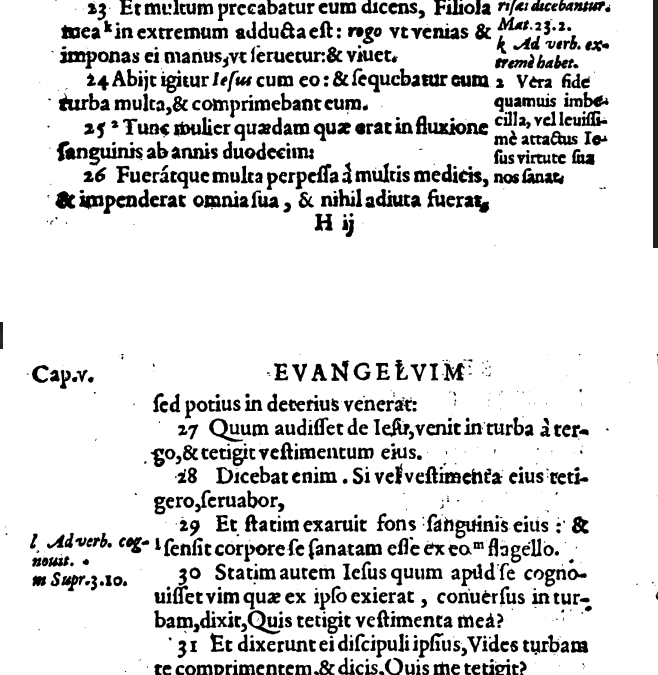
Screenshots taken from the Nouum Testamentum of Théodore de Bèze, (1519-1605) ( Londini : Thomas Vautrollerius, typographus, 1587 )
Accessed from the Post Reformation Digital Library
JUMP To Dictionary Free Interactive Text
Here is a text only version.
EVANGELIUM MARCUM
CAPUT V
24 Et abiit cum illo. Et sequebatur eum turba multa et comprimebant illum.
25 Et mulier, quae erat in profluvio sanguinis annis duodecim
26 et fuerat multa perpessa a compluribus medicis et erogaverat omnia sua nec quidquam profecerat, sed magis deterius habebat,
27 cum audisset de Iesu, venit in turba retro et tetigit vestimentum eius
28 dicebat enim Si vel vestimenta eius tetigero, salva ero.
29 Et confestim siccatus est fons sanguinis eius, et sensit corpore quod sanata esset a plaga.
30 Et statim Iesus cognoscens in semetipso virtutem, quae exierat de eo, conversus ad turbam aiebat Quis tetigit vestimenta mea?
31 Et dicebant ei discipuli sui Vides turbam comprimentem te et dicis Quis me tetigit?
How To Read the Interactive Text Without a Dictionary
On a Computer:
Hover over a word to get all its possible parts of speech, declensions, or conjugations.
On a Tablet:
'TAP' the word to see the definition, and to remove the 'definition box' you simply 'TAP' anywhere to the side.
How To Read the Interactive Text
'Tap' the word to see the definition and to remove the 'definition box' you simply 'tap' antwhere to the side.
EVANGELIUM MARCUM
CAPUT V
24 Et abiit cum illo.
Et sequebatur eum turba multa et comprimebant illum.
You Need to be at least a Trial Member to Access the Interactive Dictionary
25 Et mulier, quae erat in profluvio sanguinis annis duodecim
26 et fuerat multa perpessa a compluribus medicis et erogaverat omnia sua nec quidquam profecerat, sed magis deterius habebat,
27 cum audisset de Iesu, venit in turba retro et tetigit vestimentum eius
28 dicebat enim Si vel vestimenta eius tetigero, salva ero.
29 Et confestim siccatus est fons sanguinis eius, et sensit corpore quod sanata esset a plaga.
30 Et statim Iesus cognoscens in semetipso virtutem, quae exierat de eo, conversus ad turbam aiebat Quis tetigit vestimenta mea?
31 Et dicebant ei discipuli sui Vides turbam comprimentem te et dicis Quis me tetigit?
EVANGELIUM MARCUM
CAPUT V
24 Et abiit cum illo. Et sequebatur eum turba multa et comprimebant illum.
You Need to be at least a Trial Member to Access the Interactive Dictionary
25 Et mulier, quae erat in profluvio sanguinis annis duodecim
26 et fuerat multa perpessa a compluribus medicis et erogaverat omnia sua nec quidquam profecerat, sed magis deterius habebat,
27 cum audisset de Iesu, venit in turba retro et tetigit vestimentum eius
28 dicebat enim Si vel vestimenta eius tetigero, salva ero.
29 Et confestim siccatus est fons sanguinis eius, et sensit corpore quod sanata esset a plaga.
30 Et statim Iesus cognoscens in semetipso virtutem, quae exierat de eo, conversus ad turbam aiebat Quis tetigit vestimenta mea?
31 Et dicebant ei discipuli sui Vides turbam comprimentem te et dicis Quis me tetigit?
Recent Comments