
multus - the more the merrier
The Latin adjective multus means ‘much’, ‘many’, or ‘a great number’, and is one of the most frequently used descriptive terms in classical Latin. It functions both quantitatively and qualitatively, appearing in singular and plural forms, and is often intensified by adverbs such as valde or nimis. Its flexibility allows it to appear across genres, from epic poetry to legal prose, shaping tone, emphasis, and imagery.
In Virgil’s Aeneid, multus is used to evoke abundance, repetition, and emotional intensity. Phrases like multa vox, multus sanguis, or multae lacrimae convey not just quantity but the weight of experience—whether in battle, grief, or divine intervention. The adjective often appears in elevated contexts, contributing to the grandeur and pathos of epic narrative. It also helps to build rhythm and contrast, especially when paired with its opposite, pauci.
Ovid uses multus with a more playful and ironic touch in his elegiac poetry. In the Amores, multae puellae or multus amor reflect the poet’s persona as a lover overwhelmed by desire and variety. The adjective becomes a tool of exaggeration and wit, reinforcing the speaker’s emotional excess or romantic entanglements. In the Metamorphoses, multus often describes the scale of transformation or the multitude of characters and stories, helping to unify the sprawling narrative.
Cicero employs multus in his speeches to emphasise evidence, support, or opposition. Expressions like multi testes or multae voces lend credibility and urgency to his arguments. The adjective also appears in philosophical texts, where multae res or multae opiniones reflect the complexity of ethical or epistemological inquiry.
Historians such as Livy and Tacitus use multus to describe troops, casualties, or political factions. It serves to quantify events and underscore their significance, often in contrast to individual actions or decisions.
Overall, multus in classical Latin is a marker of scale, intensity, and narrative texture. Its recurrence across literary forms reflects its essential role in expressing abundance, diversity, and emotional depth.
The images for these posts on Mark's gospel
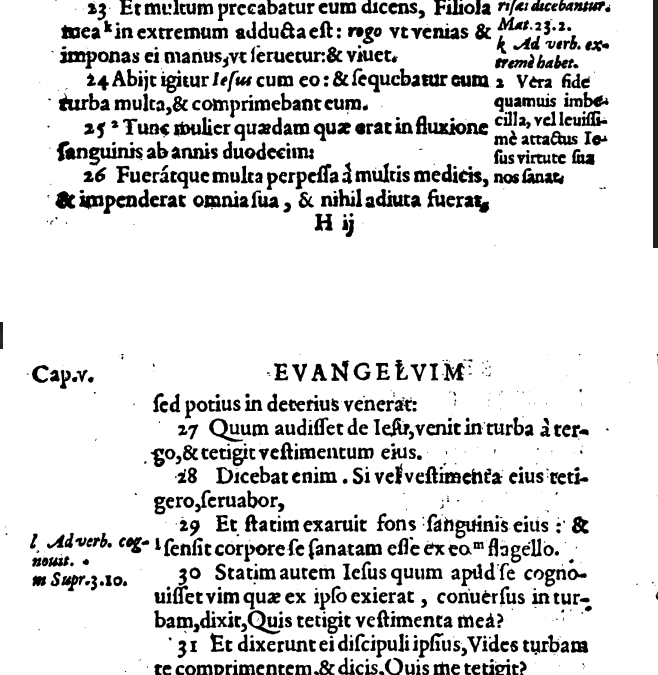
Screenshots taken from the Nouum Testamentum of Théodore de Bèze, (1519-1605) ( Londini : Thomas Vautrollerius, typographus, 1587 )
Accessed from the Post Reformation Digital Library
Red and Green Vocab
The words in red and green are found among the 3057 Most Common Words in the Classical Latin texts that we will explore on CentumVerba.com and are essential to your understanding of the texts of Caesar, Vergil and Cicero. The green words appear frequently (at least five times) among Vergil's Aeneid (books I-VI), Caesar de bello Gallico (books I-V) and in Cicero's works - in Catilinam (books I-IV), de lege Manilia (also known as de Imperio Cn. Pompei), and pro Achia. These works constituted the curriculum for Latin over 4 years in American High Schools at the start of the 20th Century. The bulk of my information is taken from The Vocabulary of High School Latin by Gonzalez Lodge. I have added to these 2000 words from varioius other sources to compile my own list of The 3057 Most Common Latin Words.
The black words do not appear frequently in Classical Latin.
The red words are the first occurrences of these words in this author and this word will appear as green the next time you encounter it.
If you are serious about building your vocabulary then you should learn the red words as they occur and you should already know the green ones!
I have provided a FLASHCARD set to help - see below.
How To Read the Interactive Text
To Read the Interactive Text Below Without a Dictionary-
On a Computer: you hover over a word and get all its possible parts of speech; declensions; and conjugations.
On a Tablet: 'Tap' the word to see the definition, and to remove the 'definition box' you simply 'Tap' anywhere to the side.
Red and Green Vocab
The words in red and green are found among the 3057 Most Common Words in the Classical Latin texts that we will explore on CentumVerba.com and are essential to your understanding of the texts of Caesar, Vergil and Cicero. The green words appear frequently (at least five times) among Vergil's Aeneid (books I-VI), Caesar de bello Gallico (books I-V) and in Cicero's works - in Catilinam (books I-IV), de lege Manilia (also known as de Imperio Cn. Pompei), and pro Achia. These works constituted the curriculum for Latin over 4 years in American High Schools at the start of the 20th Century. The bulk of my information is taken from The Vocabulary of High School Latin by Gonzalez Lodge. I have added to these 2000 words from varioius other sources to compile my own list of The 3057 Most Common Latin Words.
The black words do not appear frequently in Classical Latin.
The red words are the first occurrences of these words in this author and this word will appear as green the next time you encounter it.
If you are serious about building your vocabulary then you should learn the red words as they occur and you should already know the green ones!
I have provided a FLASHCARD set to help - see below.
How To Read the Interactive Text
To Read the Interactive Text Below Without a Dictionary-
On a Phone or Tablet: ''TAP' the word to see the definition, and to remove the 'definition box' you simply 'TAP' anywhere to the side.
INTERACTIVE DICTIONARY FREE TEXT
Caput V
24 Et abiit cum illo. Et sequebatur eum turba multa et comprimebant illum.
You Need to be at least a Trial Member to Access the Interactive Dictionary
25 Et mulier, quae erat in profluvio sanguinis annis duodecim
26 et fuerat multa perpessa a compluribus medicis et erogaverat omnia sua nec quidquam profecerat, sed magis deterius habebat,
27 cum audisset de Iesu, venit in turba retro et tetigit vestimentum eius
28 dicebat enim Si vel vestimenta eius tetigero, salva ero.
29 Et confestim siccatus est fons sanguinis eius, et sensit corpore quod sanata esset a plaga.
30 Et statim Iesus cognoscens in semetipso virtutem, quae exierat de eo, conversus ad turbam aiebat Quis tetigit vestimenta mea?
31 Et dicebant ei discipuli sui Vides turbam comprimentem te et dicis Quis me tetigit?
I have prepared online Flashcards at CRAM.com to make learning the vocabulary much easier. I have no financial gain as the app is FREE to use.
I have created a stack of the 10 new words in this passage.
YOU NEED TO SIGN UP AS A TRIAL MEMBER TO ACCESS THE FLASHCARDS
Here is the link to the FLASHCARDS
USING THE FLASHCARD APP:
To make the most of the online Flashcards use the "Click or use spacebar to begin" and the Latin word should appear. (The 'Shuffle' button will take the cards out of alphabetical order.) Type 'H' to get the conjugation / declension of the word if you want to see it. 'H' takes tyou back to the word. Click 'See Answer' or use the Spacebar to see the English.
If you were correct or close enough then select "I was right" or else "I was wrong". After you have completed the set it will start again but it will only display the ones you got wrong.
Continue through this process to learn all the words. I hope this is helpful!
Recent Comments