
alius - another is different
In Latin, alius is an adjective meaning 'other', 'another', or 'different'. It belongs to the pronominal group of first and second declension adjectives, but its declension is irregular in some forms. The nominative singular forms are alius (masculine), alia (feminine), and aliud (neuter). The genitive singular is usually alterius, borrowed from alter, and the dative singular is alii. This irregularity reflects its ancient Indo-European roots, tracing back to h₂élyos, meaning 'beyond' or 'other'.
In classical literature, alius is used to distinguish between entities, often in contrastive or distributive constructions. The phrase alius...alius means 'one...another', as in alius urbem tenet, alius castra—'one holds the city, another the camp'. Similarly, alii...alii can mean 'some...others', useful in rhetorical or poetic enumeration.
Cicero frequently employs alius in philosophical and legal contexts to differentiate between moral categories or political actors. In De Officiis, he writes of alius iudex, alius accusator, emphasizing the separation of roles in civic life. The word helps structure arguments by clarifying distinctions and opposing viewpoints.
In poetry, alius adds nuance to imagery and emotion. Ovid uses it to contrast lovers or fates, as in alius amat, alius fugit, highlighting the asymmetry of desire. Virgil’s Aeneid uses alius to mark shifts in allegiance or destiny, such as when alius heroes rise as others fall.
The word also appears in idiomatic expressions. Alius ac or alius atque means 'different from', while alius aliō (literally 'one in one direction, another in another') conveys disarray or divergence. These phrases enrich Latin’s expressive range, especially in narrative and dramatic contexts.
Modern languages inherit alius through derivatives and cognates. English words like 'alias', 'alien', and 'alibi' reflect its semantic field of otherness and distinction. Romance languages preserve it more directly: Spanish otro, French autre, and Italian altro all descend from alius or its relatives.
In sum, alius is a small but powerful word in Latin, essential for expressing contrast, variety, and differentiation across genres and centuries.
The images for these posts on Mark's gospel
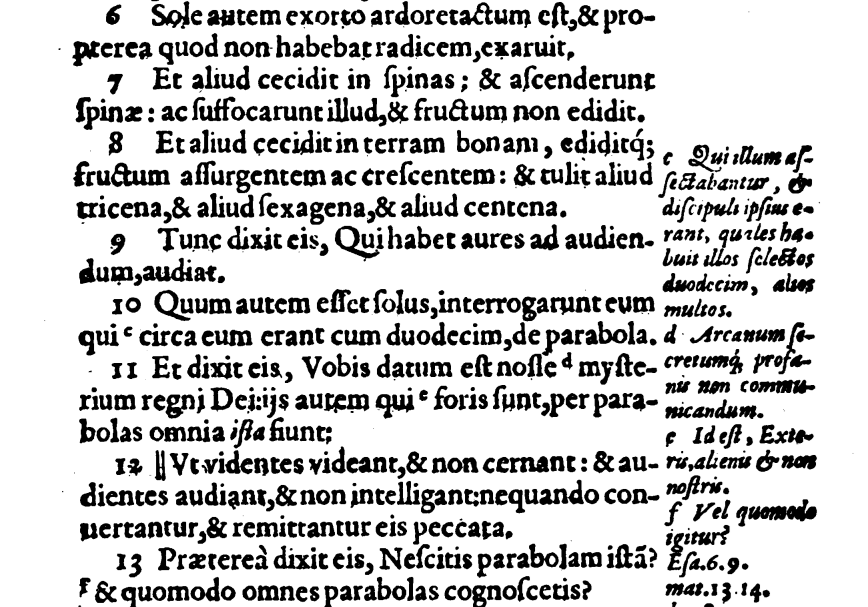
Screenshots taken from the Nouum Testamentum of Théodore de Bèze, (1519-1605) ( Londini : Thomas Vautrollerius, typographus, 1587 )
Accessed from the Post Reformation Digital Library
Red and Green Vocab
The words in red and green are found among the 3057 Most Common Words in the Classical Latin texts that we will explore on CentumVerba.com and are essential to your understanding of the texts of Caesar, Vergil and Cicero. The green words appear frequently (at least five times) among Vergil's Aeneid (books I-VI), Caesar de bello Gallico (books I-V) and in Cicero's works - in Catilinam (books I-IV), de lege Manilia (also known as de Imperio Cn. Pompei), and pro Achia. These works constituted the curriculum for Latin over 4 years in American High Schools at the start of the 20th Century. The bulk of my information is taken from The Vocabulary of High School Latin by Gonzalez Lodge. I have added to these 2000 words from varioius other sources to compile my own list of The 3057 Most Common Latin Words.
The black words do not appear frequently in Classical Latin.
The red words are the first occurrences of these words in this author and this word will appear as green the next time you encounter it.
If you are serious about building your vocabulary then you should learn the red words as they occur and you should already know the green ones!
I have provided a FLASHCARD set to help - see below.
How To Read the Interactive Text
To Read the Interactive Text Below Without a Dictionary-
On a Computer: you hover over a word and get all its possible parts of speech; declensions; and conjugations.
On a Tablet: 'Tap' the word to see the definition, and to remove the 'definition box' you simply 'Tap' anywhere to the side.
Red and Green Vocab
The words in red and green are found among the 3057 Most Common Words in the Classical Latin texts that we will explore on CentumVerba.com and are essential to your understanding of the texts of Caesar, Vergil and Cicero. The green words appear frequently (at least five times) among Vergil's Aeneid (books I-VI), Caesar de bello Gallico (books I-V) and in Cicero's works - in Catilinam (books I-IV), de lege Manilia (also known as de Imperio Cn. Pompei), and pro Achia. These works constituted the curriculum for Latin over 4 years in American High Schools at the start of the 20th Century. The bulk of my information is taken from The Vocabulary of High School Latin by Gonzalez Lodge. I have added to these 2000 words from varioius other sources to compile my own list of The 3057 Most Common Latin Words.
The black words do not appear frequently in Classical Latin.
The red words are the first occurrences of these words in this author and this word will appear as green the next time you encounter it.
If you are serious about building your vocabulary then you should learn the red words as they occur and you should already know the green ones!
I have provided a FLASHCARD set to help - see below.
How To Read the Interactive Text
To Read the Interactive Text Below Without a Dictionary-
On a Phone or Tablet: ''TAP' the word to see the definition, and to remove the 'definition box' you simply 'TAP' anywhere to the side.
INTERACTIVE DICTIONARY FREE TEXT
Caput IV
6 et quando exortus est sol, exaestuavit et, eo quod non haberet radicem, exaruit.
You Need to be at least a Trial Member to Access the Interactive Dictionary
7 Et aliud cecidit in spinas, et ascenderunt spinae et suffocaverunt illud, et fructum non dedit.
8 Et alia ceciderunt in terram bonam et dabant fructum ascendebant et crescebant et afferebant unum triginta et unum sexaginta et unum centum.
9 Et dicebat Qui habet aures audiendi, audiat.
10 Et cum esset singularis, interrogaverunt eum hi, qui circa eum erant cum Duodecim, parabolas.
11 Et dicebat eis Vobis datum est mysterium regni Dei illis autem, qui foris sunt, in parabolis omnia fiunt,
12 ut videntes videant et non videant, et audientes audiant et non intellegant, ne quando convertantur, et dimittatur eis.
13 Et ait illis Nescitis parabolam hanc, et quomodo omnes parabolas cognoscetis?
I have prepared online Flashcards at CRAM.com to make learning the vocabulary much easier. I have no financial gain as the app is FREE to use.
I have created a stack of the 15 new words in this passage.
YOU NEED TO SIGN UP AS A TRIAL MEMBER TO ACCESS THE FLASHCARDS
Here is the link to the FLASHCARDS
USING THE FLASHCARD APP:
To make the most of the online Flashcards use the "Click or use spacebar to begin" and the Latin word should appear. (The 'Shuffle' button will take the cards out of alphabetical order.) Type 'H' to get the conjugation / declension of the word if you want to see it. 'H' takes tyou back to the word. Click 'See Answer' or use the Spacebar to see the English.
If you were correct or close enough then select "I was right" or else "I was wrong". After you have completed the set it will start again but it will only display the ones you got wrong.
Continue through this process to learn all the words. I hope this is helpful!
Recent Comments