
quando - when o when?
The Latin word quando is an adverb and conjunction meaning 'when'. In both Classical and Ecclesiastical Latin, it plays an important role in temporal expressions and conditional clauses, showing flexibility in tone, structure, and theological nuance depending on context.
In Classical Latin, quando is typically used as an interrogative or relative adverb meaning 'at what time' or 'when'. For example, in Cicero's prose or Virgil's poetry, one might find phrases like 'quando venies?' ('when will you come?') or 'memini quando haec acciderint' ('I remember when these things happened'). It can also introduce temporal subordinate clauses: 'quando Caesar venit, hostes fugerunt' ('when Caesar came, the enemies fled'). In Classical literature, quando occasionally carries rhetorical weight, especially in speeches, where a pointed 'quando?' can create emphasis or urgency.
The conjunction quando also appears in conditional contexts, roughly meaning 'since' or 'as', particularly when paired with verbs in the indicative mood. For example: 'quando ita est, discedamus' ('since it is so, let us depart'). This use is especially common in philosophical and rhetorical Latin, lending a causal nuance to logical constructions.
In Ecclesiastical Latin, quando retains its classical meanings but acquires additional gravity and frequency in liturgical and theological texts. It often appears in scriptural translations, such as in the Latin Vulgate Bible. For example, in Psalm 41:3: 'Quando veniam et apparebo ante faciem Dei?' ('When shall I come and appear before the face of God?'), quando introduces an eschatological longing for divine presence.
In liturgical prayers and hymns, quando evokes sacred time, often in reference to Christ's life, Passion, or Second Coming. Phrases like 'beatus servus quem, cum venerit Dominus, invenerit vigilantem: amen dico vobis, quia super omnia bona sua constituet eum. Si autem dixerit servus ille in corde suo: Moram facit Dominus meus venire: et coeperit percutere' (Luke 12:43–45), place quando within theological narratives of vigilance and judgment.
The word is also used to reflect theological speculation or hope: 'quando veniam ad te, Domine?' ('when shall I come to you, O Lord?'). In sermons and mystic texts, this yearning when paired with quando expresses devotion and the soul's desire for union with the divine.
Thus, quando moves effortlessly between grammatical utility and spiritual depth, anchoring both earthly and eternal moments in Latin expression. Its continued resonance across centuries showcases the enduring richness of Latin in sacred and literary contexts.
The images for these posts on Mark's gospel
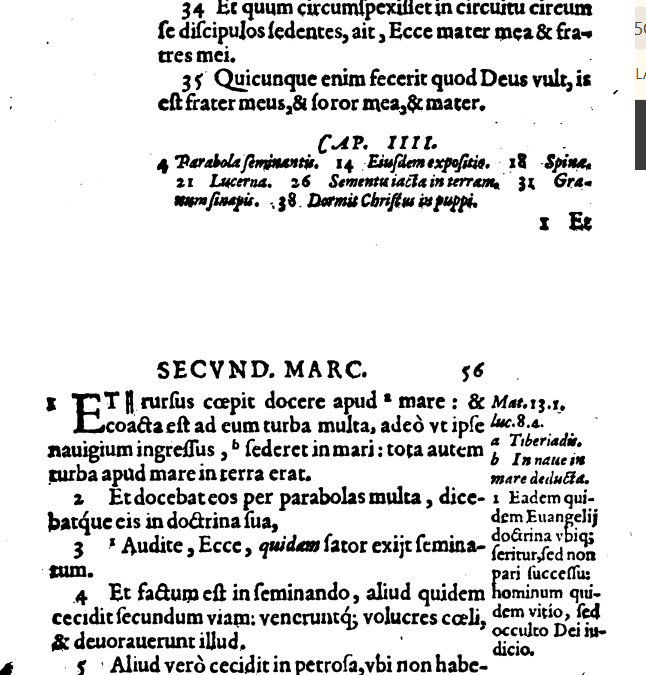
Screenshots taken from the Nouum Testamentum of Théodore de Bèze, (1519-1605) ( Londini : Thomas Vautrollerius, typographus, 1587 )
Accessed from the Post Reformation Digital Library
Red and Green Vocab
The words in red and green are found among the 3057 Most Common Words in the Classical Latin texts that we will explore on CentumVerba.com and are essential to your understanding of the texts of Caesar, Vergil and Cicero. The green words appear frequently (at least five times) among Vergil's Aeneid (books I-VI), Caesar de bello Gallico (books I-V) and in Cicero's works - in Catilinam (books I-IV), de lege Manilia (also known as de Imperio Cn. Pompei), and pro Achia. These works constituted the curriculum for Latin over 4 years in American High Schools at the start of the 20th Century. The bulk of my information is taken from The Vocabulary of High School Latin by Gonzalez Lodge. I have added to these 2000 words from varioius other sources to compile my own list of The 3057 Most Common Latin Words.
The black words do not appear frequently in Classical Latin.
The red words are the first occurrences of these words in this author and this word will appear as green the next time you encounter it.
If you are serious about building your vocabulary then you should learn the red words as they occur and you should already know the green ones!
I have provided a FLASHCARD set to help - see below.
How To Read the Interactive Text
To Read the Interactive Text Below Without a Dictionary-
On a Computer: you hover over a word and get all its possible parts of speech; declensions; and conjugations.
On a Tablet: 'Tap' the word to see the definition, and to remove the 'definition box' you simply 'Tap' anywhere to the side.
Red and Green Vocab
The words in red and green are found among the 3057 Most Common Words in the Classical Latin texts that we will explore on CentumVerba.com and are essential to your understanding of the texts of Caesar, Vergil and Cicero. The green words appear frequently (at least five times) among Vergil's Aeneid (books I-VI), Caesar de bello Gallico (books I-V) and in Cicero's works - in Catilinam (books I-IV), de lege Manilia (also known as de Imperio Cn. Pompei), and pro Achia. These works constituted the curriculum for Latin over 4 years in American High Schools at the start of the 20th Century. The bulk of my information is taken from The Vocabulary of High School Latin by Gonzalez Lodge. I have added to these 2000 words from varioius other sources to compile my own list of The 3057 Most Common Latin Words.
The black words do not appear frequently in Classical Latin.
The red words are the first occurrences of these words in this author and this word will appear as green the next time you encounter it.
If you are serious about building your vocabulary then you should learn the red words as they occur and you should already know the green ones!
I have provided a FLASHCARD set to help - see below.
How To Read the Interactive Text
To Read the Interactive Text Below Without a Dictionary-
On a Phone or Tablet: ''TAP' the word to see the definition, and to remove the 'definition box' you simply 'TAP' anywhere to the side.
INTERACTIVE DICTIONARY FREE TEXT
Caput III
33 Et respondens eis ait Quae est mater mea et fratres mei?
You Need to be at least a Trial Member to Access the Interactive Dictionary
34 Et circumspiciens eos, qui in circuitu eius sedebant, ait Ecce mater mea et fratres mei.
35 Qui enim fecerit voluntatem Dei, hic frater meus et soror mea et mater est.
CAPUT IV
1 Et iterum coepit docere ad mare. Et congregatur ad eum turba plurima, ita ut in navem ascendens sederet in mari, et omnis turba circa mare super terram erant.
2 Et docebat eos in parabolis multa et dicebat illis in doctrina sua
3 Audite. Ecce exiit seminans ad seminandum.
4 Et factum est, dum seminat, aliud cecidit circa viam, et venerunt volucres et comederunt illud.
5 Aliud cecidit super petrosa, ubi non habebat terram multam, et statim exortum est, quoniam non habebat altitudinem terrae
I have prepared online Flashcards at CRAM.com to make learning the vocabulary much easier. I have no financial gain as the app is FREE to use.
I have created a stack of the 7 new words in this passage.
YOU NEED TO SIGN UP AS A TRIAL MEMBER TO ACCESS THE FLASHCARDS
Here is the link to the FLASHCARDS
I have prepared online Flashcards at CRAM.com to make learning the vocabulary much easier. I have no financial gain as the app is FREE to use.
I have created a stack of the 7 new words in this passage.
YOU NEED TO SIGN UP AS A TRIAL MEMBER TO ACCESS THE FLASHCARDS
Here is the link to the FLASHCARDS
USING THE FLASHCARD APP:
To make the most of the online Flashcards use the "Click or use spacebar to begin" and the Latin word should appear. (The 'Shuffle' button will take the cards out of alphabetical order.) Type 'H' to get the conjugation / declension of the word if you want to see it. 'H' takes tyou back to the word. Click 'See Answer' or use the Spacebar to see the English.
If you were correct or close enough then select "I was right" or else "I was wrong". After you have completed the set it will start again but it will only display the ones you got wrong.
Continue through this process to learn all the words. I hope this is helpful!
Recent Comments