
si - condition, condition
The Latin word si is a cornerstone of conditional expressions, typically translated as ‘if.’ Its usage spans both Classical and Vulgate Latin, though with subtle shifts in nuance and frequency.
In Classical Latin, si introduces conditional clauses—hypothetical or real situations that depend on a certain condition. These are often categorized into three types:
- Simple Conditions: These use the indicative mood and refer to real or possible situations. For example, si venit, laetus sum (‘If he comes, I am happy’).
- Future More Vivid: These use the future indicative or future perfect. si venerit, laetus erō (‘If he comes, I will be happy’).
- Contrary-to-Fact Conditions: These use the subjunctive to express unreal or hypothetical scenarios. si veniret, laetus essem (‘If he were coming, I would be happy’).
Si also appears in compound forms:
- nisi (‘unless’ or ‘if not’)
- si n (‘but if’)
- sive/seu...sive/seu (‘whether...or’)
In Vulgate Latin, si retains its conditional role but occasionally reflects Greek influence, especially in translations from the New Testament. For instance, sī may sometimes be rendered where modern English would prefer ‘that,’ especially when translating the Greek εἰ. This can be seen in Acts 26:23: si passibilis Christus, si primus ex resurrectione mortuorum...—translated as ‘that Christ should suffer, and that he should be the first to rise from the dead’.
Additionally, si in the Vulgate may introduce substantive clauses expressing doubt or indirect discourse, functioning similarly to quod or cum in Classical Latin. For example, after verbs like miror (‘I wonder’), si can mean ‘that’: Noli mirari, si hoc a me non impetras (‘Do not be surprised that you do not obtain this from me’).
Thus, si is more than a simple ‘if’—it’s a grammatical hinge that opens doors to possibility, doubt, and consequence. Its adaptability across centuries and styles makes it a small but mighty word in the Latin lexicon.
The images for these posts on Mark's gospel
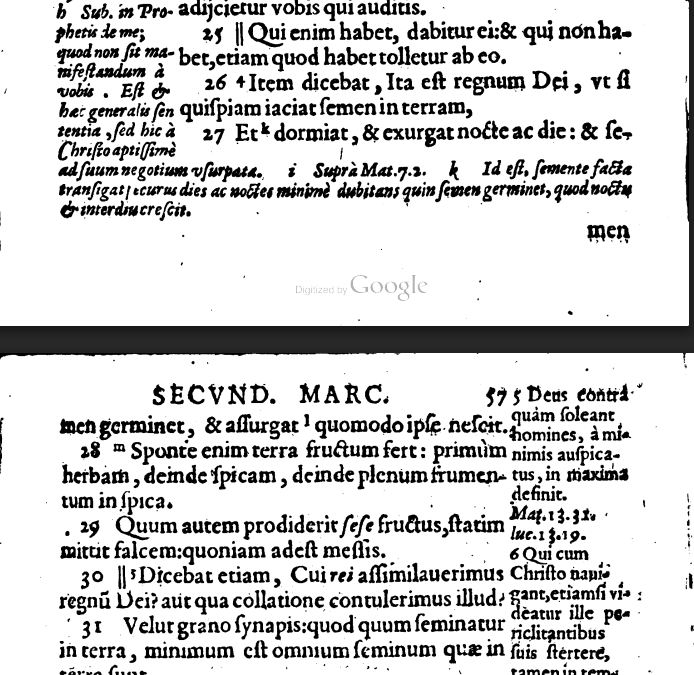
Screenshots taken from the Nouum Testamentum of Théodore de Bèze, (1519-1605) ( Londini : Thomas Vautrollerius, typographus, 1587 )
Accessed from the Post Reformation Digital Library
Red and Green Vocab
The words in red and green are found among the 3057 Most Common Words in the Classical Latin texts that we will explore on CentumVerba.com and are essential to your understanding of the texts of Caesar, Vergil and Cicero. The green words appear frequently (at least five times) among Vergil's Aeneid (books I-VI), Caesar de bello Gallico (books I-V) and in Cicero's works - in Catilinam (books I-IV), de lege Manilia (also known as de Imperio Cn. Pompei), and pro Achia. These works constituted the curriculum for Latin over 4 years in American High Schools at the start of the 20th Century. The bulk of my information is taken from The Vocabulary of High School Latin by Gonzalez Lodge. I have added to these 2000 words from varioius other sources to compile my own list of The 3057 Most Common Latin Words.
The black words do not appear frequently in Classical Latin.
The red words are the first occurrences of these words in this author and this word will appear as green the next time you encounter it.
If you are serious about building your vocabulary then you should learn the red words as they occur and you should already know the green ones!
I have provided a FLASHCARD set to help - see below.
How To Read the Interactive Text
To Read the Interactive Text Below Without a Dictionary-
On a Computer: you hover over a word and get all its possible parts of speech; declensions; and conjugations.
On a Tablet: 'Tap' the word to see the definition, and to remove the 'definition box' you simply 'Tap' anywhere to the side.
Red and Green Vocab
The words in red and green are found among the 3057 Most Common Words in the Classical Latin texts that we will explore on CentumVerba.com and are essential to your understanding of the texts of Caesar, Vergil and Cicero. The green words appear frequently (at least five times) among Vergil's Aeneid (books I-VI), Caesar de bello Gallico (books I-V) and in Cicero's works - in Catilinam (books I-IV), de lege Manilia (also known as de Imperio Cn. Pompei), and pro Achia. These works constituted the curriculum for Latin over 4 years in American High Schools at the start of the 20th Century. The bulk of my information is taken from The Vocabulary of High School Latin by Gonzalez Lodge. I have added to these 2000 words from varioius other sources to compile my own list of The 3057 Most Common Latin Words.
The black words do not appear frequently in Classical Latin.
The red words are the first occurrences of these words in this author and this word will appear as green the next time you encounter it.
If you are serious about building your vocabulary then you should learn the red words as they occur and you should already know the green ones!
I have provided a FLASHCARD set to help - see below.
How To Read the Interactive Text
To Read the Interactive Text Below Without a Dictionary-
On a Phone or Tablet: ''TAP' the word to see the definition, and to remove the 'definition box' you simply 'TAP' anywhere to the side.
INTERACTIVE DICTIONARY FREE TEXT
Caput 3
24 Et si regnum in se dividatur, non potest stare regnum illud
You Need to be at least a Trial Member to Access the Interactive Dictionary
25 et si domus in semet ipsam dispertiatur, non poterit domus illa stare.
26 Et si Satanas consurrexit in semet ipsam et dispertitus est, non potest stare, sed finem habet.
27 Nemo autem potest in domum fortis ingressus vasa eius diripere, nisi prius fortem alliget et tunc domum eius diripiet.
28 Amen dico vobis Omnia dimittentur filiis hominum peccata et blasphemiae, quibus blasphemaverint
29 qui autem blasphemaverit in Spiritum Sanctum, non habet remissionem in aeternum, sed reus est aeterni delicti.
30 Quoniam dicebant Spiritum immundum habet.
31 Et venit mater eius et fratres eius, et foris stantes miserunt ad eum vocantes eum.
32 Et sedebat circa eum turba, et dicunt ei Ecce mater tua et fratres tui et sorores tuae foris quaerunt te.
I have prepared online Flashcards at CRAM.com to make learning the vocabulary much easier. I have no financial gain as the app is FREE to use.
I have created a stack of the 11 new words in this passage.
YOU NEED TO SIGN UP AS A TRIAL MEMBER TO ACCESS THE FLASHCARDS
Here is the link to the FLASHCARDS
USING THE FLASHCARD APP:
To make the most of the online Flashcards use the "Click or use spacebar to begin" and the Latin word should appear. (The 'Shuffle' button will take the cards out of alphabetical order.) Type 'H' to get the conjugation / declension of the word if you want to see it. 'H' takes tyou back to the word. Click 'See Answer' or use the Spacebar to see the English.
If you were correct or close enough then select "I was right" or else "I was wrong". After you have completed the set it will start again but it will only display the ones you got wrong.
Continue through this process to learn all the words. I hope this is helpful!
Recent Comments