
ut - small word - big job
The Latin word ut is remarkably versatile, serving a range of grammatical and stylistic functions in both Classical and Vulgate Latin. Its meaning and use depend heavily on context, and it often introduces subordinate clauses with different nuances.
In Classical Latin, ut is most commonly used in three major constructions:
- Purpose Clauses: Here, ut introduces a clause that expresses the goal or intention of an action. The verb in the clause is in the subjunctive mood. For example, Venit ut me videat means ‘He comes in order that he may see me.’ When the purpose is negative, ne is used instead of ut.
- Result Clauses: These describe the outcome of an action and are also followed by the subjunctive. They are often preceded by words like tam (so), tantus (so great), or ita (in such a way). For instance, Tam stulte dixit ut omnes riderent means ‘He spoke so foolishly that everyone laughed.’ A negative result clause uses ut...non.
- Indirect Commands: After verbs of asking, advising, or commanding, ut introduces what someone is being asked or told to do. For example, Imperavit ut veniret means ‘He ordered that he come.’ The negative form again uses ne.
Beyond these, ut can also function as a temporal conjunction meaning ‘when’ or ‘as soon as,’ especially with the indicative mood: Ut hostes viderunt, fugerunt (‘When the enemies saw [them], they fled’).
In Vulgate Latin, which reflects a more colloquial and sometimes simplified style, ut retains these classical uses but also appears more frequently in completive clauses—that is, clauses that complete the meaning of verbs like optare (to wish) or timere (to fear). For example, Optamus ut veniat means ‘We wish that he may come.’ Interestingly, in clauses of fearing, ut can take on a negative meaning: Timeo ut veniat translates as ‘I fear that he may not come.’
Thus, ut is a linguistic chameleon—shifting between purpose, result, command, time, and completion depending on the structure and mood of the sentence. Its flexibility is a hallmark of Latin’s syntactic richness, and understanding its nuances is key to mastering both Classical prose and the ecclesiastical tone of the Vulgate. It’s a small word with a big job.
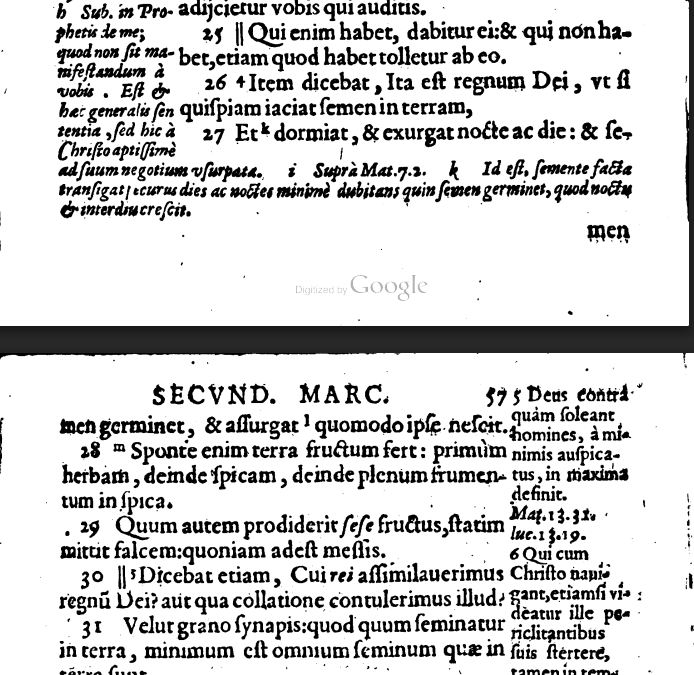
The images for these posts on Mark's gospel
Screenshots taken from the Nouum Testamentum of Théodore de Bèze, (1519-1605) ( Londini : Thomas Vautrollerius, typographus, 1587 )
Accessed from the Post Reformation Digital Library
Red and Green Vocab
The words in red and green are found among the 3057 Most Common Words in the Classical Latin texts that we will explore on CentumVerba.com and are essential to your understanding of the texts of Caesar, Vergil and Cicero. The green words appear frequently (at least five times) among Vergil's Aeneid (books I-VI), Caesar de bello Gallico (books I-V) and in Cicero's works - in Catilinam (books I-IV), de lege Manilia (also known as de Imperio Cn. Pompei), and pro Achia. These works constituted the curriculum for Latin over 4 years in American High Schools at the start of the 20th Century. The bulk of my information is taken from The Vocabulary of High School Latin by Gonzalez Lodge. I have added to these 2000 words from varioius other sources to compile my own list of The 3057 Most Common Latin Words.
The black words do not appear frequently in Classical Latin.
The red words are the first occurrences of these words in this author and this word will appear as green the next time you encounter it.
If you are serious about building your vocabulary then you should learn the red words as they occur and you should already know the green ones!
I have provided a FLASHCARD set to help - see below.
How To Read the Interactive Text
To Read the Interactive Text Below Without a Dictionary-
On a Computer: you hover over a word and get all its possible parts of speech; declensions; and conjugations.
On a Tablet: 'Tap' the word to see the definition, and to remove the 'definition box' you simply 'Tap' anywhere to the side.
Red and Green Vocab
The words in red and green are found among the 3057 Most Common Words in the Classical Latin texts that we will explore on CentumVerba.com and are essential to your understanding of the texts of Caesar, Vergil and Cicero. The green words appear frequently (at least five times) among Vergil's Aeneid (books I-VI), Caesar de bello Gallico (books I-V) and in Cicero's works - in Catilinam (books I-IV), de lege Manilia (also known as de Imperio Cn. Pompei), and pro Achia. These works constituted the curriculum for Latin over 4 years in American High Schools at the start of the 20th Century. The bulk of my information is taken from The Vocabulary of High School Latin by Gonzalez Lodge. I have added to these 2000 words from varioius other sources to compile my own list of The 3057 Most Common Latin Words.
The black words do not appear frequently in Classical Latin.
The red words are the first occurrences of these words in this author and this word will appear as green the next time you encounter it.
If you are serious about building your vocabulary then you should learn the red words as they occur and you should already know the green ones!
I have provided a FLASHCARD set to help - see below.
How To Read the Interactive Text
To Read the Interactive Text Below Without a Dictionary-
On a Phone or Tablet: ''TAP' the word to see the definition, and to remove the 'definition box' you simply 'TAP' anywhere to the side.
INTERACTIVE DICTIONARY FREE TEXT
Caput 3
14 Et fecit Duodecim, ut essent cum illo, et ut mitteret eos praedicare
You Need to be at least a Trial Member to Access the Interactive Dictionary
15 habentes potestatem curandi infirmitates et eiciendi daemonia
16 et imposuit Simoni nomen Petrum
17 et Iacobum Zebedaei et Ioannem fratrem Iacobi, et imposuit eis nomina Boanerges, quod est Filii tonitrui
18 et Andream et Philippum et Bartholomaeum et Matthaeum et Thomam et Iacobum Alphaei et Thaddaeum et Simonem Chananaeum
19 et Iudam Iscarioth, qui et tradidit illum.
20 Et venit ad domum et convenit iterum turba, ita ut non possent neque panem manducare.
21 Et cum audissent sui, exierunt tenere eum dicebant enim In furorem versus est.
22 Et scribae, qui ab Hierosolymis descenderant, dicebant Beelzebul habet et In principe daemonum eicit daemonia.
23 Et convocatis eis, in parabolis dicebat illis Quomodo potest Satanas Satanam eicere?
I have prepared online Flashcards at CRAM.com to make learning the vocabulary much easier. I have no financial gain as the app is FREE to use.
I have created a stack of the 9 new words in this passage.
YOU NEED TO SIGN UP AS A TRIAL MEMBER TO ACCESS THE FLASHCARDS
Here is the link to the FLASHCARDS
I have prepared online Flashcards at CRAM.com to make learning the vocabulary much easier. I have no financial gain as the app is FREE to use.
I have created a stack of the 9 new words in this passage.
YOU NEED TO SIGN UP AS A TRIAL MEMBER TO ACCESS THE FLASHCARDS
Here is the link to the FLASHCARDS
USING THE FLASHCARD APP:
To make the most of the online Flashcards use the "Click or use spacebar to begin" and the Latin word should appear. (The 'Shuffle' button will take the cards out of alphabetical order.) Type 'H' to get the conjugation / declension of the word if you want to see it. 'H' takes tyou back to the word. Click 'See Answer' or use the Spacebar to see the English.
If you were correct or close enough then select "I was right" or else "I was wrong". After you have completed the set it will start again but it will only display the ones you got wrong.
Continue through this process to learn all the words. I hope this is helpful!
Recent Comments