
scopulus
The Latin noun scopulus refers to a crag, cliff, or rocky outcrop, often associated with danger and obstacles in classical literature. Derived from the Greek skópelos, meaning 'lookout place' or 'promontory,' scopulus frequently appears in Roman texts to describe treacherous landscapes, maritime hazards, and metaphorical challenges.
Usage in Classical Latin Literature
The word scopulus is commonly found in epic poetry, particularly in works by Vergil, Ovid, and Horace. In Vergil’s Aeneid, scopuli often symbolize perilous journeys, as seen in descriptions of shipwrecks and coastal dangers. For instance, in Aeneid I, Aeneas and his fleet encounter towering scopuli along the shores of Libya, emphasizing the harshness of their voyage. In fact scopulus has been mentioned several time already in our reading of the Aeneid.
Ovid also employs scopulus in his Metamorphoses, using it to depict dramatic landscapes where transformations occur. In Book V, the word appears in the context of Perseus turning his enemies to stone, reinforcing the theme of rigidity and immobility. Similarly, in Book VII, Medea’s magical rituals take place near rugged scopuli, adding an eerie atmosphere to her enchantments.
Horace, in his Odes, uses scopulus metaphorically to represent obstacles in life and the dangers of ambition. His poetry often contrasts the stability of land with the unpredictability of the sea, where scopuli serve as warnings against reckless pursuits.
Symbolism and Interpretation
Beyond its literal meaning, scopulus carries symbolic weight in Latin literature. It frequently represents challenges that heroes must overcome, whether physical or metaphorical. The imagery of jagged cliffs and rocky shores underscores themes of struggle, endurance, and fate.
Legacy and Influence
The word scopulus has influenced modern Romance languages, with derivatives appearing in Italian (scopulo) and French (écueil). Its presence in classical texts continues to shape literary descriptions of rugged landscapes and perilous journeys.
Thus, scopulus is more than just a geographical term—it is a powerful literary device that conveys danger, resilience, and the trials of human existence.
Today's Artwork:
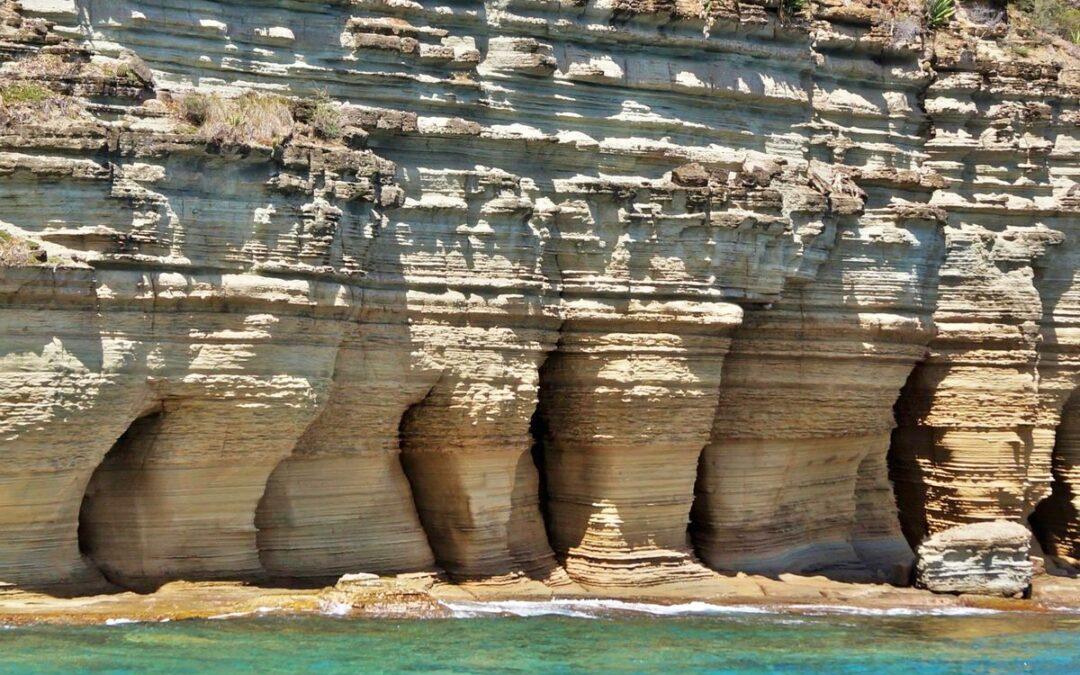
Photo: Pillars of Hercules: A series of magical limestone formations along the coastline of the country island of Antigua.
Here is a text only version. (See below for an interactive version)
Fronte sub adversa scopulis pendentibus antrum,
intus aquae dulces vivoque sedilia saxo,
nympharum domus: hic fessas non vincula navis
ulla tenent, unco non alligat ancora morsu.
Huc septem Aeneas collectis navibus omni
ex numero subit; ac magno telluris amore
egressi optata potiuntur Troes harena,
et sale tabentis artus in litore ponunt.
Ac primum silici scintillam excudit Achates, s
uccepitque ignem foliis, atque arida circum
nutrimenta dedit, rapuitque in fomite flammam.
Tum Cererem corruptam undis Cerealiaque arma
expediunt fessi rerum, frugesque receptas
et torrere parant flammis et frangere saxo.
Aeneas scopulum interea conscendit, et omnem
prospectum late pelago petit, Anthea si quem
iactatum vento videat Phrygiasque biremis,
aut Capyn, aut celsis in puppibus arma Caici.
Need Help Understanding the Latin?
You might find it helpful to start with the Side-by-Side Version which allows you to see my own very literal translation of the text which is almost a word-for-word translation - in an attempt to make it easier to understand the Latin!
Finally come back to this page - Classical Text and you should be able to better understand and competently read the original Latin text.
Vocabulary Version
I have prepared a Vocabulary Version of the passage (link at bottom of the page) which highlights the 3057 Most Common Words in the texts of Vergil, Caesar and Cicero that we will explore on CentumVerba.com
If you are serious about building your vocabulary, the FLASHCARD set should help you learn them.
How To Read the Interactive Text
To Read the Interactive Text Below Without a Dictionary-
On a Computer: you hover over a word and get all the possible parts of speech; declensions; and conjugations of every word.
Need Help Understanding the Latin?
You might find it helpful to start with the Side-by-Side Version which allows you to see my own very literal translation of the text which is almost a word-for-word translation - in an attempt to make it easier to understand the Latin!
Finally come back to this page - Classical Text and you should be able to better understand and competently read the original Latin text.
Vocabulary Version
I have prepared a Vocabulary Version of the passage (link at bottom of the page) which highlights the 3057 Most Common Words in the texts of Vergil, Caesar and Cicero that we will explore on CentumVerba.com
If you are serious about building your vocabulary, the FLASHCARD set should help you learn them.
How To Read the Interactive Text
To Read the Interactive Text Below Without a Dictionary-
On a Phone or Tablet: don't 'hover' -'tap' the word. To remove the 'definition box' you 'tap' to the side of the text box.
INTERACTIVE DICTIONARY FREE TEXT
Fronte sub adversa scopulis pendentibus antrum, intus aquae dulces vivoque sedilia saxo, nympharum domus:
You Need to be a Member to Access the Interactive Dictionary
hic fessas non vincula navis ulla tenent, unco non alligat ancora morsu.
Huc septem Aeneas collectis navibus omni ex numero subit; ac magno telluris amore egressi optata potiuntur Troes harena, et sale tabentis artus in litore ponunt.
Ac primum silici scintillam excudit Achates, succepitque ignem foliis, atque arida circum nutrimenta dedit, rapuitque in fomite flammam.
Tum Cererem corruptam undis Cerealiaque arma expediunt fessi rerum, frugesque receptas et torrere parant flammis et frangere saxo.
Aeneas scopulum interea conscendit, et omnem prospectum late pelago petit, Anthea si quem iactatum vento videat Phrygiasque biremis, aut Capyn, aut celsis in puppibus arma Caici.
Recent Comments