
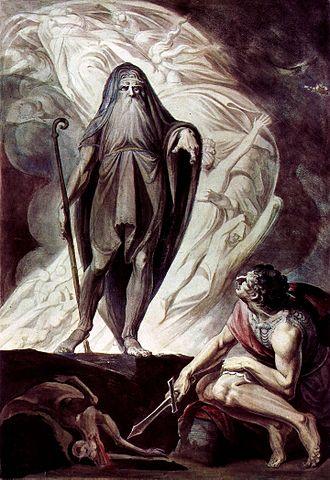
Umbra
In Latin poetry, the term ‘umbra’ (meaning ‘shadow’) holds significant symbolic and thematic weight. Shadows in Latin poetry often represent absence, memory, and the ephemeral nature of life, serving as a powerful metaphor for the human condition. One of the most notable examples of umbra is found in the works of Virgil. In the Aeneid, shadows frequently symbolize the past, the underworld, and the transient nature of human endeavors. An umbra can also be the spirit or ghost of a dead person, residing in the underworld. An underworld where the dead live in shadow (umbra) was common to beliefs in the ancient Near East.
Only select individuals were believed to be exempt from the fate of dwelling in shadow after death. They would instead ascend to the divine sphere, as is reflected in the veneration of heroes. Shades appear in Book Eleven of Homer's Odyssey, when Odysseus descends into Hades, and in Book Six of the Aeneid, when Aeneas travels to the underworld. In the Divine Comedy by Dante Alighieri, many of the dead are similarly referred to as shades (Italian ombra), including Dante's guide, Vergil.
Virgil employs umbra to evoke a sense of nostalgia and longing, as seen in Aeneas' encounters with the shades of the dead in the underworld. These shadows are not merely ghosts but represent the lingering influence of the past on the present. The encounter with the shade of Anchises, Aeneas' father, highlights the importance of legacy and the weight of ancestral expectations.
Ovid's Metamorphoses
Ovid's Metamorphoses also utilizes umbra to explore themes of transformation and the fleeting nature of beauty and youth. Shadows in Ovid's poetry often signal a transition or change, mirroring the constant flux of the world and the human experience within it. For instance, in the story of Narcissus, his obsession with his reflection can be seen as an infatuation with his own shadow, ultimately leading to his demise.
Horace's Odes
In Horace's odes, umbra is used to reflect the philosophical contemplation of mortality. Shadows here remind readers of the inevitability of death and the importance of seizing the present moment.
In Latin poetry and literature however, umbra, can just as easily mean a shadow as in darkness under a rich tree canopy - as in this instance.
Today's Artwork: The Shade of Tiresias Appearing to Odysseus during the Sacrifice
Painting by: Johann Heinrich Füssli, (c. 1780–85) showing a scene from Book Ten of the Odyssey
Source: The Yorck Project (2002) 10.000 Meisterwerke der Malerei (DVD-ROM), distributed by DIRECTMEDIA Publishing GmbH. ISBN: 3936122202.
Here is a text only version. (See below for an interactive version)
tum, pietate gravem ac meritis si forte virum quem
conspexere, silent, arrectisque auribus adstant;
ille regit dictis animos, et pectora mulcet;
sic cunctus pelagi cecidit fragor, aequora postquam
prospiciens genitor caeloque invectus aperto
flectit equos, curruque volans dat lora secundo.
Defessi Aeneadae, quae proxima litora, cursu
contendunt petere, et Libyae vertuntur ad oras.
Est in secessu longo locus: insula portum
efficit obiectu laterum, quibus omnis ab alto
frangitur inque sinus scindit sese unda reductos.
Hinc atque hinc vastae rupes geminique minantur
in caelum scopuli, quorum sub vertice late
aequora tuta silent; tum silvis scaena coruscis
desuper horrentique atrum nemus imminet umbra.
Need Help Understanding the Latin?
You might find it helpful to start with the Side-by-Side Version which allows you to see my own very literal translation of the text which is almost a word-for-word translation - in an attempt to make it easier to understand the Latin!
Finally come back to this page - Classical Text and you should be able to better understand and competently read the original Latin text.
Vocabulary Version
I have prepared a Vocabulary Version of the passage (link at bottom of the page) which highlights the 3057 Most Common Words in the texts of Vergil, Caesar and Cicero that we will explore on CentumVerba.com
If you are serious about building your vocabulary, the FLASHCARD set should help you learn them.
How To Read the Interactive Text
To Read the Interactive Text Below Without a Dictionary-
On a Computer: you hover over a word and get all the possible parts of speech; declensions; and conjugations of every word.
Need Help Understanding the Latin?
You might find it helpful to start with the Side-by-Side Version which allows you to see my own very literal translation of the text which is almost a word-for-word translation - in an attempt to make it easier to understand the Latin!
Finally come back to this page - Classical Text and you should be able to better understand and competently read the original Latin text.
Vocabulary Version
I have prepared a Vocabulary Version of the passage (link at bottom of the page) which highlights the 3057 Most Common Words in the texts of Vergil, Caesar and Cicero that we will explore on CentumVerba.com
If you are serious about building your vocabulary, the FLASHCARD set should help you learn them.
How To Read the Interactive Text
To Read the Interactive Text Below Without a Dictionary-
On a Phone or Tablet: don't 'hover' -'tap' the word. To remove the 'definition box' you 'tap' to the side of the text box.
INTERACTIVE DICTIONARY FREE TEXT
tum, pietate gravem ac meritis si forte virum quem conspexere, silent, arrectisque auribus adstant; ille regit dictis animos, et pectora mulcet,—
You Need to be a Member to Access the Interactive Dictionary
sic cunctus pelagi cecidit fragor, aequora postquam prospiciens genitor caeloque invectus aperto flectit equos, curruque volans dat lora secundo.
Defessi Aeneadae, quae proxima litora, cursu contendunt petere, et Libyae vertuntur ad oras. Est in secessu longo locus:
insula portum efficit obiectu laterum, quibus omnis ab alto frangitur inque sinus scindit sese unda reductos.
Hinc atque hinc vastae rupes geminique minantur in caelum scopuli, quorum sub vertice late aequora tuta silent;
tum silvis scaena coruscis desuper horrentique atrum nemus imminet umbra.
INTERACTIVE DICTIONARY FREE TEXT
conspexere, silent, arrectisque auribus adstant;
ille regit dictis animos, et pectora mulcet;
You Need to be a Member to Access the Interactive Dictionary
prospiciens genitor caeloque invectus aperto
flectit equos, curruque volans dat lora secundo.
Defessi Aeneadae, quae proxima litora, cursu
contendunt petere, et Libyae vertuntur ad oras.
Est in secessu longo locus: insula portum
efficit obiectu laterum, quibus omnis ab alto
frangitur inque sinus scindit sese unda reductos.
Hinc atque hinc vastae rupes geminique minantur
in caelum scopuli, quorum sub vertice late
aequora tuta silent; tum silvis scaena coruscis
desuper horrentique atrum nemus imminet umbra.
Recent Comments