
navis lusoria
A lusoria (short form of navis lusoria from Latin 'dancing/playful ship', plural naves lusoriae) was a type of small military vessel of the late Roman Empire that served as a troop transport. It was powered by about thirty soldier-oarsmen and an auxiliary sail. Nimble, graceful, and of shallow draft, such a navis lusoria was used on northern rivers close to the Limes Germanicus, the Germanic border, and thus saw service on the Rhine and the Danube. The Roman historian Ammianus Marcellinus mentioned the navis lusoria in his writings, but not much about it could be learned until the discovery of such boats at Mainz, Germany, in 1981–82.
The Roman navis of Mainz
In November 1981, during excavation in the course of the construction of a Hilton Hotel at Mainz, wooden remains were found and identified as parts of an old ship. Before construction resumed three months later, the site yielded remnants of five ships that were dated to the 4th century using dendrochronology. Each navis was measured, taken apart, and, in 1992, brought to the Museum of Ancient Seafaring (German: Museum für Antike Schifffahrt) of the Romano-Germanic Central Museum (Römisch-Germanisches Zentralmuseum) for further preservation and study.
Scientifically, the wrecks were identified as military vessels that belonged to the Roman flotilla in Germania, the Classis Germanica. The vessels could be classified into two types: small troop transports, termed navis lusoria, and patrol vessels. The lusoria is narrower than the actuaria, an earlier and wider type of Roman cargo vessel.
Reconstruction of a navis lusoria
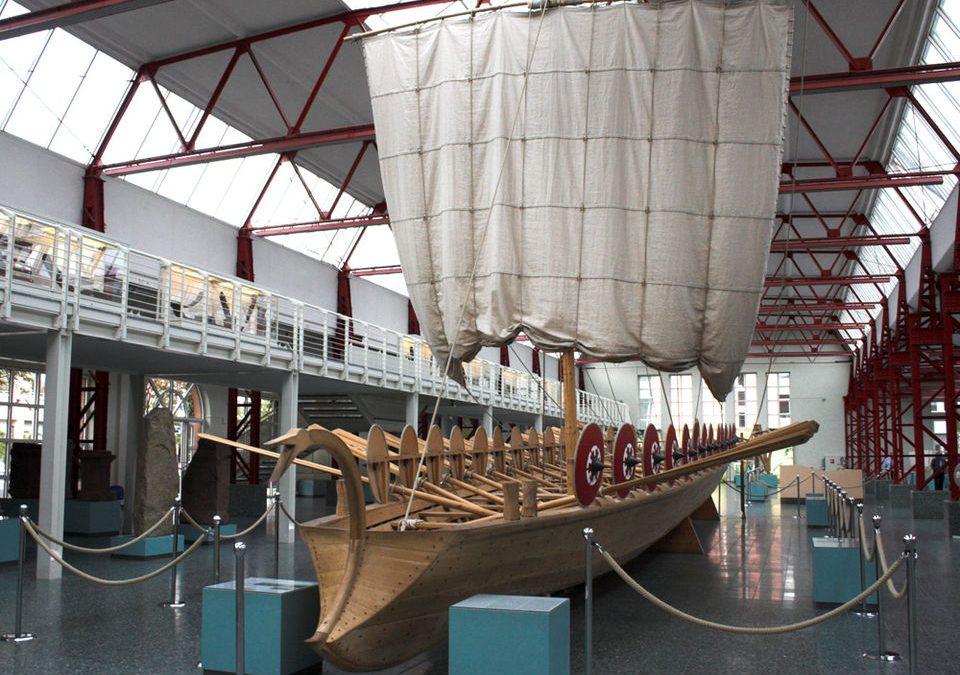
A full-sized reconstructed navis is on display at the Museum of Ancient Seafaring, Mainz, and serves as a representative of the lusoria. The replica measures 21.0 by 2.8 m (68 ft 11 in by 9 ft 2 in) while the gunwale measures 0.96 m (3 ft 2 in).[5] Again, oak is used. The planks are 2 cm (0.8 in) thick, generally 25 cm (10 in) long and are carvel-built. The keel is only 5 cm (2 in) thick and constructed of planks; it contains a central channel to collect water. There is no keelson. The frames are placed 33.5 cm (13.2 in) apart, corresponding to the measuring unit of a pes Drusianus. The frames hold the ship together. The mastframe contains a hole to place the mast. While the navis could be sailed, the main method of propulsion was rowing by one open row of oarsmen on each side. The gunwale displays an outside fender and is topped by a covering board. The covering board contains the support for the oars. The protective effect of the gunwales is further extended by the shields of the soldiers, which were hung on the outside. A navis was steered by a double rudder aft. Sails have not survived the centuries, so their reconstruction relies on ancient depictions. A navis lusoria was crewed by the steersman, two men to handle the sail, and about 30 soldiers who manned the oars.
It has been calculated that the narrow and relatively long navis lusoria could attain a travel speed of 11 to 13 km/h (6 to 7 kn) and a maximum speed of 18 km/h (10 kn).
The significance of the findings led to the establishment of a specific research center to study Roman ship transport at the Romano-Germanic Central Museum and of the Museum of Ancient Seafaring as its parent division. The latter museum has been in operation since 1994 and displays replicas of the navis lusoria and the patrol vessel as well as original artefacts.[6] It specialises in Roman shipbuilding and ship transport, in the Germanic provinces and in the whole empire.
Today's Artwork:
A reconstructed navis lusoria at the Museum of Ancient Seafaring
Photo: By Martin Bahmann - Own work, CC BY-SA 3.0
Source: https://commons.wikimedia.org
Here is a text only version. (See below for an interactive version)
Navem in conspectu nullam, tris litore cervos
prospicit errantis; hos tota armenta sequuntur
a tergo, et longum per vallis pascitur agmen.
Constitit hic, arcumque manu celerisque sagittas
corripuit, fidus quae tela gerebat Achates;
ductoresque ipsos primum, capita alta ferentis
cornibus arboreis, sternit, tum volgus, et omnem
miscet agens telis nemora inter frondea turbam;
nec prius absistit, quam septem ingentia victor
corpora fundat humi, et numerum cum navibus aequet.
Hinc portum petit, et socios partitur in omnes.
Vina bonus quae deinde cadis onerarat Acestes
litore Trinacrio dederatque abeuntibus heros,
dividit, et dictis maerentia pectora mulcet:
“O socii—neque enim ignari sumus ante malorum—
O passi graviora, dabit deus his quoque finem.
navis lusoria
A lusoria (short form of navis lusoria from Latin 'dancing/playful ship', plural naves lusoriae) was a type of small military vessel of the late Roman Empire that served as a troop transport. It was powered by about thirty soldier-oarsmen and an auxiliary sail. Nimble, graceful, and of shallow draft, such a navis lusoria was used on northern rivers close to the Limes Germanicus, the Germanic border, and thus saw service on the Rhine and the Danube. The Roman historian Ammianus Marcellinus mentioned the navis lusoria in his writings, but not much about it could be learned until the discovery of such boats at Mainz, Germany, in 1981–82.
The Roman navis of Mainz
In November 1981, during excavation in the course of the construction of a Hilton Hotel at Mainz, wooden remains were found and identified as parts of an old ship. Before construction resumed three months later, the site yielded remnants of five ships that were dated to the 4th century using dendrochronology. Each navis was measured, taken apart, and, in 1992, brought to the Museum of Ancient Seafaring (German: Museum für Antike Schifffahrt) of the Romano-Germanic Central Museum (Römisch-Germanisches Zentralmuseum) for further preservation and study.
Scientifically, the wrecks were identified as military vessels that belonged to the Roman flotilla in Germania, the Classis Germanica. The vessels could be classified into two types: small troop transports, termed navis lusoria, and patrol vessels. The lusoria is narrower than the actuaria, an earlier and wider type of Roman cargo vessel.
Reconstruction of a navis lusoria
A full-sized reconstructed navis is on display at the Museum of Ancient Seafaring, Mainz, and serves as a representative of the lusoria. The replica measures 21.0 by 2.8 m (68 ft 11 in by 9 ft 2 in) while the gunwale measures 0.96 m (3 ft 2 in).[5] Again, oak is used. The planks are 2 cm (0.8 in) thick, generally 25 cm (10 in) long and are carvel-built. The keel is only 5 cm (2 in) thick and constructed of planks; it contains a central channel to collect water. There is no keelson. The frames are placed 33.5 cm (13.2 in) apart, corresponding to the measuring unit of a pes Drusianus. The frames hold the ship together. The mastframe contains a hole to place the mast. While the navis could be sailed, the main method of propulsion was rowing by one open row of oarsmen on each side. The gunwale displays an outside fender and is topped by a covering board. The covering board contains the support for the oars. The protective effect of the gunwales is further extended by the shields of the soldiers, which were hung on the outside. A navis was steered by a double rudder aft. Sails have not survived the centuries, so their reconstruction relies on ancient depictions. A navis lusoria was crewed by the steersman, two men to handle the sail, and about 30 soldiers who manned the oars.
It has been calculated that the narrow and relatively long navis lusoria could attain a travel speed of 11 to 13 km/h (6 to 7 kn) and a maximum speed of 18 km/h (10 kn).
The significance of the findings led to the establishment of a specific research center to study Roman ship transport at the Romano-Germanic Central Museum and of the Museum of Ancient Seafaring as its parent division. The latter museum has been in operation since 1994 and displays replicas of the navis lusoria and the patrol vessel as well as original artefacts.[6] It specialises in Roman shipbuilding and ship transport, in the Germanic provinces and in the whole empire.
Today's Artwork:
A reconstructed navis lusoria at the Museum of Ancient Seafaring
Photo: By Martin Bahmann - Own work, CC BY-SA 3.0
Source: https://commons.wikimedia.org
Here is a text only version. (See below for an interactive version)
Here is a text only version. (See below for an interactive version)
Navem in conspectu nullam, tris litore cervos
prospicit errantis; hos tota armenta sequuntur
a tergo, et longum per vallis pascitur agmen.
Constitit hic, arcumque manu celerisque sagittas
corripuit, fidus quae tela gerebat Achates;
ductoresque ipsos primum, capita alta ferentis
cornibus arboreis, sternit, tum volgus, et omnem
miscet agens telis nemora inter frondea turbam;
nec prius absistit, quam septem ingentia victor
corpora fundat humi, et numerum cum navibus aequet.
Hinc portum petit, et socios partitur in omnes.
Vina bonus quae deinde cadis onerarat Acestes
litore Trinacrio dederatque abeuntibus heros,
dividit, et dictis maerentia pectora mulcet:
“O socii—neque enim ignari sumus ante malorum—
O passi graviora, dabit deus his quoque finem.
Need Help Understanding the Latin?
You might find it helpful to start with the Side-by-Side Version which allows you to see my own very literal translation of the text which is almost a word-for-word translation - in an attempt to make it easier to understand the Latin!
Finally come back to this page - Classical Text and you should be able to better understand and competently read the original Latin text.
Vocabulary Version
I have prepared a Vocabulary Version of the passage (link at bottom of the page) which highlights the 3057 Most Common Words in the texts of Vergil, Caesar and Cicero that we will explore on CentumVerba.com
If you are serious about building your vocabulary, the FLASHCARD set should help you learn them.
How To Read the Interactive Text
To Read the Interactive Text Below Without a Dictionary-
On a Computer: you hover over a word and get all the possible parts of speech; declensions; and conjugations of every word.
Need Help Understanding the Latin?
You might find it helpful to start with the Side-by-Side Version which allows you to see my own very literal translation of the text which is almost a word-for-word translation - in an attempt to make it easier to understand the Latin!
Finally come back to this page - Classical Text and you should be able to better understand and competently read the original Latin text.
Vocabulary Version
I have prepared a Vocabulary Version of the passage (link at bottom of the page) which highlights the 3057 Most Common Words in the texts of Vergil, Caesar and Cicero that we will explore on CentumVerba.com
If you are serious about building your vocabulary, the FLASHCARD set should help you learn them.
How To Read the Interactive Text
To Read the Interactive Text Below Without a Dictionary-
On a Phone or Tablet: don't 'hover' -'tap' the word. To remove the 'definition box' you 'tap' to the side of the text box.
INTERACTIVE DICTIONARY FREE TEXT
Navem in conspectu nullam, tris litore cervos prospicit errantis; hos tota armenta sequuntur a tergo, et longum per vallis pascitur agmen.
You Need to be a Member to Access the Interactive Dictionary
Constitit hic, arcumque manu celerisque sagittas corripuit, fidus quae tela gerebat Achates;
ductoresque ipsos primum, capita alta ferentis cornibus arboreis, sternit, tum volgus, et omnem miscet agens telis nemora inter frondea turbam;
nec prius absistit, quam septem ingentia victor corpora fundat humi, et numerum cum navibus aequet.
Hinc portum petit, et socios partitur in omnes. Vina bonus quae deinde cadis onerarat Acestes litore Trinacrio dederatque abeuntibus heros, dividit, et dictis maerentia pectora mulcet:
“O socii— neque enim ignari sumus ante malorum— O passi graviora, dabit deus his quoque finem.
INTERACTIVE DICTIONARY FREE TEXT
Navem in conspectu nullam, tris litore cervos prospicit errantis; hos tota armenta sequuntur a tergo, et longum per vallis pascitur agmen.
You Need to be a Member to Access the Interactive Dictionary
Constitit hic, arcumque manu celerisque sagittas corripuit, fidus quae tela gerebat Achates;
ductoresque ipsos primum, capita alta ferentis cornibus arboreis, sternit, tum volgus, et omnem miscet agens telis nemora inter frondea turbam;
nec prius absistit, quam septem ingentia victor corpora fundat humi, et numerum cum navibus aequet.
Hinc portum petit, et socios partitur in omnes. Vina bonus quae deinde cadis onerarat Acestes litore Trinacrio dederatque abeuntibus heros, dividit, et dictis maerentia pectora mulcet: “O socii— neque enim ignari sumus ante malorum— O passi graviora, dabit deus his quoque finem.
Recent Comments