
Latium
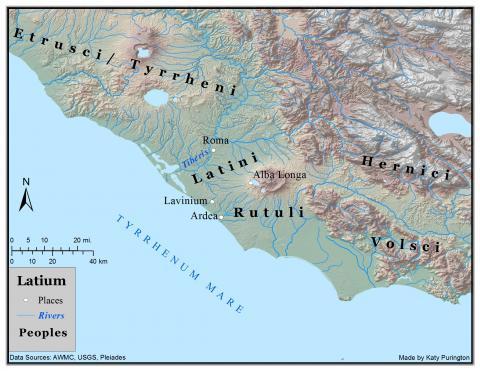
Latium, located in central Italy, is a historically and mythologically significant region in Virgil’s Aeneid. Situated south of Etruria and north of Campania, it encompasses a coastal and inland landscape that would later become the heart of Roman civilization. The region is characterized by rolling hills, fertile plains, and proximity to the Tiber River, making it an ideal location for settlement and expansion. It is home to various indigenous Italic peoples, including the Latins, and its strategic location between land and sea makes it a hub for trade, agriculture, and cultural exchange.
Aeneas, the Trojan hero, seeks out Latium not simply as a place of refuge, but as the destined land for the foundation of Rome. According to prophecy, his journey is divinely guided, and Latium represents the fulfillment of his fate. His mother, Venus, and the gods repeatedly signal that this region is where he must settle to establish a powerful lineage. Anchises, his father, confirms this vision when he describes Aeneas’ future in the underworld, pointing to Rome’s greatness arising from his settlement in Italy.
Furthermore, Latium holds political and symbolic significance in the Aeneid. King Latinus, its ruler, welcomes Aeneas, recognizing that his arrival aligns with the ancient prophecy foretelling a foreign hero who will marry his daughter, Lavinia, and bring prosperity. Latinus’ openness represents the destined union between Trojans and Italians, emphasizing Virgil’s theme of cultural fusion and the origins of Roman identity.
Aeneas’ pursuit of Latium is not without challenges. Juno, ever his adversary, incites conflict by manipulating Turnus, a local warrior, into resisting Aeneas. The ensuing war underscores the struggles of destiny—Aeneas must fight not only for survival but for the legitimacy of his claim to Latium. His eventual victory cements the region as the birthplace of Rome, marking the transition from hardship to triumph.
Through Latium, Virgil ties Aeneas’ journey to Rome’s mythological foundations, presenting the land as divinely ordained and pivotal to the empire’s rise. It is more than a geographical destination—it is the stage for fate, war, and eventual legacy.
Today's Artwork:
Image: A map of Latium. By (c) Katy Purington
Source: digitalmapsoftheancientworld.com
Here is a text only version. (See below for an interactive version)
Vos et Scyllaeam rabiem penitusque sonantis
accestis scopulos, vos et Cyclopea saxa
experti: revocate animos, maestumque timorem
mittite: forsan et haec olim meminisse iuvabit.
Per varios casus, per tot discrimina rerum
tendimus in Latium; sedes ubi fata quietas
ostendunt; illic fas regna resurgere Troiae.
Durate, et vosmet rebus servate secundis.'
Talia voce refert, curisque ingentibus aeger
spem voltu simulat, premit altum corde dolorem.
Illi se praedae accingunt, dapibusque futuris;
tergora deripiunt costis et viscera nudant;
pars in frusta secant veribusque trementia figunt;
litore aena locant alii, flammasque ministrant.
Tum victu revocant vires, fusique per herbam
implentur veteris Bacchi pinguisque ferinae.
Postquam exempta fames epulis mensaeque remotae,
amissos longo socios sermone requirunt,
spemque metumque inter dubii, seu vivere credant,
sive extrema pati nec iam exaudire vocatos.
Need Help Understanding the Latin?
You might find it helpful to start with the Side-by-Side Version which allows you to see my own very literal translation of the text which is almost a word-for-word translation - in an attempt to make it easier to understand the Latin!
Finally come back to this page - Classical Text and you should be able to better understand and competently read the original Latin text.
Vocabulary Version
I have prepared a Vocabulary Version of the passage (link at bottom of the page) which highlights the 3057 Most Common Words in the texts of Vergil, Caesar and Cicero that we will explore on CentumVerba.com
If you are serious about building your vocabulary, the FLASHCARD set should help you learn them.
How To Read the Interactive Text
To Read the Interactive Text Below Without a Dictionary-
On a Computer: you hover over a word and get all the possible parts of speech; declensions; and conjugations of every word.
Need Help Understanding the Latin?
You might find it helpful to start with the Side-by-Side Version which allows you to see my own very literal translation of the text which is almost a word-for-word translation - in an attempt to make it easier to understand the Latin!
Finally come back to this page - Classical Text and you should be able to better understand and competently read the original Latin text.
Vocabulary Version
I have prepared a Vocabulary Version of the passage (link at bottom of the page) which highlights the 3057 Most Common Words in the texts of Vergil, Caesar and Cicero that we will explore on CentumVerba.com
If you are serious about building your vocabulary, the FLASHCARD set should help you learn them.
How To Read the Interactive Text
To Read the Interactive Text Below Without a Dictionary-
On a Phone or Tablet: don't 'hover' -'tap' the word. To remove the 'definition box' you 'tap' to the side of the text box.
INTERACTIVE DICTIONARY FREE TEXT
Vos et Scyllaeam rabiem penitusque sonantis accestis scopulos, vos et Cyclopea saxa experti: revocate animos, maestumque timorem mittite: forsan et haec olim meminisse iuvabit.
You Need to be a Member to Access the Interactive Dictionary
Per varios casus, per tot discrimina rerum tendimus in Latium; sedes ubi fata quietas ostendunt; illic fas regna resurgere Troiae. Durate, et vosmet rebus servate secundis.”
Talia voce refert, curisque ingentibus aeger spem voltu simulat, premit altum corde dolorem.
Illi se praedae accingunt, dapibusque futuris; tergora deripiunt costis et viscera nudant; pars in frusta secant veribusque trementia figunt; litore aena locant alii, flammasque ministrant.
Tum victu revocant vires, fusique per herbam implentur veteris Bacchi pinguisque ferinae.
Postquam exempta fames epulis mensaeque remotae, amissos longo socios sermone requirunt, spemque metumque inter dubii, seu vivere credant, sive extrema pati nec iam exaudire vocatos.
Recent Comments