
in Catilinam
The main theme of the opening section is the anger (furor) of both protagonists Cicero and Cataline. Interestingly, the 'in' in in Catilinam does not mean the usual 'in' or 'on' but the less frequently seen 'against'. In Catilinam is a series of speeches - the Catiline or Catilinarian Orations - delivered to the Roman Senate given in 63 BC by Marcus Tullius Cicero, one of the year's consuls, accusing a senator, Lucius Sergius Catilina (Catiline), of leading a plot to overthrow the Roman Senate.
The opening lines of Cicero's in Catilinam are a powerful and direct address to the Roman Senate, exposing the conspiracy of Catiline. Cicero, as consul, dramatically reveals Catiline's treachery and audacity in planning to overthrow the government. He begins with a rhetorical question: "Quo usque tandem abutere, Catilina, patientia nostra?" This sets the tone for a fierce condemnation of Catiline's actions and a call to action for the Senate. Cicero's eloquence and urgency in these opening lines capture the gravity of the threat and his determination to protect the Republic.
In the opening lines of in Catilinam, Cicero masterfully employs several rhetorical devices to captivate and persuade his audience:
- Rhetorical Question: Cicero starts with ‘Quo usque tandem abutere, Catilina, patientia nostra? ‘ This question is designed to provoke thought and emphasize Catiline's audacity and the Senate's frustration.
- Anaphora: Repetition of a word or phrase at the beginning of successive clauses. Cicero uses ‘Quo usque tandem ‘ and ‘nihil ‘ to create a rhythm and highlight the extent of Catiline's boldness.
- Alliteration: The repetition of consonant sounds, as seen in ‘patientia nostra ‘ and ‘nihil te nocturnum praesidium Palati.‘
- Irony: Cicero ironically questions Catiline's brazenness in continuing his conspiracy despite being exposed, underscoring his audacity.
- Pathos: By invoking the emotions of the Senate, Cicero aims to stir their feelings of indignation and urgency.
These devices collectively create a powerful opening that sets the tone for the rest of his speech, underscoring the gravity of the situation and rallying the Senate to take decisive action.
Quo usque tandem abutere
Cicero lets fly at Catiline with "Quo usque tandem abutere, Catilina." All three of our classical texts start with a few famous words of Latin. However, our other two classical texts each have a memorable first line. Vergil's Aeneid starts with "Arma virumque cano" and Julius Caesar begins his de Bello Gallico with the line "Gallia est omnis divisa in partes tres" which is certainly well known.
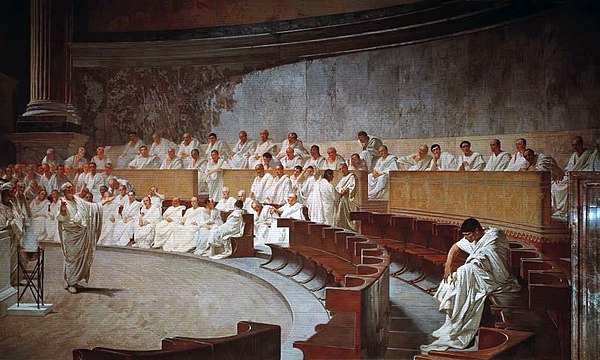
The artwork for todays post is
TITLE: Maccari Cicero-Detail ARTIST: Cesare Maccari DATE: 1882-1888 MEDIUM: fresco CURRENT LOCATION: Rome Villa Madama
Cesare Maccari, Public domain, via Wikimedia Commons

Here is a Text Only Version
Chapter 1
quo usque tandem abutere, Catilina, patientia nostra? quam diu etiam furor iste tuus nos eludet? quem ad finem sese effrenata iactabit audacia?
nihilne te nocturnum praesidium Palati, nihil urbis vigiliae, nihil timor populi, nihil concursus bonorum omnium, nihil hic munitissimus habendi senatus locus, nihil horum ora voltusque moverunt?
patere tua consilia non sentis, constrictam iam horum omnium scientia teneri coniurationem tuam non vides? quid proxima, quid superiore nocte egeris, ubi fueris, quos convocaveris, quid consili ceperis quem nostrum ignorare arbitraris?
Chapter 2
o tempora, o mores! senatus haec intellegit, consul videt; hic tamen vivit. vivit? immo vero etiam in senatum venit, fit publici consili particeps, notat et designat oculis ad caedem unum quemque nostrum.
in Catilinam
The main theme of the opening section is the anger (furor) of both protagonists Cicero and Cataline. Interestingly, the 'in' in in Catilinam does not mean the usual 'in' or 'on' but the less frequently seen 'against'. In Catilinam is a series of speeches - the Catiline or Catilinarian Orations - delivered to the Roman Senate given in 63 BC by Marcus Tullius Cicero, one of the year's consuls, accusing a senator, Lucius Sergius Catilina (Catiline), of leading a plot to overthrow the Roman Senate.
The opening lines of Cicero's in Catilinam are a powerful and direct address to the Roman Senate, exposing the conspiracy of Catiline. Cicero, as consul, dramatically reveals Catiline's treachery and audacity in planning to overthrow the government. He begins with a rhetorical question: "Quo usque tandem abutere, Catilina, patientia nostra?" This sets the tone for a fierce condemnation of Catiline's actions and a call to action for the Senate. Cicero's eloquence and urgency in these opening lines capture the gravity of the threat and his determination to protect the Republic.
In the opening lines of in Catilinam, Cicero masterfully employs several rhetorical devices to captivate and persuade his audience:
- Rhetorical Question: Cicero starts with ‘Quo usque tandem abutere, Catilina, patientia nostra? ‘ This question is designed to provoke thought and emphasize Catiline's audacity and the Senate's frustration.
- Anaphora: Repetition of a word or phrase at the beginning of successive clauses. Cicero uses ‘Quo usque tandem ‘ and ‘nihil ‘ to create a rhythm and highlight the extent of Catiline's boldness.
- Alliteration: The repetition of consonant sounds, as seen in ‘patientia nostra ‘ and ‘nihil te nocturnum praesidium Palati.‘
- Irony: Cicero ironically questions Catiline's brazenness in continuing his conspiracy despite being exposed, underscoring his audacity.
- Pathos: By invoking the emotions of the Senate, Cicero aims to stir their feelings of indignation and urgency.
These devices collectively create a powerful opening that sets the tone for the rest of his speech, underscoring the gravity of the situation and rallying the Senate to take decisive action.
Quo usque tandem abutere
Cicero lets fly at Catiline with "Quo usque tandem abutere, Catilina." All three of our classical texts start with a few famous words of Latin. However, our other two classical texts each have a memorable first line. Vergil's Aeneid starts with "Arma virumque cano" and Julius Caesar begins his de Bello Gallico with the line "Gallia est omnis divisa in partes tres" which is certainly well known.
The artwork for todays post is
TITLE: Maccari Cicero-Detail ARTIST: Cesare Maccari DATE: 1882-1888 MEDIUM: fresco CURRENT LOCATION: Rome Villa Madama
Cesare Maccari, Public domain, via Wikimedia Commons
Here is a Text Only Version
Chapter 1
quo usque tandem abutere, Catilina, patientia nostra? quam diu etiam furor iste tuus nos eludet? quem ad finem sese effrenata iactabit audacia?
nihilne te nocturnum praesidium Palati, nihil urbis vigiliae, nihil timor populi, nihil concursus bonorum omnium, nihil hic munitissimus habendi senatus locus, nihil horum ora voltusque moverunt?
patere tua consilia non sentis, constrictam iam horum omnium scientia teneri coniurationem tuam non vides? quid proxima, quid superiore nocte egeris, ubi fueris, quos convocaveris, quid consili ceperis quem nostrum ignorare arbitraris?
Chapter 2
o tempora, o mores! senatus haec intellegit, consul videt; hic tamen vivit. vivit? immo vero etiam in senatum venit, fit publici consili particeps, notat et designat oculis ad caedem unum quemque nostrum.
Do You Need A Little Help?
If you are are relatively new to reading the classic authors in Latin or if you need some extra help then you might find it helpful to start with the Side-by-Side Version which allows you to access my own attempt at VERY LITERAL TRANSLATION of the passage which should make the Latin a little bit easier to understand.
Finally come back to this page - Classical Text and you should be able to fully understand and competently read the original Latin text.
In addition there is a New-Vocabulary Version of this text with a link at the bottom of the page.
To read the text without a dictionary on a Phone or Tablet:
You simply 'tap' the word and you will get the relevant parts of speech, declensions and conjugations. To remove the 'definition box' you 'tap' to the side of the text box.
To read the text without a dictionary on a Phone or Tablet:
You simply 'tap' the word and you will get the relevant parts of speech, declensions and conjugations. To remove the 'definition box' you 'tap' to the side of the text box.
To read the text without a dictionary-
You simply hover over a word and you will get all the possible parts of speech; declensions; conjugations of every word.
INTERACTIVE DICTIONARY-FREE TEXT
Chapter 1
quo usque tandem1 abutere, Catilina, patientia nostra? quam diu etiam furor iste tuus nos eludet? quem ad finem sese effrenata iactabit audacia?
nihilne te nocturnum praesidium Palati2, nihil urbis vigiliae, nihil timor populi, nihil concursus bonorum omnium, nihil hic munitissimus habendi senatus locus3, nihil horum ora voltusque moverunt?
patere tua consilia non sentis, constrictam iam horum omnium scientia teneri coniurationem tuam non vides? quid proxima, quid superiore nocte egeris, ubi fueris, quos convocaveris, quid consili ceperis quem nostrum ignorare arbitraris?
Chapter 2
o tempora, o mores! senatus haec intellegit, consul videt; hic tamen vivit. vivit? immo vero etiam in senatum venit, fit publici consili particeps, notat et designat oculis ad caedem unum quemque nostrum.
1 tandem when used with a question or a command can mean 'pray' or 'I ask'.
2 The Palatium or Palatine Hill, as one of the most important military sites in the city, was always occupied by troops in times of emergency.
3 This 'locus' was the temple of Juppiter Sator because it was near the guarded Palatine Hill
Chapter 1
quo usque tandem¹ abutere, Catilina, patientia nostra? quam diu etiam furor iste tuus nos eludet? quem ad finem sese effrenata iactabit audacia?
nihilne te nocturnum praesidium Palati², nihil urbis vigiliae, nihil timor populi, nihil concursus bonorum omnium, nihil hic munitissimus habendi senatus locus³, nihil horum ora voltusque moverunt?
patere tua consilia non sentis, constrictam iam horum omnium scientia teneri coniurationem tuam non vides? quid proxima, quid superiore nocte egeris, ubi fueris, quos convocaveris, quid consili ceperis quem nostrum ignorare arbitraris?
Chapter 2
o tempora, o mores! senatus haec intellegit, consul videt; hic tamen vivit. vivit? immo vero etiam in senatum venit, fit publici consili particeps, notat et designat oculis ad caedem unum quemque nostrum.
1 tandem when used with a question or a command can mean 'pray' or 'I ask'.
2 The Palatium or Palatine Hill, as one of the most important military sites in the city, was always occupied by troops in times of emergency.
3 This 'locus' was the temple of Juppiter Sator because it was near the guarded Palatine Hill.
Recent Comments