
Exploring Vergil’s Aeneid: Book One, Part One
The Aeneid, one of the cornerstones of classical literature, opens with the iconic phrase “arma virumque cano,” which translates to “I sing of arms and the man.” This powerful introduction sets the stage for an epic journey, invoking themes of war and heroism. Virgil’s choice of words is not only memorable but also deeply significant, as it encapsulates the essence of the narrative that follows.
Muses
In this first segment, Virgil calls upon the Muse for inspiration, a tradition rooted in ancient Greek culture. The Muses, goddesses of literature, science, and the arts, were believed to be the source of knowledge and creativity. By invoking the Muse, Virgil aligns himself with the great poets of the past, particularly Homer, who similarly sought divine guidance in his works.
This invocation serves multiple purposes: it establishes the epic’s grandeur, emphasizes the importance of divine influence in storytelling, and connects Virgil to the rich tradition of oral poetry that preceded him. The Muses symbolize the artistic inspiration that fuels the narrative, reminding readers of the power of storytelling to convey profound truths and human experiences.
Virgil crafts his epic
As we delve into the text, we can appreciate how Virgil crafts his epic with a blend of personal and collective history, setting the tone for the adventures of Aeneas and the trials he will face. This opening introduces the protagonist and hints at the larger themes of fate, duty, and the quest for a new homeland that will unfold throughout the Aeneid.
In our next segment, we’ll continue to explore the text, breaking it down into manageable chunks to fully appreciate Virgil’s artistry and the depth of his storytelling. Stay tuned as we journey through this timeless epic!
The opening lines of the Aeneid replicate the opening to Homer's Illiad:
"Sing, goddess, of the anger of Achilles, son of Peleus,
Accursed, which brought countless pains upon the Achaeans,
Hurled to Hades many strong souls of heroes,
Served them up as carrion for the dogs and all the birds –
The will of Zeus being fulfilled..."
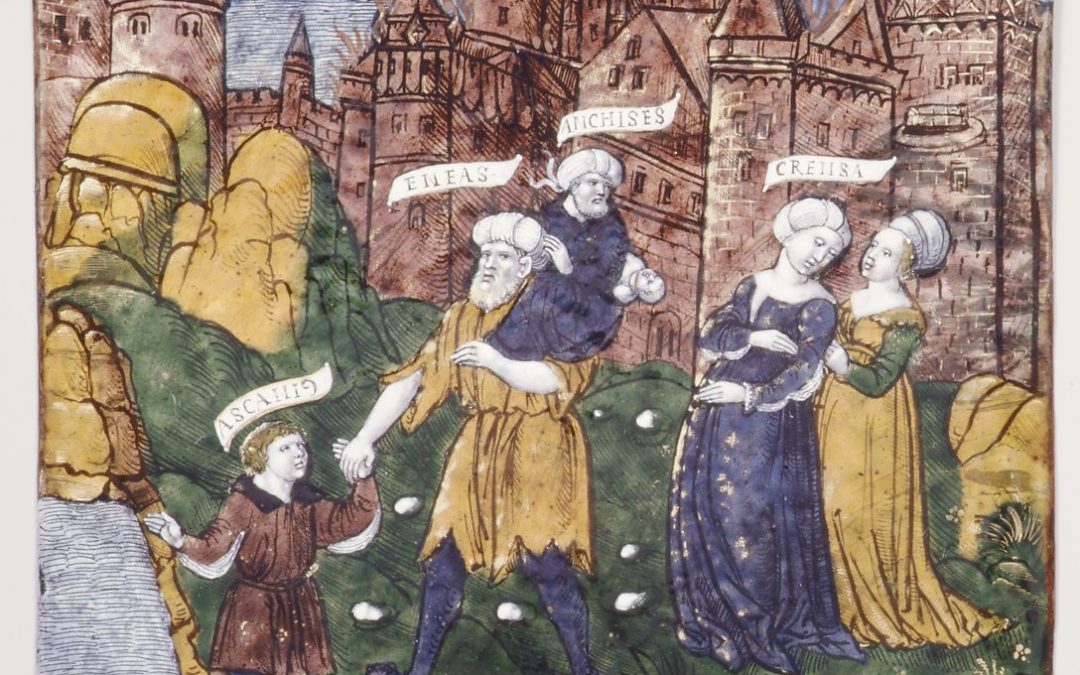
The artwork for todays post is Aeneas Fleeing Troy with Anchises, Creusa, and Ascanias
Artist: Master of the Aeneid (active ca. 1530–40) Date: probably ca. 1530–35
Culture: French, Limoges Medium: Painted enamel on copper, partly gilt
Here is a text only version. (See below for an interactive version)
arma virumque cano, Troiae qui primus ab oris
Italiam, fato profugus, Laviniaque venit
litora, multum ille et terris iactatus et alto
vi superum saevae memorem Iunonis ob iram;
multa quoque et bello passus, dum conderet urbem,
inferretque deos Latio, genus unde Latinum,
Albanique patres, atque altae moenia Romae.
Musa, mihi causas memora, quo numine laeso,
quidve dolens, regina deum tot volvere casus
insignem pietate virum, tot adire labores
impulerit. tantaene animis caelestibus irae?
urbs antiqua fuit, Tyrii tenuere coloni,
Karthago, Italiam contra Tiberinaque longe
ostia, dives opum studiisque asperrima belli;
quam Iuno fertur terris magis omnibus unam
posthabita coluisse Samo; hic illius arma,
hic currus fuit; hoc regnum dea gentibus esse,
si qua fata sinant, iam tum tenditque fovetque.
Exploring Vergil’s Aeneid:
Book One, Part One
The Aeneid, one of the cornerstones of classical literature, opens with the iconic phrase “arma virumque cano,” which translates to “I sing of arms and the man.” This powerful introduction sets the stage for an epic journey, invoking themes of war and heroism. Virgil’s choice of words is not only memorable but also deeply significant, as it encapsulates the essence of the narrative that follows.
Muses
In this first segment, Virgil calls upon the Muse for inspiration, a tradition rooted in ancient Greek culture. The Muses, goddesses of literature, science, and the arts, were believed to be the source of knowledge and creativity. By invoking the Muse, Virgil aligns himself with the great poets of the past, particularly Homer, who similarly sought divine guidance in his works.
This invocation serves multiple purposes: it establishes the epic’s grandeur, emphasizes the importance of divine influence in storytelling, and connects Virgil to the rich tradition of oral poetry that preceded him. The Muses symbolize the artistic inspiration that fuels the narrative, reminding readers of the power of storytelling to convey profound truths and human experiences.
Virgil crafts his epic
As we delve into the text, we can appreciate how Virgil crafts his epic with a blend of personal and collective history, setting the tone for the adventures of Aeneas and the trials he will face. This opening introduces the protagonist and hints at the larger themes of fate, duty, and the quest for a new homeland that will unfold throughout the Aeneid.
In our next segment, we’ll continue to explore the text, breaking it down into manageable chunks to fully appreciate Virgil’s artistry and the depth of his storytelling. Stay tuned as we journey through this timeless epic!
The opening lines of the Aeneid replicate the opening to Homer's Illiad:
"Sing, goddess, of the anger of Achilles, son of Peleus,
Accursed, which brought countless pains upon the Achaeans,
Hurled to Hades many strong souls of heroes,
Served them up as carrion for the dogs and all the birds –
The will of Zeus being fulfilled..."
The artwork for todays post is Aeneas Fleeing Troy with Anchises, Creusa, and Ascanias
Artist: Master of the Aeneid (active ca. 1530–40) Date: probably ca. 1530–35
Culture: French, Limoges Medium: Painted enamel on copper, partly gilt
Here is a text only version. (See below for an interactive version)
arma virumque cano, Troiae qui primus ab oris
Italiam, fato profugus, Laviniaque venit
litora, multum ille et terris iactatus et alto
vi superum saevae memorem Iunonis ob iram;
multa quoque et bello passus, dum conderet urbem,
inferretque deos Latio, genus unde Latinum,
Albanique patres, atque altae moenia Romae.
Musa, mihi causas memora, quo numine laeso,
quidve dolens, regina deum tot volvere casus
insignem pietate virum, tot adire labores
impulerit. tantaene animis caelestibus irae?
urbs antiqua fuit, Tyrii tenuere coloni,
Karthago, Italiam contra Tiberinaque longe
ostia, dives opum studiisque asperrima belli;
quam Iuno fertur terris magis omnibus unam
posthabita coluisse Samo; hic illius arma,
hic currus fuit; hoc regnum dea gentibus esse,
si qua fata sinant, iam tum tenditque fovetque.
Do You Need A Little Help?
If you are are relatively new to reading the classic authors in Latin or if you need some extra help then you might find it helpful to start with the Side-by-Side Version which allows you to access my own attempt at VERY LITERAL TRANSLATION of the passage which should make the Latin a little bit easier to understand.
Finally come back to this page - Classical Text and you should be able to fully understand and competently read the original Latin text.
In addition there is a New-Vocabulary Version of this text with a link at the bottom of the page.
To Read the Interactive Text Below Without a Dictionary-
On a Computer: you hover over a word and get all the possible parts of speech; declensions; and conjugations of every word.
To read the text without a dictionary-
You simply hover over a word and you will get all the possible parts of speech; declensions; conjugations of every word.
Do You Need A Little Help?
If you are are relatively new to reading the classic authors in Latin or if you need some extra help then you might find it helpful to start with the Side-by-Side Version which allows you to access my own attempt at VERY LITERAL TRANSLATION of the passage which should make the Latin a little bit easier to understand.
Finally come back to this page - Classical Text and you should be able to fully understand and competently read the original Latin text.
In addition there is a New-Vocabulary Version of this text with a link at the bottom of the page.
To read the text without a dictionary-
You simply hover over a word and you will get all the possible parts of speech; declensions; conjugations of every word.
INTERACTIVE DICTIONARY FREE TEXT
arma virumque cano, Troiae qui primus ab oris
Italiam, fato profugus, Laviniaque venit
litora, multum ille et terris iactatus et alto
vi superum saevae memorem Iunonis ob iram;
multa quoque et bello passus, dum conderet urbem,
inferretque deos Latio, genus unde Latinum,
Albanique patres, atque altae moenia Romae.
Musa, mihi causas memora, quo numine laeso,
quidve dolens, regina deum tot volvere casus
insignem pietate virum, tot adire labores
impulerit. tantaene animis caelestibus irae?
urbs antiqua fuit, Tyrii tenuere coloni,
Karthago, Italiam contra Tiberinaque longe
ostia, dives opum studiisque asperrima belli;
quam Iuno fertur terris magis omnibus unam
posthabita coluisse Samo; hic illius arma,
hic currus fuit; hoc regnum dea gentibus esse,
si qua fata sinant, iam tum tenditque fovetque.
Recent Comments