
fortuna
The Latin word fortuna refers to luck, fate, or chance, and it plays a significant role in Roman thought and literature. It embodies both positive and negative aspects of fortune, reflecting the unpredictable nature of life. The concept of fortuna was deeply intertwined with Roman beliefs about destiny and divine influence, often appearing in philosophical discussions and poetic works.
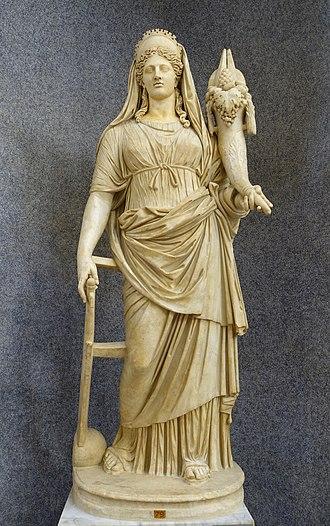
In Roman religion, Fortuna was the goddess of luck and fate, equivalent to the Greek deity Tyche. She was widely worshiped across the Roman world, with numerous temples dedicated to her. Fortuna was often depicted holding a cornucopia, symbolizing abundance, and a ship’s rudder, representing her control over human destiny. Another common representation was the Rota Fortunae, or Wheel of Fortune, which illustrated the ever-changing nature of fate—one moment elevating individuals to greatness, the next casting them into misfortune.
Fortuna’s influence extended beyond personal luck to the fate of cities and nations. Romans believed she could bring prosperity or disaster, depending on her whims. The goddess had several aspects, including Fortuna Primigenia, associated with prophecy, and Fortuna Publica, linked to the well-being of the Roman people. Her cult was particularly strong in Praeneste, where her temple housed an oracle consulted by many seeking guidance.
The idea of fortuna also appears in Roman literature and philosophy. Writers like Cicero and Seneca debated the role of fortune in human affairs, questioning whether individuals could control their destinies or were subject to the goddess’s unpredictable will. The Stoics, in particular, emphasized accepting fortuna with equanimity, recognizing that external events were beyond human control.
Even today, the legacy of Fortuna endures. The concept of fortune continues to shape modern language and culture, influencing ideas about luck, fate, and chance. Her imagery, especially the Wheel of Fortune, remains a powerful symbol of life’s uncertainties.
Today's Image: Fortuna
Artist: unknown
Braccio Nuovo, Museo Chiaramonti
Here is a text only version
quod ego praetermitto et facile patior sileri, ne in hac civitate tanti facinoris immanitas aut exstitisse aut non vindicata esse videatur. praetermitto ruinas fortunarum tuarum quas omnis proximis Idibus tibi impendere senties: ad illa venio quae non ad privatam ignominiam vitiorum tuorum, non ad domesticam tuam difficultatem ac turpitudinem, sed ad summam rem publicam atque ad omnium nostrum vitam salutemque pertinent.
[15] potestne tibi haec lux, Catilina, aut huius caeli spiritus esse iucundus, cum scias esse horum neminem qui nesciat te pridie Kalendas Ianuarias Lepido et Tullo consulibus stetisse in comitio cum telo, manum consulum et principum civitatis interficiendorum causa paravisse, sceleri ac furori tuo non mentem aliquam aut timorem tuum sed Fortunam populi Romani obstitisse?
Need Help Understanding the Latin?
You might find it helpful to start with the Side-by-Side Version which allows you to see my own very literal translation of the text which is almost a word-for-word translation - in an attempt to make it easier to understand the Latin!
Finally come back to this page - Classical Text and you should be able to better understand and competently read the original Latin text.
Vocabulary Version
I have prepared a Vocabulary Version of the passage (link at bottom of the page) which highlights the 3057 Most Common Words in the texts of Vergil, Caesar and Cicero that we will explore on CentumVerba.com
If you are serious about building your vocabulary, the FLASHCARD set should help you learn them.
How To Read the Interactive Text
To Read the Interactive Text Below Without a Dictionary-
On a Computer: you hover over a word and get all the possible parts of speech; declensions; and conjugations of every word.
Need Help Understanding the Latin?
You might find it helpful to start with the Side-by-Side Version which allows you to see my own very literal translation of the text which is almost a word-for-word translation - in an attempt to make it easier to understand the Latin!
Finally come back to this page - Classical Text and you should be able to better understand and competently read the original Latin text.
Vocabulary Version
I have prepared a Vocabulary Version of the passage (link at bottom of the page) which highlights the 3057 Most Common Words in the texts of Vergil, Caesar and Cicero that we will explore on CentumVerba.com
If you are serious about building your vocabulary, the FLASHCARD set should help you learn them.
How To Read the Interactive Text
To Read the Interactive Text Below Without a Dictionary-
On a Phone or Tablet: don't 'hover' -'tap' the word. To remove the 'definition box' you 'tap' to the side of the text box.
INTERACTIVE DICTIONARY FREE TEXT
quod ego praetermitto et facile patior sileri, ne in hac civitate tanti facinoris immanitas aut exstitisse aut non vindicata esse videatur.
You Need to be a Member to Access the Interactive Dictionary
Become a Member
praetermitto ruinas fortunarum tuarum quas omnis proximis Idibus tibi impendere senties:
ad illa venio quae non ad privatam ignominiam vitiorum tuorum, non ad domesticam tuam difficultatem ac turpitudinem, sed ad summam rem publicam atque ad omnium nostrum vitam salutemque pertinent.
[15] potestne tibi haec lux, Catilina, aut huius caeli spiritus esse iucundus, cum scias esse horum neminem qui nesciat te pridie Kalendas Ianuarias Lepido et Tullo consulibus stetisse in comitio cum telo, manum consulum et principum civitatis interficiendorum causa paravisse, sceleri ac furori tuo non mentem aliquam aut timorem tuum sed Fortunam populi Romani obstitisse?
Recent Comments