
praetermitto - let go of the past
The Latin verb praetermitto (praetermittere, praetermisi, praetermissum) is a third-conjugation verb meaning ‘to allow to pass,’ ‘to omit,’ ‘to neglect,’ or ‘to overlook’. It is formed from the prefix praeter-, meaning ‘beyond’ or ‘past,’ and mitto, meaning ‘to send’ or ‘to let go’. This compound construction conveys the idea of letting something slip by, whether intentionally or unintentionally.
In classical Latin literature, praetermitto appears in various contexts, often in rhetorical and legal discourse. Roman orators such as Cicero frequently employed the term when structuring arguments, particularly when choosing to omit certain details for emphasis or persuasion. For example, Cicero might use praetermitto to signal that he is deliberately skipping over a point, either because it is irrelevant or because he wishes to avoid discussing it. This rhetorical device allowed him to control the flow of his argument and subtly influence his audience.
In historical and philosophical texts, praetermitto is used to indicate the neglect or omission of duties, facts, or considerations. Historians such as Livy and Tacitus used the term when describing instances where leaders or officials failed to act, either through negligence or strategic avoidance. In legal texts, praetermitto could refer to the failure to fulfill obligations or the deliberate omission of evidence.
The verb also appears in moral and ethical discussions, where it is used to critique individuals who overlook important responsibilities or fail to acknowledge significant truths. The concept of omission, whether accidental or deliberate, was a crucial theme in Roman thought, influencing discussions on duty, justice, and personal integrity.
Thus, praetermitto was a versatile term in classical Latin literature, shaping rhetorical strategies, historical narratives, legal arguments, and ethical reflections. Its usage underscores the importance of omission as both a linguistic tool and a philosophical concept in Roman intellectual traditions.
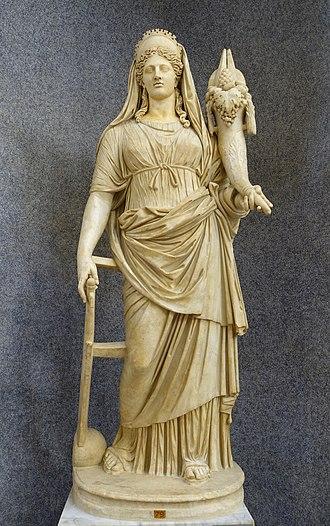
Today's Image: Fortuna
Artist: unknown
Braccio Nuovo, Museo Chiaramonti
praetermitto - let go of the past
The Latin verb iubeo, iubere, iussi, iussum means ‘to order,’ ‘to command,’ or ‘to bid.’ It is a second-conjugation verb frequently used in classical texts to express authority, instruction, or permission. Its usage varies depending on context, and it can take different constructions.
One common construction is iubeo followed by an infinitive, which expresses direct orders. For example, Imperator milites oppugnare iubet (‘The general orders the soldiers to attack’). This structure is widely used in historical and military contexts.
Another possibility is iubeo with an accusative and infinitive, often found in indirect speech. For instance, Senatus consulem pacem petere iussit (‘The Senate ordered the consul to seek peace’). This construction allows for more complex sentences, particularly in legal and political discourse.
In poetry and elevated prose, iubeo can take a subjunctive clause, especially in indirect commands. For example, Deus ut servus oraret iussit (‘The god ordered that the servant pray’). This form is less common but appears in literary and philosophical texts.
The verb also appears in passive constructions, where the subject is the one receiving the command. Iussi sumus domum redire (‘We were ordered to return home’). This passive form is useful when emphasizing the action rather than the authority behind it.
Additionally, iubeo can be used in expressions of permission or authorization. Iubeo te intrare (‘I allow you to enter’) conveys a softer command, closer to granting permission rather than issuing an order.
Throughout Latin literature, iubeo remains a versatile verb, appearing in legal, military, and poetic contexts. Its ability to structure commands and directives makes it essential in understanding Roman authority and governance.
Today's Image: Fortuna
Artist: unknown
Braccio Nuovo, Museo Chiaramonti
Red and Green Vocab
The words in red and green are found among the 3057 Most Common Words in the Classical Latin texts that we will explore on CentumVerba.com and are essential to your understanding of the texts of Caesar, Vergil and Cicero. The green words appear frequently (at least five times) among Vergil's Aeneid (books I-VI), Caesar de bello Gallico (books I-V) and in Cicero's works - in Catilinam (books I-IV), de lege Manilia (also known as de Imperio Cn. Pompei), and pro Achia. These works constituted the curriculum for Latin over 4 years in American High Schools at the start of the 20th Century. The bulk of my information is taken from The Vocabulary of High School Latin by Gonzalez Lodge. I have added to these 2000 words from varioius other sources to compile my own list of The 3057 Most Common Latin Words.
The black words do not appear frequently in Classical Latin.
The red words are the first occurrences of these words in this author and this word will appear as green the next time you encounter it.
If you are serious about building your vocabulary then you should learn the red words as they occur and you should already know the green ones!
I have provided a FLASHCARD set to help - see below.
How To Read the Interactive Text
To Read the Interactive Text Below Without a Dictionary-
On a Computer: you hover over a word and get all the possible parts of speech; declensions; and conjugations of every word.
Red and Green Vocab
The words in red and green are found among the 3057 Most Common Words in the Classical Latin texts that we will explore on CentumVerba.com and are essential to your understanding of the texts of Caesar, Vergil and Cicero. The green words appear frequently (at least five times) among Vergil's Aeneid (books I-VI), Caesar de bello Gallico (books I-V) and in Cicero's works - in Catilinam (books I-IV), de lege Manilia (also known as de Imperio Cn. Pompei), and pro Achia. These works constituted the curriculum for Latin over 4 years in American High Schools at the start of the 20th Century. The bulk of my information is taken from The Vocabulary of High School Latin by Gonzalez Lodge. I have added to these 2000 words from varioius other sources to compile my own list of The 3057 Most Common Latin Words.
The black words do not appear frequently in Classical Latin.
The red words are the first occurrences of these words in this author and this word will appear as green the next time you encounter it.
If you are serious about building your vocabulary then you should learn the red words as they occur and you should already know the green ones!
I have provided a FLASHCARD set to help - see below.
How To Read the Interactive Text
To Read the Interactive Text Below Without a Dictionary-
On a Phone or Tablet: don't 'hover' -'tap' the word. To remove the 'definition box' you 'tap' to the side of the text box.
INTERACTIVE DICTIONARY FREE TEXT
quod ego praetermitto et facile patior sileri, ne in hac civitate tanti facinoris immanitas aut exstitisse aut non vindicata esse videatur.
You Need to be a Member to Access the Interactive Dictionary
praetermitto ruinas fortunarum tuarum quas omnis proximis Idibus tibi impendere senties:
ad illa venio quae non ad privatam ignominiam vitiorum tuorum, non ad domesticam tuam difficultatem ac turpitudinem, sed ad summam rem publicam atque ad omnium nostrum vitam salutemque pertinent.
[15] potestne tibi haec lux, Catilina, aut huius caeli spiritus esse iucundus, cum scias esse horum neminem qui nesciat te pridie Kalendas Ianuarias Lepido et Tullo consulibus stetisse in comitio cum telo, manum consulum et principum civitatis interficiendorum causa paravisse,
sceleri ac furori tuo non mentem aliquam aut timorem tuum sed Fortunam populi Romani obstitisse?
I have prepared online Flashcards at CRAM.com to make learning the vocabulary much easier. I have no financial gain from you using the app as it is FREE to use.
I have created a stack of the 20 new words in this passage.
Here is the link to the FLASHCARDS
USING THE FLASHCARD APP:
To make the most of the online Flashcards use the "Click or use spacebar to begin" and the Latin word should appear. (The 'Shuffle' button will take the cards out of alphabetical order.) Type 'H' to get the conjugation / declension of the word if you want to see it. 'H' takes tyou back to the word. Click 'See Answer' or use the Spacebar to see the English.
If you were correct or close enough then select "I was right" or else "I was wrong". After you have completed the set it will start again but it will only display the ones you got wrong.
Continue through this process to learn all the words. I hope this is helpful!
I have prepared online Flashcards at CRAM.com to make learning the vocabulary much easier. I have no financial gain from you using the app as it is FREE to use.
I have created a stack of the 23 new words in this passage.
Here is the link to the FLASHCARDS
USING THE FLASHCARD APP:
To make the most of the online Flashcards use the "Click or use spacebar to begin" and the Latin word should appear. (The 'Shuffle' button will take the cards out of alphabetical order.) Type 'H' to get the conjugation / declension of the word if you want to see it. 'H' takes tyou back to the word. Click 'See Answer' or use the Spacebar to see the English.
If you were correct or close enough then select "I was right" or else "I was wrong". After you have completed the set it will start again but it will only display the ones you got wrong.
Continue through this process to learn all the words. I hope this is helpful!
Recent Comments