
by Ian | Aug 11, 2025 | Argonauts Vocab
dum - while, provided that The Latin word dum serves as a conjunction with a range of temporal and concessive meanings, making it a subtle yet potent tool in classical Latin literature. Its primary function is to denote simultaneity—'while'—but it also appears with...
by Ian | Aug 8, 2025 | Mark SbS
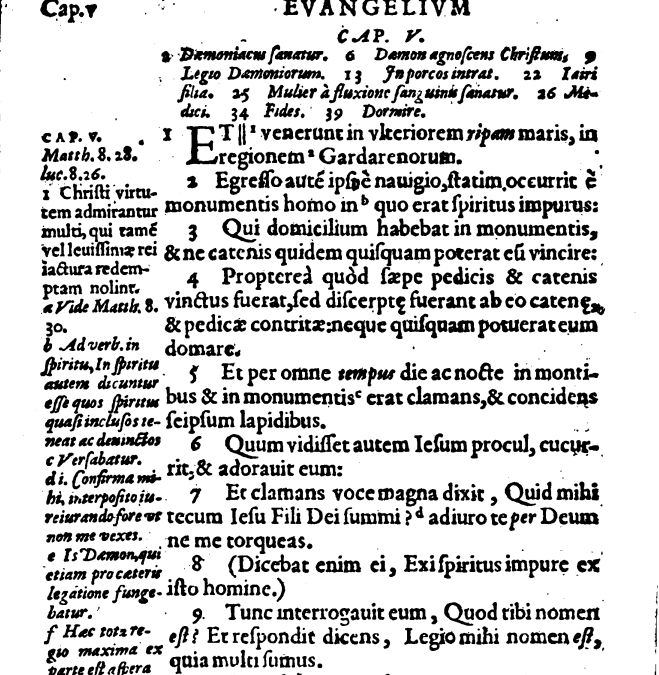
CHAPTER 5 1 And they came ouer vnto the other side of the sea, into the countrey of the Gadarenes.2 And when hee was come out of the ship, immediatly there met him out of the tombes, a man with an vncleane spirit,3 Who had his dwelling among the tombs, and no man...
by Ian | Aug 8, 2025 | Mark Vocab
trans - one side or the other The Latin preposition trans means ‘across’, ‘beyond’, or ‘through’, and is used to indicate movement or extension from one side to another. It governs the accusative case and appears frequently in classical Latin literature, both in...
by Ian | Aug 7, 2025 | Aeneid Translation
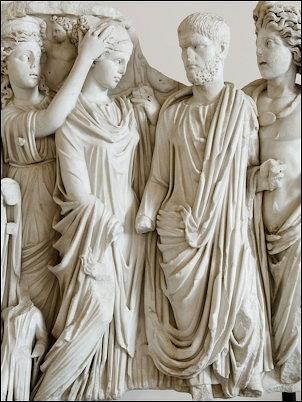
Her husband was Sychaeus, wealthiest in lands of the Phoenicians, and loved of her with ill-fated passion; to whom with virgin rites her father had given her maidenhood in wedlock. But the kingdom of Tyre was in her brother Pygmalion's hands, a monster of guilt...
by Ian | Aug 7, 2025 | Aeneid Vocab
magnus - the bigger they are... The Latin adjective magnus means ‘great’, ‘large’, or ‘important’, and its semantic range extends from physical size to moral stature, political power, and cosmic significance. It is one of the most frequently used adjectives in Latin...
by Ian | Aug 6, 2025 | Cicero in Catilinam-SbS
I wish the gods may give you such a mind; though I see, if alarmed at my words you bring your mind to go into banishment, what a storm of unpopularity hangs over me, if not at present, while the memory of your wickedness is fresh, at all events hereafter. But it is...

Recent Comments