
Helvetii
In Chapters 9 and 10 of De Bello Gallico, Julius Caesar describes the political and military tensions among the Gallic tribes, particularly the Helvetii and their interactions with neighbouring groups.
Chapter 9: The Helvetii and Their Allies
Caesar details how the Helvetii, a powerful Gallic tribe, seek alliances with other groups to strengthen their position. They attempt to persuade the Sequani and Aedui to support their migration across Gaul. The Sequani, pressured by the Helvetii and their allies, reluctantly agree, while the Aedui, traditionally Roman allies, find themselves caught in a difficult position. Caesar emphasizes the growing instability in Gaul, as various tribes maneuver for dominance.
Chapter 10: Caesar’s Strategic Response
Recognizing the threat posed by the Helvetii and their expanding influence, Caesar takes decisive action. He mobilizes his forces and prepares to confront the migrating tribes. He also highlights the Aedui’s appeals for Roman assistance, reinforcing Rome’s role as a protector of its allies. Caesar’s response is not merely military but also diplomatic—he seeks to maintain Roman authority while preventing Gaul from descending into chaos.
Significance
These chapters illustrate Caesar’s strategic thinking, both in warfare and diplomacy. His ability to manipulate alliances and respond to threats showcases his leadership skills. The narrative also underscores the fragile balance of power in Gaul, setting the stage for further conflicts.
Today's Image
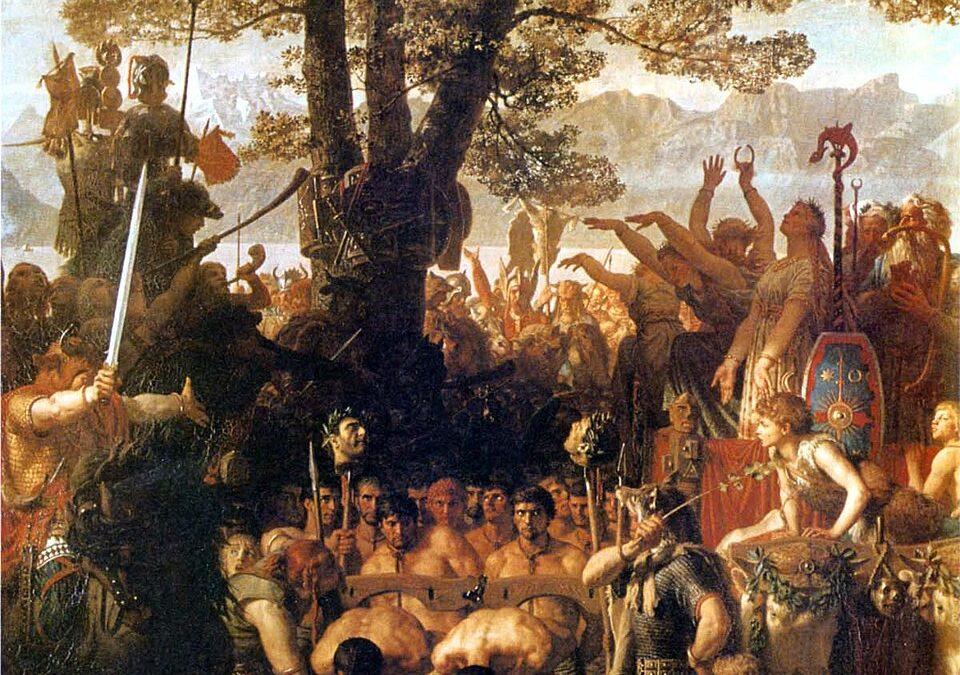
The Helvetians force the Romans to pass under the yoke celebrating the Helvetian victory over the Romans at Agen (107 BC) under Divico's command.
Charles Gleyre (19th century)
Here is a text only version. (See below for an interactive version)
[9.4] Itaque rem suscipit et a Sequanis impetrat ut per fines suos Helvetios ire patiantur, obsidesque uti inter sese dent perficit: Sequani, ne itinere Helvetios prohibeant, Helvetii, ut sine maleficio et iniuria transeant.
CHAPTER 10
[1] Caesari renuntiatur Helvetiis esse in animo per agrum Sequanorum et Haeduorum iter in Santonum fines facere, qui non longe a Tolosatium finibus absunt, quae civitas est in provincia.
[2] Id si fieret, intellegebat magno cum periculo provinciae futurum ut homines bellicosos, populi Romani inimicos, locis patentibus maximeque frumentariis finitimos haberet.
[3] Ob eas causas ei munitioni quam fecerat T. Labienum legatum praeficit; ipse in Italiam magnis itineribus contendit duasque ibi legiones conscribit et tres, quae circum Aquileiam hiemabant, ex hibernis educit et, qua proximum iter in ulteriorem Galliam per Alpes erat, cum his quinque legionibus ire contendit.
Need Help Understanding the Latin?
You might find it helpful to start with the Side-by-Side Version which allows you to see my own very literal translation of the text which is almost a word-for-word translation - in an attempt to make it easier to understand the Latin!
Finally come back to this page - Classical Text and you should be able to better understand and competently read the original Latin text.
Vocabulary Version
I have prepared a Vocabulary Version of the passage (link at bottom of the page) which highlights the 3057 Most Common Words in the texts of Vergil, Caesar and Cicero that we will explore on CentumVerba.com
If you are serious about building your vocabulary, the FLASHCARD set should help you learn them.
How To Read the Interactive Text
To Read the Interactive Text Below Without a Dictionary-
On a Computer: you hover over a word and get all the possible parts of speech; declensions; and conjugations of every word.
Need Help Understanding the Latin?
You might find it helpful to start with the Side-by-Side Version which allows you to see my own very literal translation of the text which is almost a word-for-word translation - in an attempt to make it easier to understand the Latin!
Finally come back to this page - Classical Text and you should be able to better understand and competently read the original Latin text.
Vocabulary Version
I have prepared a Vocabulary Version of the passage (link at bottom of the page) which highlights the 3057 Most Common Words in the texts of Vergil, Caesar and Cicero that we will explore on CentumVerba.com
If you are serious about building your vocabulary, the FLASHCARD set should help you learn them.
How To Read the Interactive Text
To Read the Interactive Text Below Without a Dictionary-
On a Phone or Tablet: don't 'hover' -'tap' the word. To remove the 'definition box' you 'tap' to the side of the text box.
Dictionary-Free Interactive Text
[9.4] Itaque rem suscipit et a Sequanis impetrat ut per fines suos Helvetios ire patiantur, obsidesque uti inter sese dent perficit:
You Need to be a Member to Access the Interactive Dictionary
Sequani, ne itinere Helvetios prohibeant, Helvetii, ut sine maleficio et iniuria transeant.
CHAPTER 10
[1] Caesari renuntiatur Helvetiis esse in animo per agrum Sequanorum et Haeduorum iter in Santonum fines facere, qui non longe a Tolosatium finibus absunt, quae civitas est in provincia.
[2] Id si fieret, intellegebat magno cum periculo provinciae futurum ut homines bellicosos, populi Romani inimicos, locis patentibus maximeque frumentariis finitimos haberet.
[3] Ob eas causas ei munitioni quam fecerat T. Labienum legatum praeficit; ipse in Italiam magnis itineribus contendit duasque ibi legiones conscribit et tres, quae circum Aquileiam hiemabant, ex hibernis educit et, qua proximum iter in ulteriorem Galliam per Alpes erat, cum his quinque legionibus ire contendit.
INTERACTIVE DICTIONARY-FREE TEXT
[9.4]Itaque rem suscipit et a Sequanis impetrat ut per fines suos Helvetios ire patiantur, obsidesque uti inter sese dent perficit:
You Need to be a Member to Access the Interactive Dictionary
Sequani, ne itinere Helvetios prohibeant, Helvetii, ut sine maleficio et iniuria transeant.
CHAPTER 10
[1] Caesari renuntiatur Helvetiis esse in animo per agrum Sequanorum et Haeduorum iter in Santonum fines facere, qui non longe a Tolosatium finibus absunt, quae civitas est in provincia.
[2] Id si fieret, intellegebat magno cum periculo provinciae futurum ut homines bellicosos, populi Romani inimicos, locis patentibus maximeque frumentariis finitimos haberet.
[3] Ob eas causas ei munitioni quam fecerat T. Labienum legatum praeficit; ipse in Italiam magnis itineribus contendit duasque ibi legiones conscribit et tres, quae circum Aquileiam hiemabant, ex hibernis educit et, qua proximum iter in ulteriorem Galliam per Alpes erat, cum his quinque legionibus ire contendit.
Recent Comments