
Ocelum
Ocelum was a Roman town located at the frontier of Cisalpine Gaul, marking the boundary between Roman-controlled territory and the independent Alpine tribes. Julius Caesar mentions Ocelum in Commentarii de Bello Gallico, describing it as the last settlement in the province before entering the rugged and often hostile regions beyond.
Strategically, Ocelum played a crucial role in Roman expansion. It served as a gateway for military campaigns and trade routes through the Alps. The town was positioned along a well-traveled road that led over the Mont Genèvre pass, connecting settlements such as Scingomagus (modern Sezanne), Brigantium (Briançon), and Ebrodunum (Embrun). This route was vital for Roman movements, allowing access to the territory of the Vocontii and further into Gaul.
In Strabo’s time, Ocelum was the frontier town of the kingdom of Cottius, a semi-independent region that maintained a delicate balance between Roman influence and local autonomy. The town’s exact location has been debated, with scholars such as D’Anville identifying it as Uxeau, a village in the valley of Fenestrelles, rather than Oulx in the valley of the Dora, as previously thought.
Ocelum’s role in the Gallic Wars was primarily logistical rather than military. It provided a staging ground for Roman forces as they prepared to push deeper into Gaul. The town’s placement at the edge of Roman territory highlights the challenges Caesar faced in his conquest, navigating both geographical obstacles and resistance from local tribes. Its mention in The Gallic Wars underscores the importance of frontier settlements in Rome’s expansionist strategy.
The strategic significance of Ocelum lay in its position as a gateway to the Alpine passes, enabling Roman forces to secure supply lines and maintain control over key transit routes. As Rome expanded its influence, towns like Ocelum became essential in facilitating movement, trade, and military operations, ensuring the stability of Roman rule in the region.
Today's Image
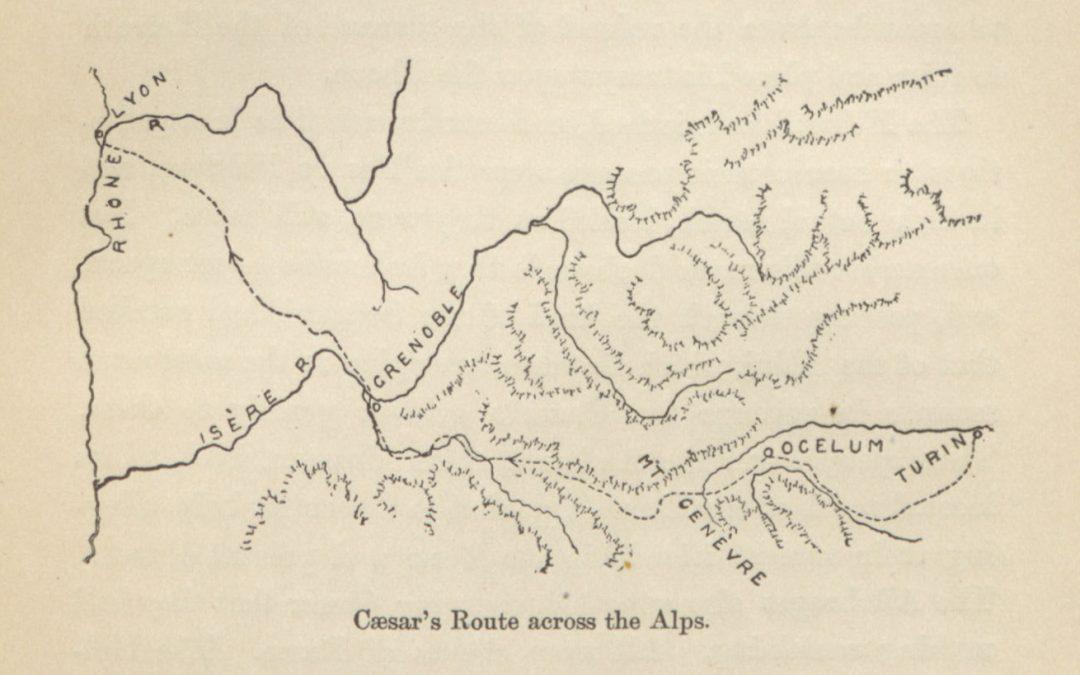
Map of Caesar's return to the Helvetii front after reinforcing with legions from Aquileia
From: Theodore Ayrault Dodge, Caesar: A History of the Art of War Among the Romans Down to the End of the Roman Empire, with a Detailed Account of the Campaigns of Caius Julius Caesar (Boston: Houghton Mifflin, 1892), p. 65.
Here is a text only version. (See below for an interactive version)
[10.4] Ibi Ceutrones et Graioceli et Caturiges locis superioribus occupatis itinere exercitum prohibere conantur. Compluribus his proeliis pulsis ab Ocelo, quod est oppidum citerioris provinciae extremum, in fines Vocontiorum ulterioris provinciae die septimo pervenit; inde in Allobrogum fines, ab Allobrogibus in Segusiavos exercitum ducit. Hi sunt extra provinciam trans Rhodanum primi.
CHAPTER 11
Helvetii iam per angustias et fines Sequanorum suas copias traduxerant et in Haeduorum fines pervenerant eorum agros populabantur. Haedui, cum se suaque ab iis defendere non possent, legatos ad Caesarem mittunt rogatum auxilium: ita se omni tempore de populo Romano meritos esse ut paene in conspectu exercitus nostri agri vastari, liberi [eorum] in servitutem abduci, oppida expugnari non debuerint. Eodem tempore quo Haedui Ambarri, necessarii et consanguinei Haeduorum, Caesarem certiorem faciunt sese depopulatis agris non facile ab oppidis vim hostium prohibere.
Need Help Understanding the Latin?
You might find it helpful to start with the Side-by-Side Version which allows you to see my own very literal translation of the text which is almost a word-for-word translation - in an attempt to make it easier to understand the Latin!
Finally come back to this page - Classical Text and you should be able to better understand and competently read the original Latin text.
Vocabulary Version
I have prepared a Vocabulary Version of the passage (link at bottom of the page) which highlights the 3057 Most Common Words in the texts of Vergil, Caesar and Cicero that we will explore on CentumVerba.com
If you are serious about building your vocabulary, the FLASHCARD set should help you learn them.
How To Read the Interactive Text
To Read the Interactive Text Below Without a Dictionary-
On a Computer: you hover over a word and get all the possible parts of speech; declensions; and conjugations of every word.
Need Help Understanding the Latin?
You might find it helpful to start with the Side-by-Side Version which allows you to see my own very literal translation of the text which is almost a word-for-word translation - in an attempt to make it easier to understand the Latin!
Finally come back to this page - Classical Text and you should be able to better understand and competently read the original Latin text.
Vocabulary Version
I have prepared a Vocabulary Version of the passage (link at bottom of the page) which highlights the 3057 Most Common Words in the texts of Vergil, Caesar and Cicero that we will explore on CentumVerba.com
If you are serious about building your vocabulary, the FLASHCARD set should help you learn them.
How To Read the Interactive Text
To Read the Interactive Text Below Without a Dictionary-
On a Phone or Tablet: don't 'hover' -'tap' the word. To remove the 'definition box' you 'tap' to the side of the text box.
Dictionary-Free Interactive Text
[10.4] Ibi Ceutrones et Graioceli et Caturiges locis superioribus occupatis itinere exercitum prohibere conantur.
You Need to be a Member to Access the Interactive Dictionary
Compluribus his proeliis pulsis ab Ocelo, quod est oppidum citerioris provinciae extremum, in fines Vocontiorum ulterioris provinciae die septimo pervenit;
inde in Allobrogum fines, ab Allobrogibus in Segusiavos exercitum ducit.
Hi sunt extra provinciam trans Rhodanum primi.
CHAPTER 11
Helvetii iam per angustias et fines Sequanorum suas copias traduxerant et in Haeduorum fines pervenerant eorum agros populabantur.
Haedui, cum se suaque ab iis defendere non possent, legatos ad Caesarem mittunt rogatum auxilium:
ita se omni tempore de populo Romano meritos esse ut paene in conspectu exercitus nostri agri vastari, liberi [eorum] in servitutem abduci, oppida expugnari non debuerint.
Eodem tempore quo Haedui Ambarri, necessarii et consanguinei Haeduorum, Caesarem certiorem faciunt sese depopulatis agris non facile ab oppidis vim hostium prohibere.
INTERACTIVE DICTIONARY-FREE TEXT
[10.4] Ibi Ceutrones et Graioceli et Caturiges locis superioribus occupatis itinere exercitum prohibere conantur.
You Need to be a Member to Access the Interactive Dictionary
Compluribus his proeliis pulsis ab Ocelo, quod est oppidum citerioris provinciae extremum, in fines Vocontiorum ulterioris provinciae die septimo pervenit;
inde in Allobrogum fines, ab Allobrogibus in Segusiavos exercitum ducit.
Hi sunt extra provinciam trans Rhodanum primi.
CHAPTER 11
Helvetii iam per angustias et fines Sequanorum suas copias traduxerant et in Haeduorum fines pervenerant eorum agros populabantur.
Haedui, cum se suaque ab iis defendere non possent, legatos ad Caesarem mittunt rogatum auxilium:
ita se omni tempore de populo Romano meritos esse ut paene in conspectu exercitus nostri agri vastari, liberi [eorum] in servitutem abduci, oppida expugnari non debuerint.
Eodem tempore quo Haedui Ambarri, necessarii et consanguinei Haeduorum, Caesarem certiorem faciunt sese depopulatis agris non facile ab oppidis vim hostium prohibere.
Recent Comments