
Sequani
Before the arrival of Julius Caesar in Gaul, the Sequani had taken the side of the Arverni against their rivals the Aedui and hired the Suebi under Ariovistus to cross the Rhine and help them (71 BC). Although his assistance enabled them to defeat the Aedui, the Sequani were worse off than before, for Ariovistus deprived them of a third of their territory and threatened to take another third, while subjugating them into semi-slavery.
The Sequani then appealed to Caesar, who drove back the Germanic tribesmen (58 BC), but at the same time obliged the Sequani to surrender all that they had gained from the Aedui. This so exasperated the Sequani that they joined in the revolt of Vercingetorix (52 BC).
Relinquebatur una per Sequanos via.
As you remember from earlier the Jura Mountains separated the Sequani from the Helvetii on the east. However the mountains belonged to the Sequani, as the narrow pass (see below) between the Rhone and Lake Geneva was Sequanian. This meant that the Helvetii had to negotiate a way through the territory of the Sequani. In the sentence 'relinquebatur una per Seqanos via' you can see how Caesar has cleverly split the una via (one passage) with the per Sequanos (through the Sequani) making it more interesting and demonstrating the problem. He could easily have said relinquebatur una via per Sequanos.
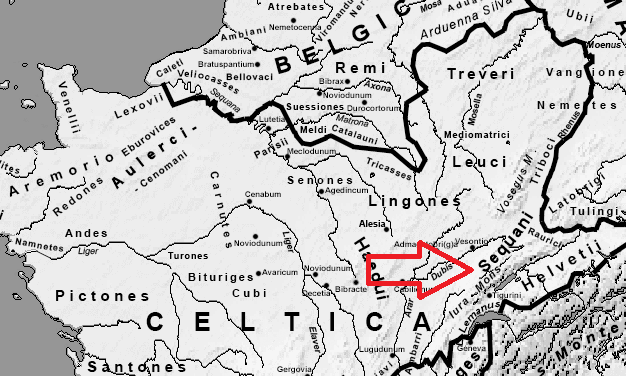
Today's Image
Today's image shows the relative positions of the various tribes in central Gaul around the time of our story. The red arrow shows the territory of the Sequani and if you look closely below the arrow you can see the narrow pass referred to in the text. It lies exactly between the words Jura and Lemanus
Here is a text only version. (See below for an interactive version)
[4] Helvetii ea spe deiecti navibus iunctis ratibusque compluribus factis, alii vadis Rhodani, qua minima altitudo fluminis erat, non numquam interdiu, saepius noctu si perrumpere possent conati, operis munitione et militum concursu et telis repulsi, hoc conatu destiterunt.
CHAPTER 9
Relinquebatur una per Sequanos via, qua Sequanis invitis propter angustias ire non poterant.
[2] His cum sua sponte persuadere non possent, legatos ad Dumnorigem Haeduum mittunt, ut eo deprecatore a Sequanis impetrarent.
[3] Dumnorix gratia et largitione apud Sequanos plurimum poterat et Helvetiis erat amicus, quod ex ea civitate Orgetorigis filiam in matrimonium duxerat, et cupiditate regni adductus novis rebus studebat et quam plurimas civitates suo beneficio habere obstrictas volebat.
Need Help Understanding the Latin?
You might find it helpful to start with the Side-by-Side Version which allows you to see my own very literal translation of the text which is almost a word-for-word translation - in an attempt to make it easier to understand the Latin!
Finally come back to this page - Classical Text and you should be able to better understand and competently read the original Latin text.
Vocabulary Version
I have prepared a Vocabulary Version of the passage (link at bottom of the page) which highlights the 3057 Most Common Words in the texts of Vergil, Caesar and Cicero that we will explore on CentumVerba.com
If you are serious about building your vocabulary, the FLASHCARD set should help you learn them.
How To Read the Interactive Text
To Read the Interactive Text Below Without a Dictionary-
On a Computer: you hover over a word and get all the possible parts of speech; declensions; and conjugations of every word.
Need Help Understanding the Latin?
You might find it helpful to start with the Side-by-Side Version which allows you to see my own very literal translation of the text which is almost a word-for-word translation - in an attempt to make it easier to understand the Latin!
Finally come back to this page - Classical Text and you should be able to better understand and competently read the original Latin text.
Vocabulary Version
I have prepared a Vocabulary Version of the passage (link at bottom of the page) which highlights the 3057 Most Common Words in the texts of Vergil, Caesar and Cicero that we will explore on CentumVerba.com
If you are serious about building your vocabulary, the FLASHCARD set should help you learn them.
How To Read the Interactive Text
To Read the Interactive Text Below Without a Dictionary-
On a Phone or Tablet: don't 'hover' -'tap' the word. To remove the 'definition box' you 'tap' to the side of the text box.
Dictionary-Free Interactive Text
Helvetii ea spe deiecti navibus iunctis ratibusque compluribus factis, alii vadis Rhodani, qua minima altitudo fluminis erat, non numquam interdiu, saepius noctu si perrumpere possent conati, operis munitione et militum concursu et telis repulsi, hoc conatu destiterunt.
You Need to be a Member to Access the Interactive Dictionary
CHAPTER 9
Relinquebatur una per Sequanos via, qua Sequanis invitis propter angustias ire non poterant.
[2] His cum sua sponte persuadere non possent, legatos ad Dumnorigem Haeduum mittunt, ut eo deprecatore a Sequanis impetrarent.
[3] Dumnorix gratia et largitione apud Sequanos plurimum poterat et Helvetiis erat amicus, quod ex ea civitate Orgetorigis filiam in matrimonium duxerat, et cupiditate regni adductus novis rebus studebat et quam plurimas civitates suo beneficio habere obstrictas volebat.
INTERACTIVE DICTIONARY-FREE TEXT
Helvetii ea spe deiecti navibus iunctis ratibusque compluribus factis, alii vadis Rhodani, qua minima altitudo fluminis erat, non numquam interdiu, saepius noctu si perrumpere possent conati, operis munitione et militum concursu et telis repulsi, hoc conatu destiterunt.
You Need to be a Member to Access the Interactive Dictionary
CHAPTER 9
Relinquebatur una per Sequanos via, qua Sequanis invitis propter angustias ire non poterant.
[2] His cum sua sponte persuadere non possent, legatos ad Dumnorigem Haeduum mittunt, ut eo deprecatore a Sequanis impetrarent.
[3] Dumnorix gratia et largitione apud Sequanos plurimum poterat et Helvetiis erat amicus, quod ex ea civitate Orgetorigis filiam in matrimonium duxerat, et cupiditate regni adductus novis rebus studebat et quam plurimas civitates suo beneficio habere obstrictas volebat.
Recent Comments