
familiaris - keep it in the family
The Latin adjective and noun familiaris carries meanings related to intimacy, household, and personal association. As an adjective, it denotes something 'of the household', 'intimate', or 'friendly'; as a noun, it refers to a close associate, friend, or member of one’s domestic circle. In Caesar’s Commentarii de Bello Gallico, familiaris appears in contexts that highlight personal relationships within the broader framework of military and diplomatic operations.
One notable example occurs in Book V, where Caesar writes of Gaius Arpineius, described as familiaris Quinti Tituri. Here, familiaris identifies Arpineius as a trusted associate of Quintus Titurius Sabinus, one of Caesar’s legates. This usage is not merely descriptive—it signals a level of personal trust and informal influence that transcends official rank. By choosing familiaris rather than a more neutral term like amicus, Caesar emphasizes the closeness of the relationship, suggesting that Arpineius was not just a colleague but someone whose presence could facilitate delicate negotiations.
In Caesar’s narrative, familiaris often serves to delineate networks of loyalty and influence. When Caesar sends envoys or negotiators, he sometimes selects individuals who are familiares of his commanders or allies, implying that personal bonds can enhance diplomatic credibility. This reflects a Roman cultural norm in which private relationships often supported public duties, especially in military and political spheres.
The term also appears in contexts where Caesar discusses the reliability or character of individuals. A familiaris might be entrusted with sensitive tasks or consulted in moments of strategic uncertainty. Such usage underscores the importance of personal loyalty and shared experience in Caesar’s command structure.
Thus, familiaris in Caesar’s works is more than a lexical choice—it is a marker of trust, proximity, and informal authority. It reveals how Caesar understood and leveraged personal relationships within the machinery of war and governance, blending public strategy with private allegiance.
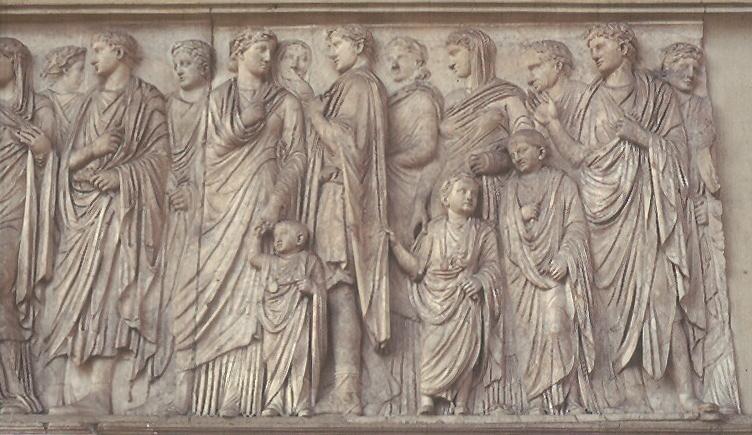
Today's Image
Ara Pacis: processional frieze showing members of the Imperial household (south face)
Source: Structure of Roman Family
Here is a text only version. (See below for an interactive version)
[4] His rebus et suam rem familiarem auxisse et facultates ad largiendum magnas comparasse; [5] magnum numerum equitatus suo sumptu semper alere et circum se habere, [6] neque solum domi, sed etiam apud finitimas civitates largiter posse, atque huius potentiae causa matrem in Biturigibus homini illic nobilissimo ac potentissimo conlocasse;
[7] ipsum ex Helvetiis uxorem habere, sororum ex matre et propinquas suas nuptum in alias civitates conlocasse. [8] Favere et cupere Helvetiis propter eam adfinitatem, odisse etiam suo nomine Caesarem et Romanos, quod eorum adventu potentia eius deminuta et Diviciacus frater in antiquum locum gratiae atque honoris sit restitutus. [9] Si quid accidat Romanis, summam in spem per Helvetios regni obtinendi venire;
Need Help Understanding the Latin?
You might find it helpful to start with the Side-by-Side Version which allows you to see my own very literal translation of the text which is almost a word-for-word translation - in an attempt to make it easier to understand the Latin!
Finally come back to this page - Classical Text and you should be able to better understand and competently read the original Latin text.
Vocabulary Version
I have prepared a Vocabulary Version of the passage (link at bottom of the page) which highlights the 3057 Most Common Words in the texts of Vergil, Caesar and Cicero that we will explore on CentumVerba.com
If you are serious about building your vocabulary, the FLASHCARD set should help you learn them.
How To Read the Interactive Text
To Read the Interactive Text Below Without a Dictionary-
On a Computer: you hover over a word and get all the possible parts of speech; declensions; and conjugations of every word.
Need Help Understanding the Latin?
You might find it helpful to start with the Side-by-Side Version which allows you to see my own very literal translation of the text which is almost a word-for-word translation - in an attempt to make it easier to understand the Latin!
Finally come back to this page - Classical Text and you should be able to better understand and competently read the original Latin text.
Vocabulary Version
I have prepared a Vocabulary Version of the passage (link at bottom of the page) which highlights the 3057 Most Common Words in the texts of Vergil, Caesar and Cicero that we will explore on CentumVerba.com
If you are serious about building your vocabulary, the FLASHCARD set should help you learn them.
How To Read the Interactive Text
To Read the Interactive Text Below Without a Dictionary-
On a Phone or Tablet: don't 'hover' -'tap' the word. To remove the 'definition box' you 'tap' to the side of the text box.
Dictionary-Free Interactive Text
[4] His rebus et suam rem familiarem auxisse et facultates ad largiendum magnas comparasse;
You Need to be a Member to Access the Interactive Dictionary
[5] magnum numerum equitatus suo sumptu semper alere et circum se habere, [6] neque solum domi, sed etiam apud finitimas civitates largiter posse,
atque huius potentiae causa matrem in Biturigibus homini illic nobilissimo ac potentissimo conlocasse;
[7] ipsum ex Helvetiis uxorem habere, sororum ex matre et propinquas suas nuptum in alias civitates conlocasse.
[8] Favere et cupere Helvetiis propter eam adfinitatem, odisse etiam suo nomine Caesarem et Romanos, quod eorum adventu potentia eius deminuta et Diviciacus frater in antiquum locum gratiae atque honoris sit restitutus.
[9] Si quid accidat Romanis, summam in spem per Helvetios regni obtinendi venire;
INTERACTIVE DICTIONARY-FREE TEXT
[4] His rebus et suam rem familiarem auxisse et facultates ad largiendum magnas comparasse;
You Need to be a Member to Access the Interactive Dictionary
[5] magnum numerum equitatus suo sumptu semper alere et circum se habere, [6] neque solum domi, sed etiam apud finitimas civitates largiter posse,
atque huius potentiae causa matrem in Biturigibus homini illic nobilissimo ac potentissimo conlocasse;
[7] ipsum ex Helvetiis uxorem habere, sororum ex matre et propinquas suas nuptum in alias civitates conlocasse.
[8] Favere et cupere Helvetiis propter eam adfinitatem, odisse etiam suo nomine Caesarem et Romanos, quod eorum adventu potentia eius deminuta et Diviciacus frater in antiquum locum gratiae atque honoris sit restitutus.
[9] Si quid accidat Romanis, summam in spem per Helvetios regni obtinendi venire;
Recent Comments